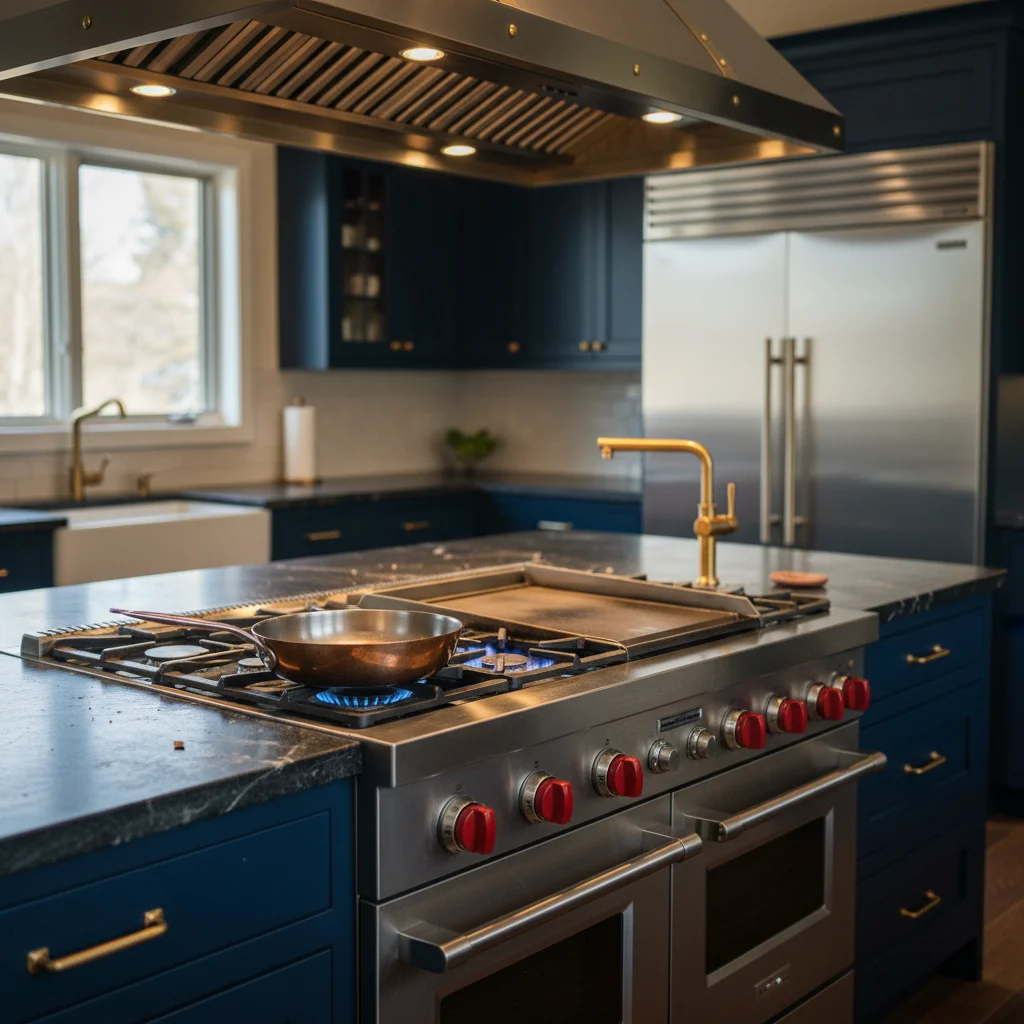
If your range is acting up in a Congress Park kitchen, the house it sits in is usually part of the story. These tree-lined blocks just off the Denver Botanic Gardens are full of brick Tudors and 1920s bungalows, and the kitchens that came with them were never drawn around a modern range. When a remodel slid a sleek slide-in into that original footprint, it inherited every quirk of the old space — and that’s where a lot of the trouble starts.
Why your range is acting up
A range is really two appliances sharing one frame: a cooktop on top, an oven below. In a snug bungalow kitchen either half can drift out of spec while the other looks fine, so we diagnose the whole unit, not just the burner you flagged. The board that drops the oven relay can be the same board that won’t quiet a clicking surface spark. In these tight period installs we check clearance and venting up front too, since heat with nowhere to escape quietly cooks the electronics and igniters.
The faults we trace most often across Congress Park kitchens:
- One gas burner won’t light — a clogged port, a worn spark electrode, a cracked ceramic insulator, or moisture shorting the igniter switch.
- Every burner clicks but none catches — a failed spark module or an ignition harness jolted loose when a slide-in was pushed back into its alcove.
- Oven bakes cool or uneven — a fatigued bake igniter, a wandering oven sensor, or a control board misreading the cavity.
- Burner won’t hold a low simmer — a gummed gas valve, or a sealed-burner cap seated slightly off and breaking up the flame.
- Electric element or radiant glass stays cold — a burned-out element, a failed infinite switch, or a corroded terminal block.
Denver factors we weigh first
Before condemning a part, we account for the things sea-level diagnostics miss. Denver sits at 5,280 feet, where the air is roughly 15% thinner. On a gas range that leaner air shifts the fuel-to-air mix, so burners and orifices tuned elsewhere can run rich — lazy yellow flames, sooty pan bottoms — while a marginal bake igniter loses the margin it needs to fire cleanly. The cure is often correct orifice or air-shutter tuning, not a new component.
The dry mile-high climate is the quieter offender: it hardens oven door gaskets and stiffens seals faster than humid air would, letting heat leak out so the oven cycles harder to hold its setpoint. And on any water-fed range, Denver’s 150–250 ppm hard water scales the valves and injectors, with Congress Park’s aging supply lines layering on sediment. We weigh all three together.
How we diagnose it
- We confirm the exact symptom and check how the range is installed and whether clearances are choking it.
- We read actual cavity temperatures and pull any stored fault codes from the control.
- We test the cooktop and oven as one connected system — ignition, valves, elements, sensors, and board.
- We measure components under load, not just at rest, so a part that fails only when hot can’t slip past.
- We explain the cause in plain terms and quote a firm price before any work begins.
Components we service
We match parts to your exact model and serial using OEM-grade and manufacturer-compatible components. On a premium range that distinction carries weight — igniters, gas valves, surface and bake burners, radiant and induction elements, infinite and selector switches, oven sensors, and control boards all decide whether a repair holds for years or months. In a boxed-in Congress Park install we reseat the unit and verify clearances afterward, since anything running hot in a starved cabinet will fail early no matter how good the replacement.
Same-day scheduling
Congress Park sits in central-east Denver, an easy neighborhood for us to reach, so we typically offer same-day or next-day appointments. Call (720) 770-4189 any hour — the phone is answered 24/7 — or book online. On-site repairs run daily 8 AM to 6 PM, the diagnostic is a flat $89 applied to the repair, and you’ll always see an up-front price before we begin. Independent and serving the Denver metro since 2012.