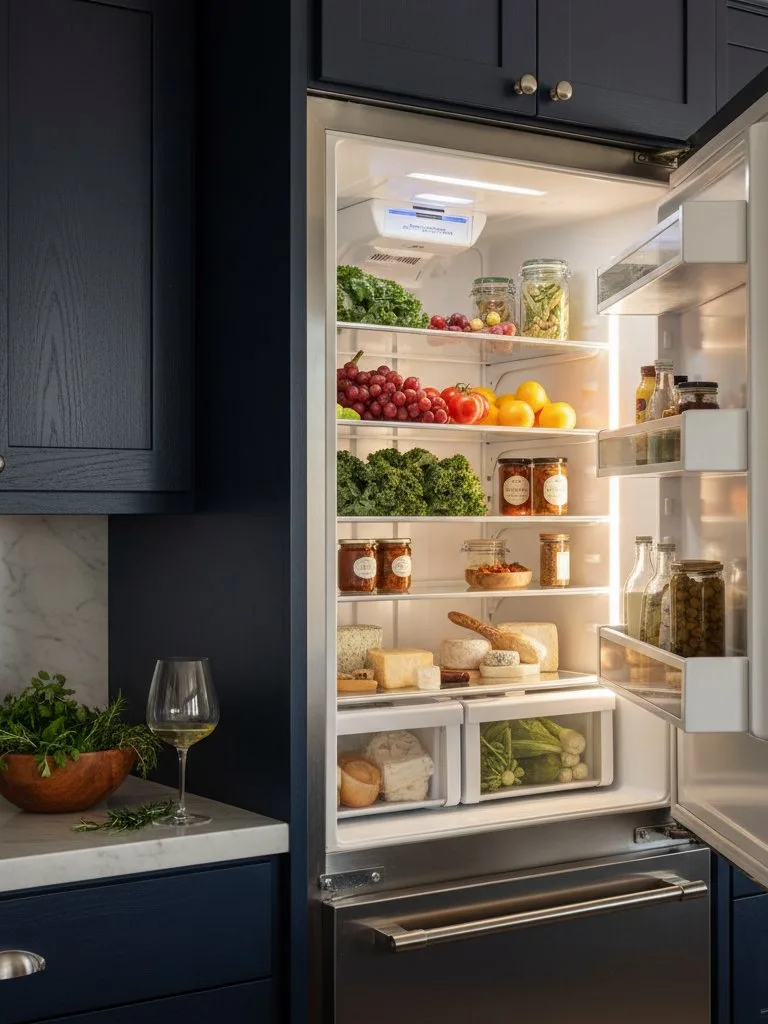
You opened the freezer for ice and the cubes were welded into one cloudy lump, or the bag of peas had gone soft at the edges. Nothing beeped. The door still feels cold to the hand. But a freezer running a few degrees warm is no longer freezing — it’s just chilling — and in a Congress Park kitchen, where that unit is often an integrated column tucked into a compact original layout, the slip can go unnoticed until the contents tell on it.
What’s going on
A freezer has almost no margin. A refrigerator can drift a couple of degrees and your milk survives the day; a freezer that climbs from zero to twenty is quietly thawing everything inside. Congress Park’s housing stock makes this harder to catch. The brick Tudors and 1920s bungalows clustered near the Denver Botanic Gardens were built with small, closed-off kitchens, and when owners fit modern built-in refrigeration into that footprint, the freezer often ends up boxed tight against cabinetry with little room to breathe. We read the appliance and the alcove it lives in as one problem.
Common problems we see here
Most freezer calls in this neighborhood trace to a short list:
- Compressor runs, but nothing freezes — typically a frosted-over evaporator from a dead defrost heater, sensor, or control board.
- Ice sheets on the back wall — a stuck defrost cycle, or a Denver-dried gasket letting warm room air seep in.
- Running nonstop, never cycling off — a condenser choked in a tight bungalow cabinet run, or a tired compressor fighting the thin-air heat penalty.
- Slow, slushy, hollow ice — hard-water scale clogging fill valves and lines.
- One zone warm, another cold — a failed evaporator fan or damper in a multi-zone built-in.
How we diagnose it
- We confirm the symptom and study how the freezer is installed — clearances and condenser access come before we blame any single part.
- We measure real internal temperatures and pull any stored fault codes from the control.
- We test the sealed system, defrost circuit, fans, and gasket seal to pin the true failure rather than the obvious one.
- You get one up-front price. Approve it and the $89 diagnostic comes straight off the total.
The Denver factors behind the fault
Two local realities shadow every freezer here. First, altitude: near the Botanic Gardens you’re at roughly 5,280 feet, where the air is about 15% thinner and a condenser sheds correspondingly less heat. Wedge that condenser into a snug 1920s cabinet and a freezer that was merely borderline tips into failure. Second, water: Denver’s supply is hard at around 150 to 250 ppm, and the resulting scale slowly strangles ice-maker valves, fill tubes, and mold. We factor both in from the first measurement, along with the dry-climate gasket wear that lets frost build in the first place.
Brands and related units
We service integrated and freestanding freezers across the major premium and mainstream brands found in Congress Park kitchens — built-in columns, freezer drawers, top-mount sections, and standalone uprights and chests. If a freezing or icing fault shows up, the same family of parts (evaporators, fans, defrost circuits, control boards) often drives trouble in a paired refrigerator or wine unit, so we check related appliances when the symptoms point that way. Replacement parts are OEM-grade or manufacturer-compatible from verified suppliers, matched to your exact model.
Book a visit
If your freezer is drifting, don’t wait for the contents to thaw — a stocked built-in holds a lot of food. Call (720) 770-4189 any time; the phone is answered 24/7. You can also book online. Repairs run daily from 8:00 AM to 6:00 PM, the on-site diagnostic is $89, and it’s credited toward the repair when you approve the work.