Quick orientation
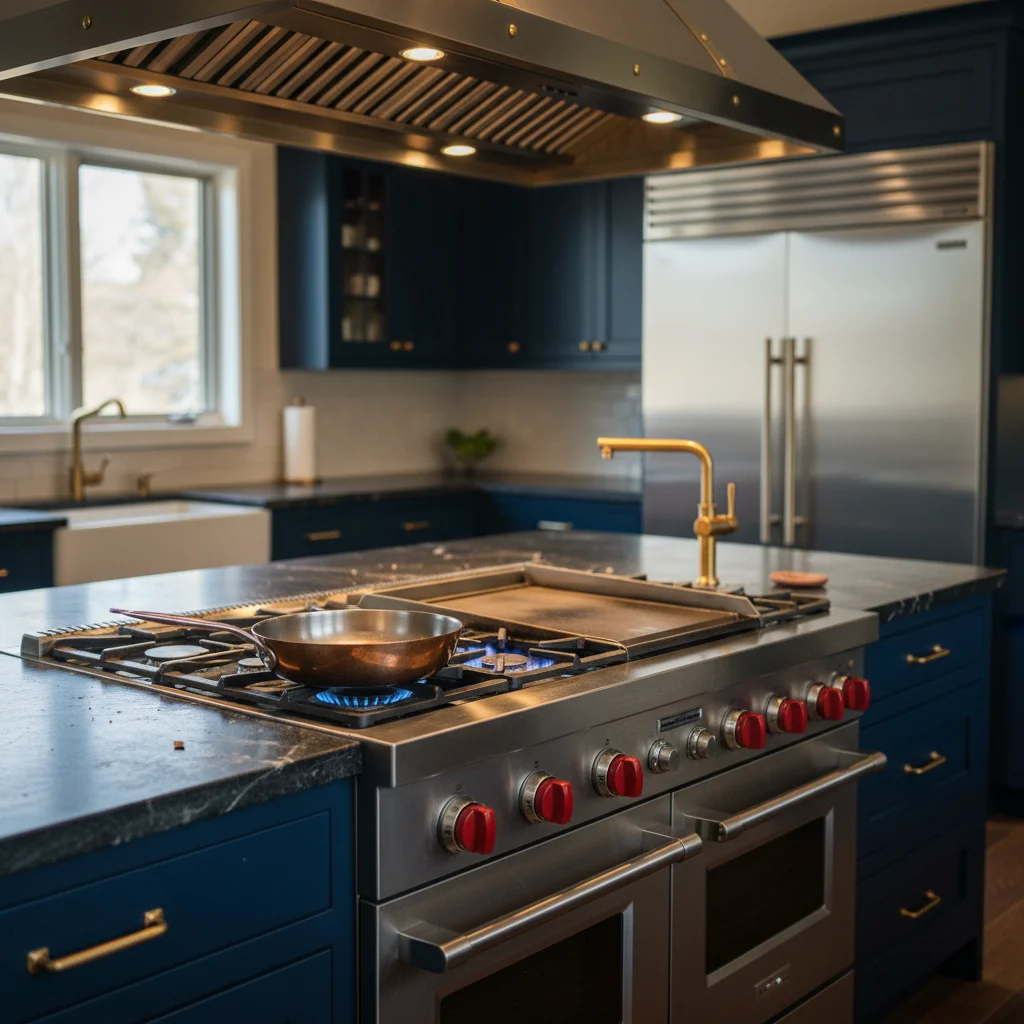
Wolf is the cooking half of the same design house behind Sub-Zero, and it shows in how the appliances are built. These are heavy, commercially-inspired units meant to live in a kitchen for fifteen or twenty years — dual-stacked sealed burners that hold a clean low simmer and a high sear, dual-convection ovens that try to keep every rack at the same temperature, red knobs that have become a kind of signature. That engineering character is exactly why a generic appliance call often goes sideways on a Wolf. The control logic, the gas train, and the convection airflow are tuned more tightly than on a mass-market range, so the symptom you see is rarely the part that’s actually at fault.
Our approach is straightforward: confirm the complaint, read whatever the unit is telling us, and trace the failure to its source before we quote anything. You get a plain-language explanation and a firm price up front. The $89 service call covers that inspection and rolls into the repair if you move forward. Nothing gets replaced on a guess, because on a range this well-made, the expensive mistake is swapping a control board when the real problem was a $40 sensor.
If you’d rather skip ahead, the phone is (720) 770-4189, answered around the clock, and online booking is below.
What we service for Wolf
- Dual-fuel ranges — gas sealed burners over an electric, dual-convection oven, in 30”, 36”, 48”, and 60” widths.
- All-gas ranges — gas surface burners with a gas oven, including infrared broiler and griddle configurations.
- Rangetops and cooktops — sealed-burner gas rangetops, gas cooktops, and induction cooktops, often paired with separate wall ovens.
- Wall ovens — single and double electric convection ovens, including models with the dual-fan convection system.
- Built-in and convection microwave ovens, warming drawers, and the M-series and E-series oven lines.
We are an independent repair company. We are not affiliated with, endorsed by, or sponsored by the manufacturer — what we bring instead is brand-specific experience and parts matched to your model, without routing you through a factory channel.
Most common faults we see on Wolf appliances
No two service calls are identical, but certain failures recur often enough that an experienced tech can usually narrow them down before lifting a panel. Here are the ones we diagnose most:
- Oven won’t reach or hold temperature — most often a drifting oven temperature sensor (RTD), a failed bake or broil element, or a convection fan motor that has slowed. A Wolf oven is unusually sensitive to sensor drift, so a unit that runs 25–40°F off without throwing a hard fault is a classic case.
- Slow or failed ignition on gas burners — a worn spark electrode, a cracked or carbon-fouled igniter, a misaligned or wet burner cap, or a tired spark module. The telltale is a burner that clicks long after it should have lit, or clicks endlessly without catching.
- Endless clicking from a sealed burner — moisture under the cap after a spill or a cleaning, a cap seated slightly off its locating pins, or a spark module that keeps firing. Often a five-minute fix once it’s correctly diagnosed.
- Weak or yellow flame, lazy simmer — frequently an air-shutter or orifice issue, sometimes worsened at altitude where the air-fuel mix runs richer than the factory sea-level default.
- Dual-fuel oven error codes / control faults — the electronic control board or a wiring/relay fault. We read the stored code and verify it against the actual circuit rather than reflexively replacing the board.
- Convection that bakes unevenly — a failing convection fan motor or its relay, a blocked airflow path, or a calibration that has slipped after years of heavy use.
- Broiler that won’t fire or won’t get hot — on infrared gas broilers, the igniter or gas valve; on electric broilers, the element or its relay.
- Door and seal complaints — a sagging door, a worn hinge, or a gasket that has gone brittle and is leaking heat. Denver’s dry air is hard on seals, which we’ll cover below.
- Knob, light, and control-panel quirks — burnt-out oven lamps, cracked knob D-rings, or display segments that have failed.
How we actually run the diagnosis
- Confirm the symptom. We reproduce what you’re seeing instead of taking the complaint at face value — “the oven is slow” and “the oven runs cold” lead to different parts.
- Read the unit. Stored fault codes, sensor resistance, igniter glow and current draw, gas pressure where relevant.
- Trace to the source. We follow the circuit or the gas path to the one component that’s out of spec.
- Quote up front. You hear the cause, the part, and the total price before we touch a wrench — no work proceeds without your okay.
Parts and longevity
A Wolf range is built to outlast the kitchen it sits in, and the right repair should respect that. We install OEM-grade and manufacturer-compatible parts from verified suppliers, matched to your exact model and serial. That distinction matters most on the components that determine how long the fix lasts — oven sensors, igniters and spark modules, gas valves, convection motors, and control boards. A bargain igniter that doesn’t match the original spec can light fine on day one and fail by the next holiday; a correctly matched part is what keeps you from seeing us again for the same complaint.
Longevity also comes from fixing the actual cause. If an oven sensor reads high because a connector is corroded, replacing the sensor alone is a patch — we address the connector too. If a burner ignites poorly because the orifice is partially blocked and the air shutter is mistuned for altitude, swapping the igniter is treating the symptom. This is the part of the job that separates a repair that holds from one that boomerangs, and it’s why we diagnose deliberately rather than fast.
Because Wolf shares so much engineering DNA across model years, well-cared-for units stay serviceable for a long time. Keeping the burner ports clean, wiping spills before they bake on, and not slamming the oven door all extend the life of the parts we’d otherwise be back to replace.
The altitude and water angle in Denver
This is where servicing a Wolf in Denver genuinely differs from servicing one at sea level, and it’s the part a generic tech tends to miss.
Thinner air at 5,280 feet. Denver’s air is roughly 15% less dense than sea level, and that has direct consequences for cooking appliances. Gas burns differently up here — the air-fuel mixture skews rich unless the orifices and air shutters are sized and tuned for altitude, which is why a Wolf burner that ran a crisp blue flame elsewhere can burn lazy and yellow after a move to Colorado. The same thin air affects how an oven sheds and circulates heat, so a marginal convection fan or a slightly drifting sensor produces noticeably worse results here than it would at lower elevation. When we diagnose ignition, flame quality, or preheat complaints, altitude is part of the equation from the start — not an afterthought.
Hard water, around 150–250 ppm. Much of the metro runs hard, and the mineral content scales up anything that touches water. On Wolf appliances that means steam-assist oven features, any plumbed components, and the broader kitchen ecosystem where the range lives alongside a dishwasher and an ice maker. Scale is gradual and easy to ignore until it isn’t, so we flag it when we see it.
Very dry climate. Denver’s low humidity is quietly hard on rubber and gaskets. Oven door seals dry out, stiffen, and crack sooner here than in humid regions, which shows up as a door that doesn’t hold heat, longer preheats, and uneven baking. A door or hinge complaint that looks cosmetic is often an early seal failure — worth catching before it costs you energy and even cooking.
Strong UV and a punishing dry-cold winter round out the picture, accelerating wear on exposed trim and any externally routed components. None of this is exotic; it’s just local reality, and folding it into the diagnosis is what an altitude-aware specialist brings that a national dispatch line doesn’t.
Why an independent specialist, not the manufacturer
Going through a factory channel for a premium brand often means a longer wait and a rigid script. As an independent specialist who has worked on Wolf equipment across the Denver metro since the company began serving the area in 2012, we offer something different: same-day or next-day scheduling, a real diagnosis instead of a parts-cannon approach, OEM-grade parts matched to your model, and up-front pricing you approve before work starts. We focus on premium cooking and refrigeration brands, so a Wolf range isn’t an unfamiliar unit we’re figuring out on your time. To be clear, independent means independent — we’re not authorized by or affiliated with the maker, and we think the speed and the straight talk are the better trade for most Denver homeowners.
How to book
Getting a Wolf appliance looked at is quick:
- Call (720) 770-4189 — the line is answered 24/7, so you can reach a person whenever it’s convenient. Repairs themselves run daily from 8:00 AM to 6:00 PM.
- Or book online at the scheduler — pick a window that works for you.
- Meet the technician, who diagnoses the real cause on site and gives you a firm, up-front price. The $89 service call covers that visit and is applied to the repair if you go ahead.
Whether it’s a burner that won’t light, an oven running cold before a dinner party, or a convection bake that’s gone uneven, we’ll find what actually failed and tell you the price before we fix it.
Ready when you are — call (720) 770-4189 or book online to get your Wolf range, cooktop, or oven back in service across the Denver metro.