When the Viking warms up overnight
You open the Viking in the morning and the milk is cooler than the counter but warmer than it should be. The freezer below is still rock-solid, the lights work, the compartment hums along — but the butter is soft and the produce drawer feels like a cellar instead of a refrigerator. Nothing is screaming for attention, which is exactly the problem, because a fresh-food section drifting into the high forties is already on the clock for everything inside it. By the time it’s obvious enough to act on, the spoilage has usually started.
That scenario plays out on Viking refrigerators more often than a total no-cool failure, and it tells you something about how these units are built. Viking made its name on commercial-grade ranges, then carried that same heavy-duty philosophy into refrigeration: thick cabinets, serious insulation, powerful fans, and doors built like a restaurant’s walk-in. The upside is that a Viking rarely dies all at once. The downside is that one tired component — a damper that won’t open, a fan that slowed, a sensor reading three degrees off — can quietly throw the whole compartment out of balance while the rest of the machine keeps running like nothing’s wrong.
The good news for your wallet: caught early, those are small, affordable fixes. A stuck damper or a $40 sensor is a routine repair. Left alone, the same fault forces the sealed system to labor, run hot, and wear, and a quick fix turns into a compressor conversation. Calling at the first sign of drift is almost always the cheaper path. The phone is (720) 770-4189, answered around the clock, and the $89 service call covers a full on-site diagnosis that we credit back if you go ahead.
Overview: how a Viking refrigerator is built — and where that matters
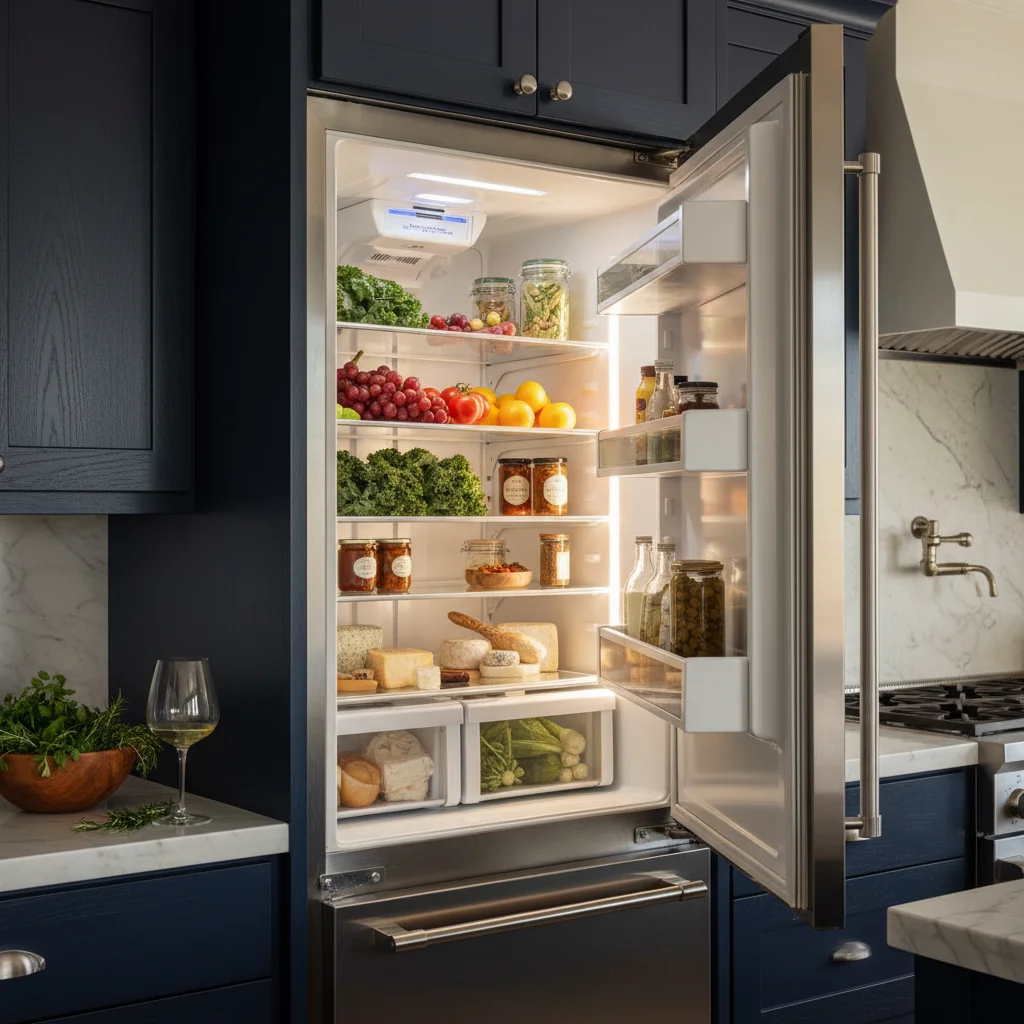
Viking refrigeration is engineered to feel like professional equipment. The professional-style freestanding models wear those unmistakable heavy doors and pro handles; the built-in and integrated columns disappear into custom cabinetry behind panel-ready fronts; and across the line you’ll find bottom-freezer combinations, side-by-sides, and under-counter units. Many models carry Viking’s air-purification feature (marketed as Plasmacluster on a number of units) and digital touch controls that report stored fault information.
What unites them is mass and power. The doors are heavy, which puts real load on hinges and on the gasket that has to seal that weight against the cabinet. The cooling hardware is robust, which means a Viking will often keep running and try to compensate when something upstream fails — masking the root cause behind a unit that still “works.” And the controls are electronic, so a single out-of-spec sensor can hand the board a wrong number and send the whole compartment chasing a temperature it never reaches.
That combination is why the symptom you notice on a Viking is frequently a layer removed from the part that actually broke. A warm fridge isn’t always a cooling failure — it’s often an airflow or defrost or sensor failure pretending to be one. Diagnosing to the real component, rather than the most obvious suspect, is the difference between a fix that lasts and one that comes back.
Common problems we see on Viking refrigerators
Viking complaints tend to cluster into a recognizable set of symptoms. Knowing which one you’re looking at points the diagnosis in the right direction before a single panel comes off:
- Fresh-food section warm, freezer still cold. The classic split failure — usually a stuck air damper, a stalled evaporator fan, a frosted evaporator from a defrost fault, or a sensor misreading the compartment.
- The whole unit won’t cool. Less common, but when it happens it points to the condenser fan, the compressor, the start components, or a sealed-system charge problem.
- Runs constantly and never cycles off. A dust-packed condenser, a weak condenser fan, a door that no longer seals, or a charge that has drifted — something stealing efficiency rather than a dead compressor.
- Frost or ice where it shouldn’t be. Frost on the back wall, ice caking a freezer drawer, or a frosted evaporator almost always means the automatic defrost cycle has stopped doing its job.
- Water pooling inside or leaking onto the floor. Typically a clogged or frozen defrost drain, or condensation that has nowhere to go.
- Ice maker and water dispenser trouble. No ice, slow or hollow cubes, cloudy ice, or no water at the dispenser on plumbed models — frequently a scaled inlet valve or fill line in our hard-water region.
- Door, hinge, and gasket problems. A heavy Viking door that won’t seat, a sagging hinge, or a stiff, cracked gasket leaking conditioned air. Easy to dismiss as cosmetic; expensive in run time and compressor wear.
- A fault code or flashing alarm on the display. Viking’s electronic controls store fault information, and that code is a starting point for the diagnosis — not the final verdict on what’s broken.
A repeated lesson on Viking equipment: the honest cause of a warm compartment is rarely the most expensive part. The costly mistake is assuming it is and replacing a control board when a corroded sensor connector was the real problem. We diagnose to the failed component first, every time.
Our diagnostic process
Viking builds for the long haul, and a proper repair should match that. Our method is deliberate rather than rushed — confirm the symptom, let the unit report what it knows, trace the fault to one source, and put a firm number on it before any work begins.
- Confirm what’s actually happening. “The fridge is warm” and “the fridge runs all the time” point to different parts. We verify the complaint instead of taking it at face value, and we rule out the simple stuff — a vent blocked by overpacking, a door left ajar, a recent power event — before chasing hardware.
- Read the unit. We pull stored fault codes, check sensor resistance against spec, measure evaporator and condenser fan current draw, watch defrost-cycle behavior, test damper operation, inspect the heavy-door gasket seal, and where it applies, take sealed-system pressures and evaluate the refrigerant charge.
- Trace to the source. We follow the airflow path, the electrical circuit, or the sealed system to the single component that’s out of spec — not the first plausible suspect. On a split fresh-food/freezer symptom, that means isolating which side of the air-distribution system actually failed.
- Quote up front. You hear the cause, the part, and the total before a wrench moves. The $89 service call covers that inspection and folds into the repair if you proceed. Nothing goes ahead without your okay.
Parts and what makes a repair last
We install OEM-grade and manufacturer-compatible parts from verified suppliers, matched to your exact model and serial number. That distinction matters most on the parts that decide how long a fix holds — evaporator and condenser fans, temperature and defrost sensors, defrost heaters, dampers, control boards, inlet valves, and the gaskets that seal those heavy Viking doors. A bargain sensor that doesn’t match the original spec might read fine on day one and drift again by next season; a correctly matched part is what keeps you from calling us back for the same complaint.
Longevity also comes from repairing the true cause, not the visible symptom. If a sensor reads warm because its connector is corroded, swapping the sensor alone is a patch — we address the connector too. If a Viking runs nonstop because the condenser is choked with dust and the fan is tired, replacing a board solves nothing. A little upkeep extends the life of the parts we’d otherwise be back to replace: keep the condenser area clear of dust and pet hair, don’t overpack the compartment in a way that blocks the vents, change water filters on schedule, and wipe the door gaskets so they stay supple.
Denver-specific factors that change how a Viking behaves
This is where servicing a Viking in Denver genuinely diverges from servicing one at sea level — and it’s the part a generic, out-of-town dispatch tech tends to miss.
Thinner air at 5,280 feet. Denver’s air is roughly 15% less dense than at the coast, and a refrigeration system rejects compressor heat into that thinner air less efficiently. A sealed system already running near its limit shows symptoms sooner here. A marginal condenser fan or a slightly low charge that would pass unnoticed near sea level produces real temperature drift in Denver, and a Viking’s powerful cooling hardware can mask that by simply running longer and hotter — until it can’t. We fold altitude into the diagnosis from the first minute rather than treating it as an afterthought, and it’s why we test the condenser side and the charge before reaching for the expensive parts.
Hard water, roughly 150–250 ppm. Much of the metro runs hard, and that mineral load scales up everything that touches water. On a Viking refrigerator that means plumbed ice makers and water dispensers, where scale builds in the inlet valve and fill line and slowly chokes ice production. It’s easy to ignore until ice slows to a trickle or cubes come out hollow and cloudy, so we check the whole water path on any unit that makes ice or dispenses water, and we recommend a filter and maintenance interval that fits local water.
A very dry climate and strong UV. Denver’s low humidity is quietly hard on rubber, and Viking’s heavy doors put more load on their gaskets than a lightweight door does. Those seals dry out, stiffen, and crack sooner here than in humid regions. The result shows up as a unit that runs constantly trying to hold temperature, condensation or frost from humid air sneaking past a failing seal, or a compartment that can’t quite reach its setting. A door or gasket complaint that looks merely cosmetic is often an early seal failure worth catching before it drives up run time and compressor wear.
Related brands and the rest of the Viking kitchen
We service the full range of Viking refrigeration across the Denver metro:
- Built-in and fully integrated columns — refrigerator and freezer columns, combination units, and panel-ready integrated installs, including alignment on heavy custom door panels.
- Professional-style freestanding refrigerators — the heavy-door, pro-handle models, side-by-sides, and bottom-freezer combinations.
- Under-counter units — compact refrigeration and beverage centers.
- Ice and water systems — plumbed ice makers and dispensers, inlet valves, and water lines.
Viking is best known as a cooking brand, so plenty of Viking refrigerator owners also run a Viking range, cooktop, or wall oven — and Denver’s altitude affects gas combustion and orifice sizing on those just as it affects refrigerant charge on the fridge. We’re an independent repair company that has serviced high-end appliances across the Denver metro since 2012, and Viking is one of several premium brands we specialize in — alongside Sub-Zero, Wolf, Thermador, Miele, and Liebherr. Concentrating on professional-grade kitchens is what lets us diagnose a Viking against how it’s actually engineered, rather than guessing on your dime. To be clear, independent means independent: we are not affiliated with, endorsed by, or sponsored by Viking Range, LLC or any manufacturer named here.
Booking your Viking refrigerator repair
Getting a Viking looked at is quick:
- Call (720) 770-4189 — the line is answered 24/7, so you can reach a real person whenever it suits you. Repairs themselves run daily from 8:00 AM to 6:00 PM, usually same day or next day.
- Or book online through the scheduler and pick a window that works for you.
- Meet the technician, who diagnoses the real cause on site and gives you a firm, up-front price. The $89 service call covers that visit and is credited toward the repair if you proceed.
Whether it’s a fresh-food section drifting warm while the freezer stays cold, a unit running nonstop in our thin mountain air, frost creeping up the back wall, or an ice maker scaled shut by Denver’s hard water, we’ll find what actually failed and tell you the price before we fix it.
Ready when you are — call (720) 770-4189 or book online to get your Viking refrigerator back in service across the Denver metro.