
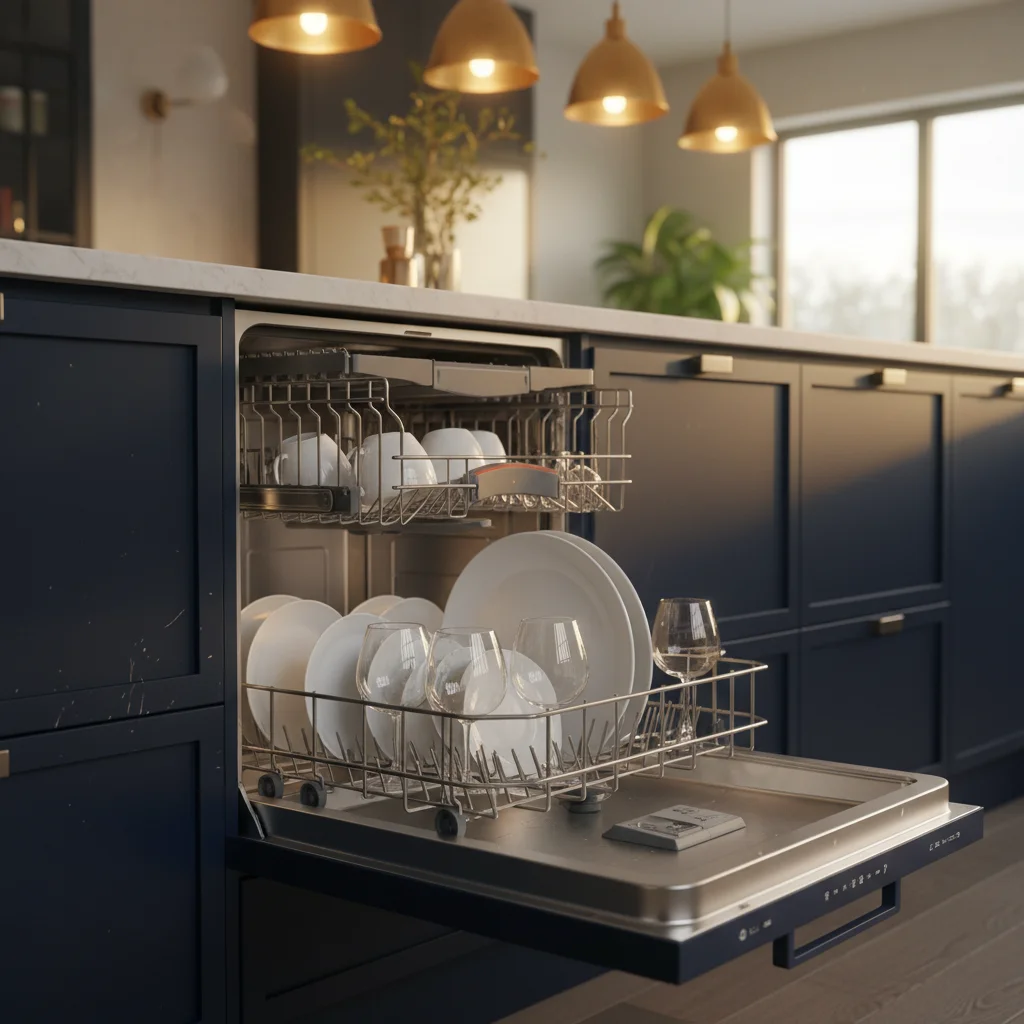
When a slow drain turns into a real bill
A Viking dishwasher does not usually fail all at once. It starts as a glass that comes out cloudy, a faint puddle under the door, or a cycle that takes longer than it used to. Easy things to live with for a week — which is exactly the problem. A film of scale that you ignore keeps thickening on the heating element until the machine fights to hit temperature and a wash cycle that used to take two hours now takes three. A door gasket that has only just begun to weep can soak into the toe-kick and the subfloor beneath it before you ever see standing water on the kitchen tile. A drain that empties a little slower each week is one greasy meal away from not emptying at all, and a tub full of stale water sitting overnight is how a gasket goes from “slightly tired” to “needs replacing.” Waiting rarely makes a dishwasher repair smaller. It makes it bigger, and on a built-in Viking that sits flush against cabinetry and flooring, the collateral damage from a slow leak can dwarf the cost of the original part.
The good news is that almost every one of these complaints has a single, findable cause. We are an independent appliance repair company that has worked the Denver metro since 2012, and we are not affiliated with, endorsed by, or sponsored by Viking or any manufacturer. What we bring is hands-on familiarity with how these dishwashers are built, parts matched to your unit, and a diagnosis that accounts for the water and air your machine actually lives in. Call (720) 770-4189 any time — the line is answered 24/7 — and we will get the dishwasher back to running quiet and clean.
What you are noticing at the sink
Owners rarely call us with a part number. They call with a symptom, and on a Viking dishwasher these are the ones we hear most:
- Water sitting in the bottom after the cycle ends. The dishwasher seems to wash but never fully empties, leaving an inch of cloudy water over the filter.
- Dishes coming out gritty, spotted, or still soiled. The cycle runs its full length, yet the top rack in particular comes out as dirty as it went in.
- A chalky white haze on glassware and the inside of the tub. It wipes off with vinegar and comes right back next load.
- A puddle creeping out from under the door or a damp cabinet panel, sometimes without any obvious source.
- A cycle that drags on far longer than normal, or one that halts partway through with the dishes still wet and warm.
- The machine that won’t start at all — you press the cycle, the door seems shut, and nothing happens.
- A blinking light sequence or an error indication on the concealed top-edge controls.
- A new grinding, humming, or rattling noise during the wash or drain that wasn’t there a month ago.
Because Viking’s integrated models hide their controls on the top lip of the door and tuck the machine behind a custom cabinet panel, a few of these — a damp panel, a faint smell, a control you have to open the door to even see — can hide longer than they would on a basic exposed-front unit. That is one more reason not to let an early symptom ride.
What it usually means
The symptom is the headline; the cause is a step or two behind it. On Viking dishwashers, the failures sort into a handful of recognizable patterns, and an experienced tech can usually narrow the field before the kick panel ever comes off.
- Won’t drain / standing water — a clogged filter or sump, food and grease packed into the drain pump, a kinked or blocked drain hose, or a check valve stuck partly closed. In this region mineral scale quietly narrows those passages, so a drain that was fine last year fails this year for no obvious reason.
- Poor wash results — spray-arm jets scaled or clogged shut, a circulation pump that has lost pressure, a starved or failing inlet valve, or incoming water that simply isn’t hot enough. When the lower arm can’t push water with force, the upper rack is the first thing to come out dirty.
- White film and cloudiness — overwhelmingly Denver’s hard water depositing minerals on glass and on the heater, frequently compounded by a rinse-aid dispenser that has stopped releasing.
- Leaks — a hardened or torn door gasket, a loose hose clamp, a cracked sump, a worn pump seal, or an inlet valve sticking open and overfilling. On an integrated Viking, the seal between the tub and the door is doing a lot of work, and the dry climate is hard on it.
- Won’t start or won’t latch — a worn or misaligned door latch and switch (the machine simply doesn’t believe the door is shut), a blown thermal fuse, a tripped control lock, or a control-board fault.
- Cycle stalls or runs forever — a dead heating element or a drifting thermistor, since many programs hold until the water reaches a set temperature; alternatively a drain or fill timeout from a partial blockage.
- Fault indications — Viking’s controls log conditions tied to fill, drain, heat, and sensors. We treat that signal as a lead to verify, never as a final verdict.
The connecting thread is that the obvious part is often innocent. A control board flagging a drain problem is usually reading a real blockage downstream and doing precisely its job. Condemning the board in that case fixes nothing and costs the most.
How we approach a Viking dishwasher
We diagnose deliberately, because on a machine this well-built the expensive mistake is swapping parts on a hunch. A typical visit moves through the dishwasher the way the water itself does — in, around, and out.
Knowing how Viking builds the machine
Viking’s built-in dishwashers are engineered to vanish into a high-end kitchen: a stainless interior tub, multi-stage filtration instead of a disposable grinder, controls hidden on the top edge of the door, and a chassis built to accept a custom cabinet panel so the unit reads as cabinetry rather than appliance. That integration is the whole appeal, and it shapes the repair. The concealed controls mean we open the door to read the machine. The panel-ready front means the door is carrying real weight and its hinges and springs are tuned for it, so a door that drops or won’t seal is a mechanical question as much as a gasket question. The quiet operation owners prize comes from insulation and a circulation system designed to run gently, which also means a new grinding or humming noise is a genuine signal worth chasing rather than ignoring. We confirm which Viking platform is in front of us before we assume anything, because the integrated and panel-ready designs route water and wiring differently than a plain exposed-front machine.
Tracing the fault to its source
- Confirm the symptom. We reproduce what you are seeing where we can, because “won’t drain” and “drains but won’t clean” lead to completely different parts.
- Read the controls. We pull whatever the machine will report and check it against what it is physically doing, rather than trusting a flashing code at face value.
- Test the water path end to end — inlet valve and fill, float, circulation and drain pumps, spray arms, and the filter and sump — measuring flow and electrical values instead of eyeballing them.
- Check the heat and dry circuit, including the element and the thermistor that gate the cycle, since a stalled program so often lives here.
- Inspect the door system — latch, switch, hinges, springs, and gasket — because a surprising share of “electronic” complaints turn out to be mechanical on an integrated door.
- Explain the cause and quote up front. You hear the part, the reason, and the total before any work begins, and nothing proceeds without your okay.
This order is what keeps two stacked faults from biting you later — a partly clogged filter masking a weakening drain pump, say — so we don’t fix the obvious problem and leave you to find the second one next week.
Parts that make the fix last
When a Viking dishwasher needs a part, we install OEM-grade or manufacturer-compatible components from verified suppliers, matched to your exact model and serial. The pieces that decide longevity are the circulation pump, the drain pump, the water inlet valve, the spray arms and their bearings, the heating element and thermistor, the door gasket and latch assembly, the float and sensors, the dispenser, and the control board. Fitment matters more here than people expect: a generic pump that is close but not exact can run loud and wear its seal early, and a non-matched gasket can leave a slow weep that warps the cabinet base below before anyone notices. We also fix the real cause, not just the visible one — if a sensor reads wrong because a connector corroded, we address the connector too.
The Denver water and altitude angle
Servicing a Viking dishwasher in Denver genuinely differs from servicing one at sea level, and most of it comes down to water chemistry.
Hard water is the headline here. Metro supplies commonly run 150 to 250 ppm of dissolved minerals, and every wash leaves a little behind. Over months that scale collects on spray-arm jets, inside the heating element, across the filter, and on the door seal — and it is the hidden driver behind a large share of the cloudy-glass, weak-wash, and slow-drain calls we get. Treating the scale, not just the symptom it produced, is what makes the repair actually hold.
The dry climate is the quiet one. Denver’s low humidity ages rubber and silicone faster than humid coastal air, so a Viking door gasket hardens, shrinks, and cracks years sooner here than it would near the ocean. A leak that “came out of nowhere” is very often just a tired seal reaching the end of its life in dry mountain air.
Altitude plays a smaller part. At 5,280 feet the air is roughly 15% thinner, which changes how heat moves during the wash and the condensation-dry phase and nudges how detergents and rinse aids behave. It is a lighter factor than the water, but it is part of why a diagnosis tuned to the Front Range beats a checklist written for sea level.
We fold all three into every visit, because the goal is a machine that is still washing clean next year, not one that comes back in three months.
Coverage and the brands beside it
We repair Viking dishwashers across Denver and the surrounding suburbs, and because Viking rarely stands alone in a kitchen, we service the appliances around it too. A Viking dishwasher often shares a kitchen with a Viking range, cooktop, wall oven, or built-in refrigerator, and if more than one is acting up we can frequently handle it in a single trip — just mention it when you book. Beyond Viking, our technicians regularly work on dishwashers and the wider premium lineup from Sub-Zero, Wolf, Cove, Thermador, Miele, Bosch, Gaggenau, Dacor, Jenn-Air, KitchenAid, Monogram, Fisher & Paykel, Bertazzoni, and Smeg, bringing model-specific knowledge rather than a one-size-fits-all approach.
Independent means independent. We are not authorized by or affiliated with Viking or any maker, and for most Denver homeowners that translates into faster scheduling, a real diagnosis instead of a parts-cannon, and up-front pricing you approve before work starts.
Get it fixed
You don’t have to keep rewashing dishes by hand or mopping under the door. Our technicians repair Viking dishwashers throughout the Denver metro, with same-day or next-day appointments in most cases, and every visit starts with the $89 diagnostic service call that is credited toward the repair. You will always get a firm, up-front price before we begin, because we quote the work only after we have actually inspected the machine.
Call (720) 770-4189 any time — the phone is answered 24/7, and repairs run daily from 8:00 AM to 6:00 PM. Prefer to book it yourself? Reserve a window online at nexfield.pro and get your Viking dishwasher back to running quietly, draining fully, and finishing every load clean.