
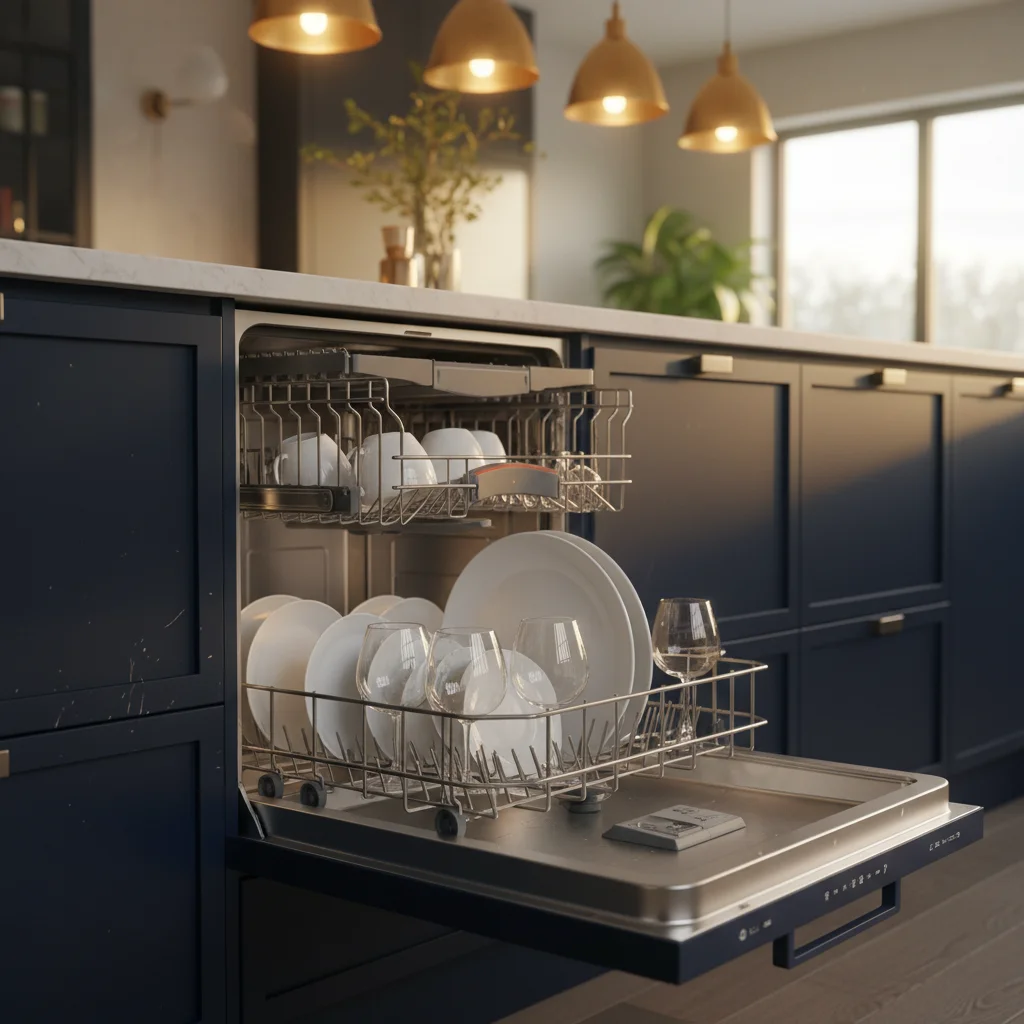
A quick orientation before the panel comes off
Picture the usual Dacor call. The dishwasher ran last night, and this morning the cycle either never finished, there’s a film of water sitting over the filter, or the dishes came out spotted and damp. Nothing slammed or sparked — these machines are built to run quietly and seal tightly, so when one fails it tends to do it without announcement. You’re left with an indicator blinking in a dark kitchen and no obvious reason why.
That silence is exactly what makes a Dacor easy to misjudge. A unit that won’t start gets written off as a fried control board. Wet dishes get blamed on a burned-out heater. Standing water gets called a dead pump. On a dishwasher built to this standard, those snap diagnoses are usually wrong, and acting on them is how a thirty-dollar check valve or a clogged filter turns into a needless electronics swap that doesn’t even fix the complaint.
Our approach is the opposite of guessing. We read what the machine is reporting, test the suspect circuit, and trace the symptom to one named part before we quote anything. You get a plain explanation and a single firm price up front — and the $89 service call folds into that price if you decide to go ahead. The goal is a repair that holds, not a parade of parts. Call (720) 770-4189 any time; the phone is answered around the clock, and the online booking link sits at the bottom of this page.
How a Dacor dishwasher is built — and why that shapes the repair
Dacor is worth understanding as two overlapping eras, because the dishwasher in your cabinet was engineered under one of them and that changes how it fails. The brand began in Southern California in the 1960s as a family luxury-appliance maker, then joined the Samsung family in 2016. The dishwashers that came afterward — the Modernist and Contemporary collections — share engineering DNA with Samsung’s premium built-in platform, which is genuinely useful to know on a service call because it tells a technician what architecture to expect inside the tub.
A handful of design traits drive almost every Dacor dishwasher repair:
- A hidden flow-through or in-line heating approach. Rather than a bare coil glowing in the tub floor, these machines warm water as it circulates and lean on condensation drying. When wash temperature or drying is off, the suspects are the heating circuit, the temperature sensor, and the circulation path — not a visible element you can eyeball.
- An auto-opening vent door to finish drying. Newer models crack the door at the end of the cycle to vent steam and pull in room air. That makes drying performance depend on the vent actuator, rinse aid, and the heating circuit all cooperating — so “it won’t dry” has several very different root causes.
- Multi-zone or linear spray systems. Instead of one tired rotating arm, many Dacor tubs route pressurized water through a diverter to different zones. A weak-wash complaint can therefore come from the diverter motor, a starved spray zone, or scaled jets rather than the pump itself.
- A fine multi-stage filter and quiet drain and circulation pumps. The filtration keeps wash water clean and the machine library-quiet, but it also collects food debris that, left alone, starves both the wash and the drain.
- Sensor-driven fill and a base-pan leak sensor. Water comes in by sensed fill rather than a blind timed dump, and a float or leak sensor in the base pan cuts water and locks the unit out the instant it detects a leak. That safety feature is the reason a surprising number of “won’t run” calls are really “there is water where there shouldn’t be.”
Name the architecture and the failures stop looking random. A dishwasher that meters water, diverts it between zones, dries by condensation, and watches its own base pan for leaks simply breaks along different lines than a basic builder-grade unit — and each of those subsystems is a place to test rather than a part to swap on a hunch.
The faults we see most on Dacor dishwashers
Every job starts from a symptom, so it helps to describe what you’re actually seeing instead of guessing at the cause. On Dacor units the complaints cluster into a recognizable set:
- Standing water over the filter. A pool that didn’t pump out, sometimes sour-smelling. This is a drain-path story until proven otherwise — filter, sump, drain hose, check valve, or drain pump.
- Won’t drain at all. The cycle ends but the tub stays full. A jammed drain pump or a blocked non-return valve leads the list, and a single olive pit or shard of glass in the impeller can mimic a dead pump exactly.
- Won’t start, or stops partway. A door latch not registering, a tripped base-pan leak sensor sitting in a slow leak, or a thermal or flow fault that halts the program. The machine looks dead but is often just protecting itself.
- Damp dishes / vent door that never opened. Plastics beaded, glassware spotted, and on auto-open models a door that stayed shut at the end. Rinse aid, the vent actuator, or the heating circuit.
- A leak you can see or smell. Water at the toe-kick, a damp cabinet base, or a musty odor — frequently paired with a leak-sensor lockout once the float trips.
- Weak wash results. Grit left on plates, cloudy glass, detergent not dissolving. Usually scaled spray jets, a clogged filter, a lazy diverter, or low water temperature — and on Denver water, often several of those at once.
- A blinking light or error indicator. Many Dacor and Samsung-platform models flash a code or a pulsing indicator that points at a subsystem — drain, fill, heat, or leak — rather than naming a broken board. It’s a clue to chase, not a verdict.
- New noise. Grinding or buzzing on drain or wash that wasn’t there before, pointing at the drain pump, the circulation motor, or a foreign object lodged in the pump chamber.
You don’t have to sort this out yourself. The more precisely you can describe the symptom — which indicator, when in the cycle it happens, whether the vent door cracked — the faster we narrow the field before anything is disassembled.
How we run the diagnosis
We follow the same disciplined sequence on every Dacor, because this brand rewards patience over part-swapping:
- Read what the machine reports. We pull any stored code or note the indicator pattern, then pair it with your description of when the trouble shows up. A drain fault that appears only on heavy cycles points somewhere different than one that trips every time.
- Test the suspect, don’t assume it. If it won’t drain, we open and inspect the filter and sump, check the hose and non-return valve, and bench-confirm the pump before naming it. If drying is weak, we verify rinse-aid metering, confirm the heating circuit, and watch the vent door actually release before condemning anything.
- Factor in the local water and air — covered in detail below, because Denver changes what wears out and how fast.
- Quote it straight, then fix it. One written price, OEM-grade parts matched to your model and serial, and no padding the job with components that tested fine.
Parts, fitment, and getting real life out of the machine
A dishwasher this carefully built deserves parts chosen for fitment, not for whatever’s cheapest on a shelf. We install OEM-grade and manufacturer-compatible components from verified suppliers, matched to your exact model and serial number — which matters more on Dacor than on a generic unit, because the brand’s two eras and the shift onto the Samsung platform mean part numbers and connectors vary across model generations. Bring the rating plate numbers to the call and we can stage the right part before we arrive instead of returning for a second visit.
The components that decide whether a repair holds are predictable: circulation and drain pumps, the water-inlet valve, the diverter motor on multi-zone models, temperature and leak sensors, the vent-door actuator, the door gasket, and the control module. On those, correct fitment comes first — a near-match inlet valve or an off-spec sensor is exactly the kind of shortcut that brings a machine back in six months.
Longevity is also a habit, not just a part. A Dacor dishwasher run on filtered or softened water, with the filter rinsed regularly and rinse aid kept topped up, will outlast one fed straight Front Range tap water and neglected. When we’re on-site we’ll tell you honestly which failures were wear and which were avoidable, so the next repair is further off — and if a simple maintenance routine will head off the next fault, you’ll hear that instead of a sales pitch for parts.
The altitude-and-water angle on a Denver Dacor
It’s worth dwelling on why a high-altitude, hard-water city is rough on a precision dishwasher, because it genuinely changes the diagnosis.
Start with the water. Denver’s supply runs roughly 150–250 ppm hard, and a Dacor’s fine filter, narrow spray jets, and quiet pumps are all engineered around clean, scale-free water moving freely through tight passages. Mineral scale builds on the heating circuit, where it slows heat transfer and quietly drops both wash and drying temperatures; it narrows the spray jets, which shows up as grit left on the bottom rack; and it crusts the inlet valve, which the machine’s sensed fill then reads as a slow or failed fill. None of those look like “hard water” to a homeowner — they look like a broken heater, a worn pump, or a dead valve. That’s precisely why the descaling angle gets missed by anyone diagnosing the unit as if it lived at sea level, and why we check for mineral buildup as a contributing cause rather than a footnote.
The dry climate works on a different part entirely. A door gasket on a Front Range dishwasher lives in far drier, roughly fifteen-percent-thinner air than the same gasket in a coastal home. Rubber that dries out shrinks and hardens, then weeps. And because the base-pan leak sensor reacts to that weep by locking the machine out, a tired seal frequently surfaces not as a visible puddle but as a dishwasher that flatly refuses to start. We’ve learned to check the base pan and float before assuming the control side is at fault — a habit that saves Denver homeowners from paying for electronics that were never broken.
Altitude matters least of the three but isn’t nothing. At 5,280 feet the air is about fifteen percent thinner, which subtly shifts heat rejection and boiling behavior. On a condensation-drying machine, that’s most relevant when we’re deciding whether a “won’t dry” complaint is a true component fault or simply the unit performing as it should up here. An honest diagnosis separates the climate from the failure rather than charging you for one when the other is to blame.
Coverage, independence, and the rest of your kitchen
We’re an independent appliance-repair company that has served the Denver metro since 2012. We are not affiliated with, endorsed by, or sponsored by Dacor, Samsung, or any manufacturer — what we bring instead is brand-specific experience and parts matched to your model, without routing you through a factory channel.
For Dacor, we service fully integrated and panel-ready built-in dishwashers across the brand’s original luxury era and its newer Samsung-platform Modernist and Contemporary collections — including units with multi-zone or linear spray, third racks, leak detection, and auto-opening vent-door drying. Because the same drain-path, sensor, diverter, and seal logic carries across premium dishwashers generally, that diagnostic discipline extends to the other brands we handle — Sub-Zero, Wolf, Cove, Bosch, Thermador, Gaggenau, Viking, Miele, JennAir, KitchenAid, Fisher & Paykel, and more — and to the rest of a Dacor kitchen suite, from dual-fuel ranges and wall ovens to cooktops and built-in refrigeration.
We cover Denver proper and the surrounding suburbs — Aurora, Lakewood, Centennial, Highlands Ranch, Littleton, Arvada, Westminster, Englewood, and the neighboring communities across the metro.
How to book your Dacor dishwasher repair
A Dacor dishwasher is a precise, tightly sealed machine, and it deserves a repair that finds the one component that actually failed instead of guessing through expensive parts. If yours has stalled mid-cycle, refused to start, held standing water, left dishes damp, or locked itself out after a leak, the smart move is to catch it before a small fault becomes a soaked cabinet base or a seized pump.
Call (720) 770-4189 any time — the phone is answered 24/7, and repairs run daily from 8 AM to 6 PM. The $89 service call covers a full on-site inspection and a firm, up-front price, and it’s credited toward the repair if you go ahead. You can also book online whenever it’s convenient, and we’ll confirm a same-day or next-day window anywhere across the Denver metro.