The burner that clicks and clicks but never catches
It almost always happens mid-prep. The pan is ready, you turn the knob, and the igniter starts its rapid tick-tick-tick — but the flame never comes. Or it lights, then drops out the moment you ease it down toward a simmer. Maybe the whole cooktop fires every electrode at once like a stuck buzzer, or your SimmerSear burner that used to hold a tidy blue ring now wanders orange and lazy and leaves soot on the bottom of the pot. On the induction side, the story is different but just as aggravating: a zone that hums up to a sear, then blinks an error and quits the second the cookware gets hot.
These are the calls we take most often on Dacor cooktops, and they rarely have a single obvious cause. That is exactly why guessing is expensive.
We are an independent appliance repair company that has served the Denver metro since 2012, and high-end cooktop work like this is a large share of what we do. To be plain and up front: we are not affiliated with, endorsed by, or sponsored by Dacor, its parent Samsung, or Sub-Zero Group, Inc. We are technicians who understand how Dacor engineers these cooktops, how they fail differently from a builder-grade unit, and how Denver’s thin air and hard water quietly bend the picture.
How Dacor builds the cooktop — and why that shapes the repair
Dacor doesn’t sell one generic cooktop. It sells a few distinct platforms, and the first move on any visit is recognizing which one is sitting in the counter, because the same complaint means different things on each.
Sealed-burner gas cooktops
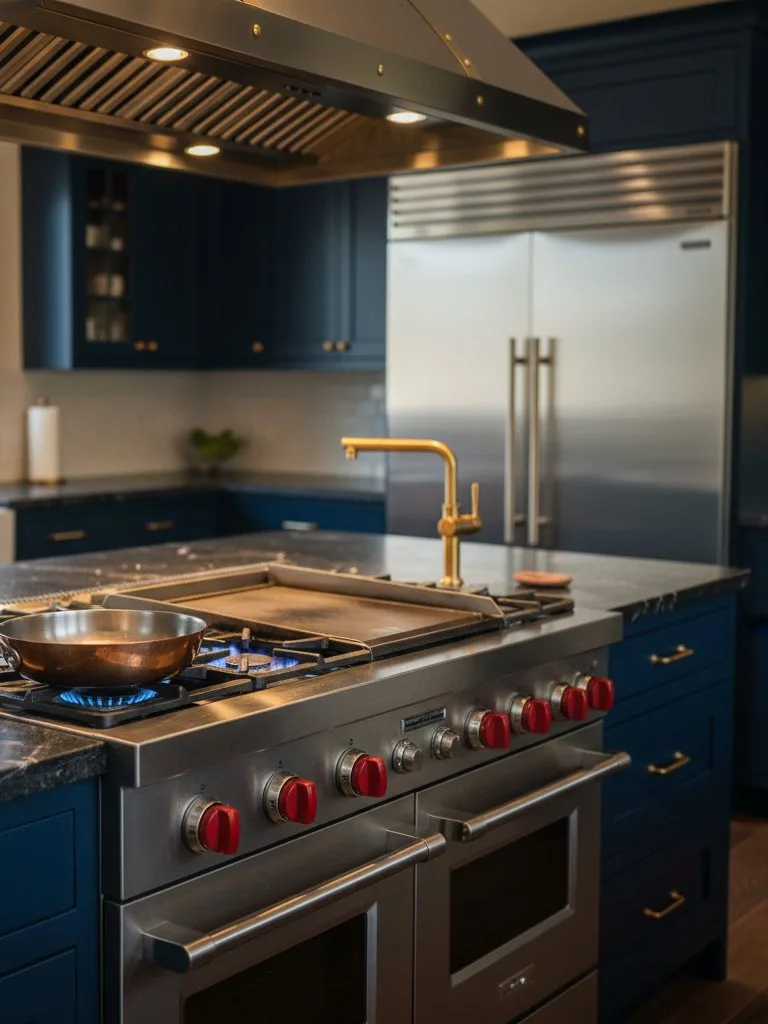
Dacor’s gas cooktops use sealed burners — the brass or alloy burner heads sit on top of a sealed surface so a boil-over can’t drain down into the burner box. Each burner has its own spark electrode, a flame-port ring, and a gas valve under the knob. Two Dacor signatures matter on a service call:
- SimmerSear (and similar wide-range) burners are tuned for an unusually broad turndown — a genuine low simmer at one end and high output at the other. That range depends on a clean, correctly aligned burner head and a properly sized orifice. When either drifts, the low end is the first thing to suffer: the simmer won’t hold, or the flame goes ragged.
- Illumina backlit knobs are the lighted control rings Dacor is known for. They glow to signal that a burner is live, which is genuinely useful in a dim kitchen — but it also means the cooktop carries an LED-and-control layer that a plain knob range simply doesn’t. A knob lighting issue is an electrical diagnosis, not a gas one.
The heavy continuous grates that span the surface are part of the brand’s look, but they also add weight and capture spills, so cap and head alignment after cleaning is a more common culprit here than on a lighter cooktop.
Induction cooktops
Dacor’s induction tops have no flame anywhere. Each cooking zone is a copper coil beneath a sheet of ceramic glass, driven by a power board that switches at high frequency to induce heat directly in the pan’s base. Some layouts offer a bridge zone — two elements that link to act as one large surface for a griddle or roasting pan. The entire failure vocabulary here is electronic: power modules, cooling fans, pan-detection sensors, control boards, and the glass itself. None of the gas-side parts — electrodes, valves, orifices — exist on these units, which is why a tech has to know within the first minute which platform is in front of them.
Electric radiant tops
Some Dacor kitchens run a radiant ceramic-glass cooktop instead, where ribbon or coil elements heat the glass and the glass heats the pan. These fail along their own lines — a dead element, a faulty infinite switch or control, or a cracked surface — and we diagnose them as their own thing rather than lumping them in with induction just because both hide under glass.
Common problems we see on Dacor cooktops
Because Dacor’s strengths are flame precision, lighted controls, and high-frequency induction, those same features are where the brand tends to show wear. The faults below cover the bulk of what comes through:
- Continuous clicking with no flame. A wet, dirty, or cracked spark electrode; a burner cap seated even slightly off; or a tired spark module that won’t stop firing.
- One burner won’t light while the rest do. Almost always local to that burner — a clogged port, fouled electrode, misaligned cap, or loose connection — not a whole-cooktop failure.
- A flame that lights then dies at low settings. A marginal valve, a partly blocked orifice, or — very commonly in Denver — an air-fuel mixture that’s wrong for the altitude.
- Orange or yellow, lazy flame and sooting. A rich mixture, debris in the ports, or moisture, rather than a “broken” burner.
- Illumina knob faults. A knob that stays dark, glows after the burner is off, or shows the wrong color — an LED, harness, or control-board issue.
- Induction zone cutting out under load. A failing power module, an overheated or clogged cooling fan, or a pan-detection error.
- Induction “no pan detected” with cookware on the zone. Non-magnetic or warped-base pans, or a genuine sensor or coil fault.
- Cracked or chipped ceramic glass. On induction and radiant tops, a crack can interrupt the coil or element and must be addressed before the cooktop is used again.
- Dead radiant element or stuck control. A burnt-out element or a failed infinite switch on glass-radiant models.
How we run the diagnosis
Our method is deliberate, not fast. On a cooktop this well built, the costly mistake is swapping a control board or a power module when a $30 electrode, a misaligned cap, or an altitude tuning issue was the real story. The sequence looks like this:
- Confirm the actual symptom. We reproduce what you’re seeing instead of taking the complaint at face value. “It won’t light” and “it lights but won’t simmer” send us toward different parts, and on induction “it shuts off” can mean the power board, the cooling fan, or pan detection.
- Identify the platform and model. Gas, induction, or radiant — and the exact Dacor model and serial — so any part we name actually fits your unit.
- Isolate gas-side faults. On burners we check spark at each electrode individually, inspect cap and head seating, read the flame quality and color, and verify gas delivery and orifice condition. Testing electrodes one at a time tells us instantly whether the fault is one burner or the shared spark module.
- Isolate electronic faults. On induction we test the coil and power board with the cookware you actually use, check the cooling fan and airflow, and read any error codes the board is throwing. On Illumina controls we trace the LED, harness, and board separately from the gas system.
- Factor in Denver. Before we condemn any part, we account for altitude, water, and dry-climate wear — covered in detail below — because here those forces routinely masquerade as component failures.
- Explain it in plain terms and quote a firm price. You get the real cause, the part involved, and an up-front total before we touch anything. The $89 diagnostic covers this visit and is credited toward the repair if you go ahead.
Why Denver changes the picture
This is where servicing a Dacor cooktop in Denver genuinely diverges from servicing one at sea level — and it’s the part a generic, out-of-town dispatch tech routinely misses.
Thin air at 5,280 feet. Denver sits a mile up, where the air is roughly 15 percent less dense than at the coast. Gas needs oxygen to burn cleanly, and there’s simply less of it per breath up here. Unless a burner’s orifices and air shutters are sized and tuned for altitude, the mixture skews rich — which is precisely why a Dacor SimmerSear burner that held a tight blue flame in California can run orange, lazy, and sooty after a move to Colorado, and why a low simmer struggles to stay lit. A burner that someone else “couldn’t fix” is frequently a burner that was diagnosed at the wrong elevation. We build altitude into the read from the first minute. Induction is immune to the air-fuel side of this — it makes heat in the pan, not in a flame — so on those units we’re free to focus squarely on the electronics.
Hard water, roughly 150–250 ppm. Much of the metro runs hard, and that mineral load leaves its mark anywhere water touches the cooking surface. On a cooktop it shows up as stubborn mineral film and etching on ceramic glass, and as scale on any spill that bakes onto a burner or grate. It’s less central here than on an ice maker or dishwasher, but it’s why glass-top cleaning and cap maintenance matter more in Denver than the manuals assume.
A very dry climate. Low humidity is quietly tough on rubber and on anything that depends on a clean electrical contact. Gaskets, wiring grommets, and knob seals stiffen and wear faster here, and dry air plus fine household dust can foul a spark electrode or an induction cooling fan sooner than in a humid region. A burner that’s started clicking intermittently is sometimes just a dry, dusty electrode that needs cleaning, not replacement.
Strong UV and hard, dry-cold winters round out the local reality, accelerating wear on exposed trim and any externally routed component. None of this is exotic — it’s just Denver — and folding it into the diagnosis is exactly what an altitude-aware specialist brings that a national call center can’t.
Other Dacor appliances and related brands we service
A cooktop rarely lives alone. We also repair Dacor dual-fuel and gas ranges, Modernist and Heritage wall ovens, rangetops, and built-in column refrigeration, so if the cooktop trouble turns out to be part of a larger range or a connected-control issue, we can address the whole picture on one visit. Because Dacor now sits within the Samsung family and shares the luxury-kitchen space with several peers, our techs work across comparable high-end lines too — including Wolf, Thermador, Viking, Miele, Gaggenau, BlueStar, and Bertazzoni cooktops — which means we recognize when a symptom is a Dacor-specific quirk versus a pattern common to premium gas and induction tops generally.
Book your Dacor cooktop repair
If your Dacor cooktop won’t light, won’t simmer, keeps clicking, or an induction zone keeps quitting on you, get it diagnosed properly rather than guessing at parts. Call (720) 770-4189 — the line is answered 24/7, and repairs run daily from 8:00 AM to 6:00 PM, with same-day or next-day appointments common across the Denver metro. You can also book online anytime at https://nexfield.pro/crm/book?u=33.
The $89 diagnostic service call covers a full on-site inspection and a clear, up-front price, and it’s credited toward the repair when you approve the work. If you ever smell gas, shut the gas off and call before using the cooktop — we’ll move your visit up.