Quick orientation
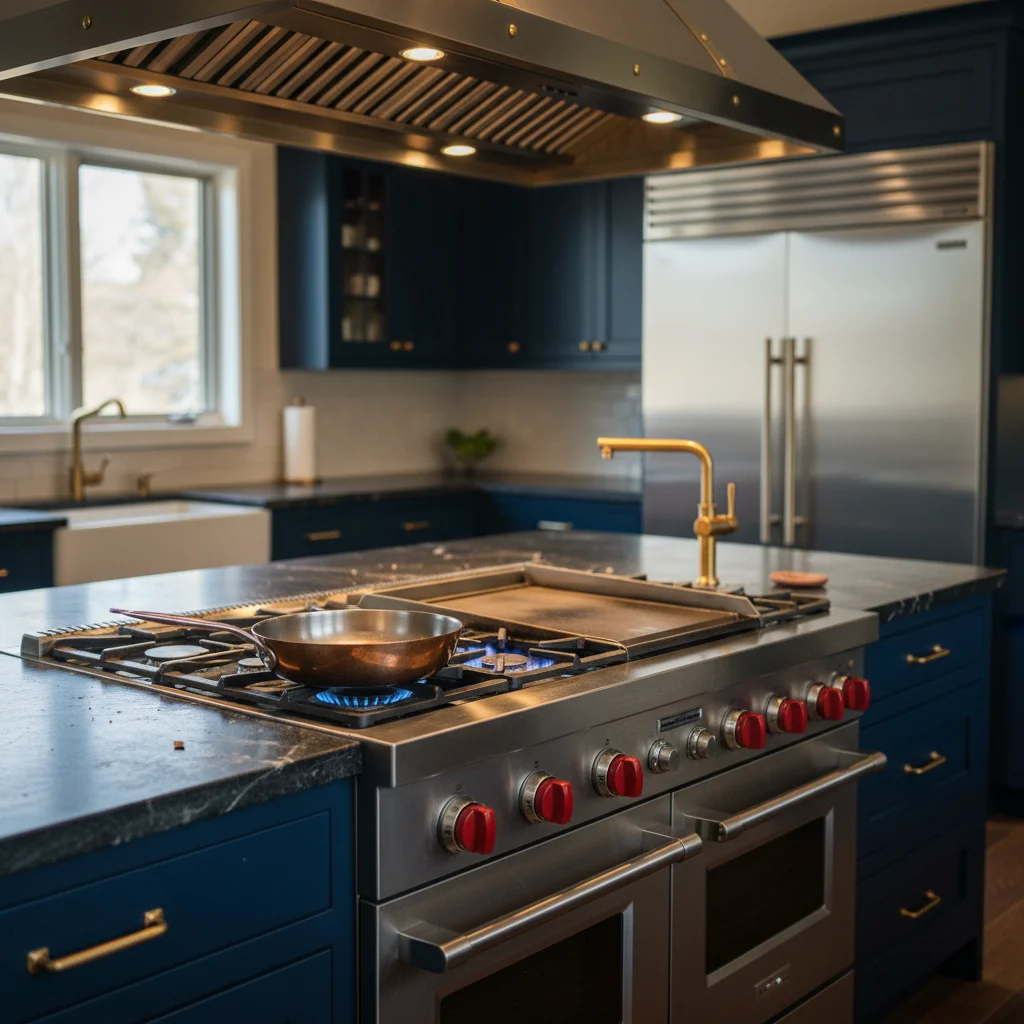
A BlueStar is not a typical home range, and that shapes every repair. These are hand-assembled, commercial-style cookers built around an open-burner top — the flame sits in the open under heavy cast-iron grates instead of hiding under a sealed cap — paired with a roomy gas convection oven. That architecture gives a BlueStar its enormous heat and instant, responsive flame, but it also means the things that go wrong, and the right way to chase them, differ from a mass-market range.
Our starting point is never a part. A technician confirms what the range is genuinely doing, walks the gas path or the oven circuit in order, then explains the real cause and quotes a single up-front price before any wrench turns. The on-site diagnostic is a flat $89, credited toward the repair if you proceed. We’re an independent service that has worked the Denver metro since 2012, and we are not affiliated with, endorsed by, or sponsored by the manufacturer.
Most common faults we see
BlueStar ranges fail in recognizable patterns. The ones that bring people to the phone most often:
- Burner sparks but won’t light. Typically a carbon-fouled or moisture-soaked spark electrode, a burner ring nudged off its seat, or a spark module firing every burner at once. Usually a correction, not a major part.
- Lazy, yellow, or roaring flame. An open burner running rich — frequently because the range was never re-tuned for altitude after a move to Colorado. The single most common Denver-specific BlueStar call we take.
- High-output burner that won’t simmer low. BlueStar’s big Nova-style burners are built to sear; the low end is the hardest to hold, and at altitude it’s the first thing to drift. Often tuning rather than a broken part.
- Oven slow to preheat or won’t ignite. A weak or cracked oven igniter that no longer draws enough current to open the safety gas valve. The oven may click and smell faintly of gas before catching.
- Uneven baking or one rack always off. A slowed convection fan motor or an oven heating unevenly — it reaches temperature but can’t distribute it.
- Oven drifts hot or cold with no error. A temperature sensor out of spec or a tired igniter; a pro oven 30 degrees off setpoint quietly ruins baking.
Parts and longevity
A BlueStar is engineered to be rebuilt and kept for decades, which is exactly why the right part matters. We install OEM-grade or manufacturer-compatible components matched to your model and serial — spark electrodes and modules, oven igniters, gas valves and orifices, temperature sensors, and convection motors. On a range this heavily built, the cast iron and the chassis outlast everything; it’s the ignition and control parts that wear, and fitting the correct one is what makes a repair hold instead of bringing us back.
The altitude and water angle
Denver leans on a gas range harder than on almost anything else in the kitchen. At 5,280 feet, the air is roughly 15% thinner, so each open burner gets less oxygen per breath and the factory air-fuel mix skews rich — the reason a BlueStar that burned crisp blue flame at sea level can run lazy and yellow here. That same thin air changes combustion and heat circulation in the gas oven, so a marginal convection fan or drifting sensor produces noticeably worse baking than it would lower down. Denver’s very dry air also stiffens and cracks the oven door gasket sooner, letting heat leak and stretching preheats. Most BlueStar ranges aren’t plumbed, so hard water (150–250 ppm on the Front Range) matters only where a setup adds a plumbed feature — but altitude and dryness are always in play, and we build both into the diagnosis.
How to book
If your BlueStar won’t light, burns lazy or yellow, won’t simmer low, drifts off temperature, or bakes unevenly, the sooner we look the smaller the fix usually is. Call (720) 770-4189 any time, or book online, and we’ll get your range searing, simmering, and baking the way BlueStar built it to — tuned for Denver’s altitude, not someone else’s. The diagnostic is a flat $89, applied straight to the repair.