The repair, explained
A BlueStar is not a typical range, and servicing one is not a typical service call. The brand is built by hand in Reading, Pennsylvania, and its whole identity is restaurant-grade cooking power in a residential chassis — open star-shaped burners that push serious BTUs, a heavy welded body, and, on most models, a refreshing absence of circuit boards. Where a mass-market range hides its function behind a glass touch panel and a stack of electronics, a BlueStar mostly relies on brass valves, a mechanical oven thermostat, and a gas train you can actually trace with a gauge and a meter. That design philosophy is the reason these ranges are worth keeping for decades. It is also the reason a generic appliance tech, trained to read error codes off a display, can stand in front of one and not know where to start.
So the way we approach a BlueStar is shaped by the machine itself. There is rarely a fault code to lean on, which means the diagnosis lives in the physical evidence — flame color and shape, igniter spark and current, gas pressure at the manifold, thermostat behavior across a real preheat. We confirm what you are actually seeing, measure the relevant part of the system, and follow it to the one component that is out of spec. Then we put a firm number on the fix before any tool comes out. The $89 service call covers that inspection and rolls into the repair if you decide to proceed. On a machine built this deliberately, the expensive mistake is swapping a part on a hunch when a five-minute measurement would have pointed somewhere cheaper.
If you would rather skip ahead, the phone is (720) 770-4189, answered around the clock, and online booking is linked at the bottom of the page.
What we service for BlueStar
- Gas ranges — Heritage, Platinum, and Nova-series models from 24” up through the 48” and 60” pro widths, with open or sealed burners over a gas convection or standard oven.
- Rangetops and cooktops — drop-in rangetops and gas cooktops that pair with separate wall ovens, including the high-output open-burner configurations.
- Wall ovens — gas wall ovens with mechanical and, on some builds, electronic thermostats.
- Salamander and infrared broilers — the integrated overhead and in-oven broilers that are a signature BlueStar feature and a frequent service item.
- Griddle, French-top, and charbroiler inserts — the interchangeable cooking surfaces that drop into the burner grate area and have their own wear patterns.
We are an independent repair company. We are not affiliated with, endorsed by, or sponsored by BlueStar or Prizer-Hansen — what we bring instead is hands-on experience with these ranges and parts matched to your specific model, with no factory dispatch line in the middle.
Symptoms and causes
Every BlueStar that comes across our schedule is its own puzzle, but the open-burner, low-electronics architecture means the failures cluster in predictable places. Knowing those places is half the diagnosis. Here are the ones we see most:
- Burner clicks but won’t light — usually a spark igniter fouled with carbon or food debris, a burner cap or head seated slightly off its locating posts, moisture trapped under the cap after a spill or a cleaning, or a spark module that keeps firing without lighting. Several of these are a quick correction once properly identified.
- Lazy, yellow, or sooty flame — an air-shutter or orifice mismatch, a partly blocked burner port, or a flame that simply runs rich because the range was never re-jetted for Denver’s altitude after install. This is the single most common BlueStar complaint we get in Colorado, and it is covered in detail below.
- Weak flame or low BTU output — a partly closed valve, a clogged orifice, or low gas pressure at the manifold. On a range that people buy specifically for its high heat, a burner that should roar and instead simmers is an immediate giveaway.
- Oven won’t ignite or is slow to heat — most often a weak or cracked oven igniter that no longer draws enough current to open the safety valve, so the oven clicks, glows faintly, and never fully lights. The gas safety valve itself can also be at fault.
- Oven runs hot, cold, or wanders off setpoint — because most BlueStar ovens use a mechanical thermostat rather than a digital sensor, drift here points to the thermostat, its capillary bulb position, or a calibration that has slipped. An oven running 30 to 50 degrees off without any display to warn you is a classic version.
- Salamander or infrared broiler not firing — a dedicated igniter, a separate gas valve, or a fouled burner specific to the broiler assembly. These run hot and cycle hard, so they wear on their own timeline.
- Door and seal complaints — a sagging or misaligned oven door, a worn hinge spring, or an oven gasket gone brittle and leaking heat. Denver’s dry air is hard on these, which we explain further down.
- Surface spark continuing after lighting — a grounding or moisture issue at the spark electrode, common after deep cleans where the cooktop got wet.
Reading a range with no error codes
The thing that trips up generalists is exactly the thing BlueStar owners love: there is usually no screen telling you what is wrong. That is not a disadvantage to someone who knows the machine. A mechanical range tells the truth through its physics — you just have to measure it:
- Flame diagnostics. Color, height, and shape across each burner reveal air-fuel balance, orifice condition, and altitude tuning long before guesswork enters the picture.
- Ignition measurement. We check spark at the electrode and current draw through the oven igniter, because “it won’t light” has at least three different causes that look identical from the front.
- Gas pressure at the manifold. A pressure reading separates a supply problem from a range problem and keeps us from replacing parts that were never the issue.
- Thermostat behavior over a real cycle. We watch an actual preheat and hold, because a mechanical thermostat’s drift only shows itself under load.
Why a specialist instead of the manufacturer
Routing a hand-built brand through a national dispatch channel tends to mean a longer wait and a technician working from a script written for ranges that have circuit boards. A BlueStar has almost none, and the diagnosis lives in places a code-reader never looks. As an independent company that has serviced premium cooking equipment across the Denver metro since 2012, we offer a different trade: same-day or next-day scheduling, a genuine hands-on diagnosis instead of a parts-cannon approach, OEM-grade parts matched to your model, and up-front pricing you approve before any work starts.
There is also the altitude factor, which a factory line three time zones away simply does not account for. A BlueStar burner that ran a crisp blue flame in its old kitchen can burn lazy and yellow after a move to Denver, and the fix is tuning, not replacement — a distinction a generic tech may miss entirely. Independent means independent here: we are not authorized by or affiliated with BlueStar, and for most Denver owners the speed, the local knowledge, and the straight talk are the better deal.
What a visit looks like
We try to make the appointment itself uneventful, which is the point. Here is how a typical BlueStar call runs:
- Booking. You call (720) 770-4189 or book online and pick a window. The phone is answered 24/7; repairs themselves run daily from 8:00 AM to 6:00 PM.
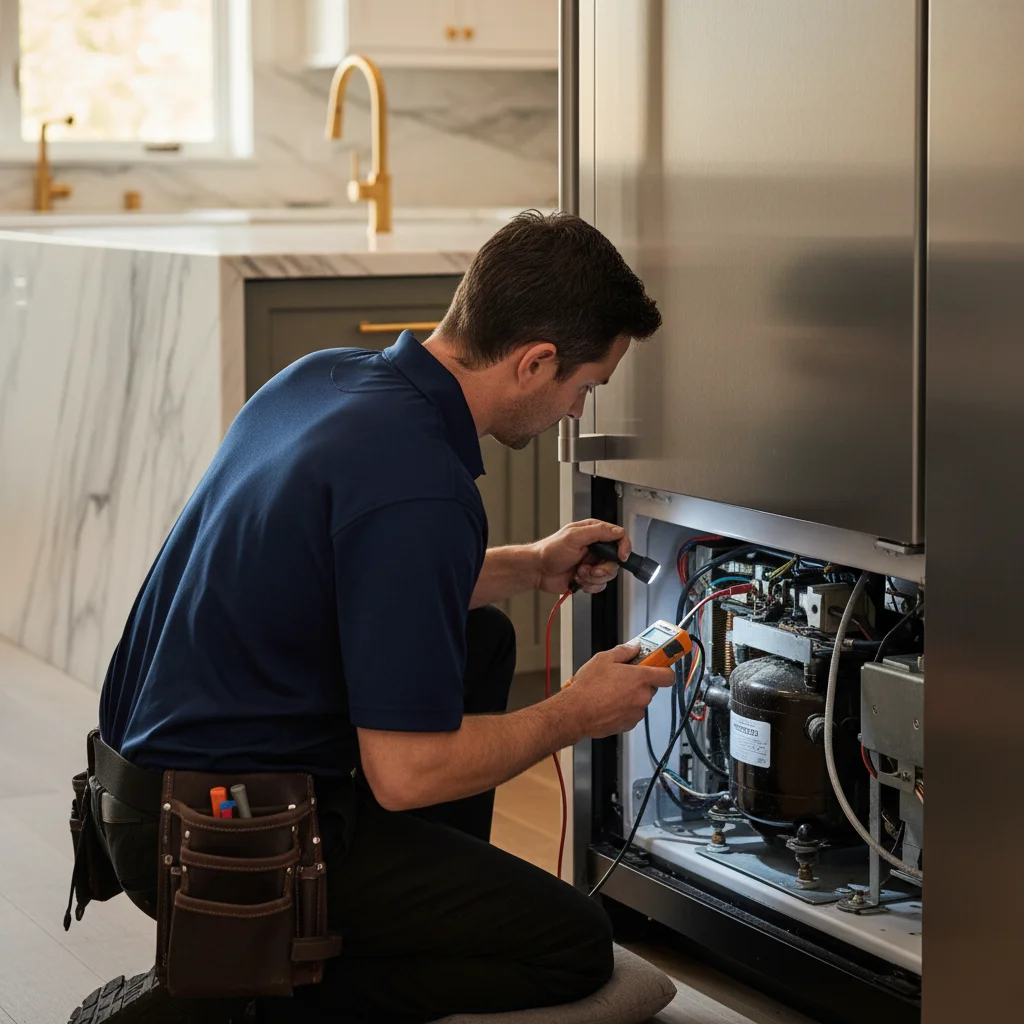
- On-site inspection. The technician confirms the symptom by reproducing it, then measures the relevant part of the system — flame, ignition, gas pressure, thermostat — rather than taking the complaint at face value.
- The diagnosis and quote. You hear the actual cause in plain language and a firm total before any wrench moves. The $89 service call covers this and is credited toward the repair if you proceed.
- The repair. With your approval, we fix the real fault — and we address the thing that caused it, not just the symptom. If a thermostat reads off because a capillary bulb slipped its clip, we re-secure the bulb, not just swap the thermostat.
Nothing gets replaced without your okay, and there are no surprise line items after the fact.
Parts and how long the fix lasts
A BlueStar is built to outlive the cabinetry around it, and an honest repair should respect that. We install OEM-grade and manufacturer-compatible parts from verified suppliers, matched to your exact model and serial number. That distinction matters most on the parts that decide how long a fix holds — burner heads and caps, spark electrodes and modules, oven igniters, mechanical thermostats, gas safety valves, and the brass surface valves. A bargain igniter that does not match the original specification can light fine the day it goes in and quit by the next holiday season; a correctly matched part is what keeps you from calling us back for the same complaint.
Longevity is also about fixing the cause, not the visible symptom. If a burner runs yellow, simply scrubbing the cap is a patch when the orifice was never sized for altitude. If an oven igniter is weak, the safety valve it feeds may be near the end of its own life too. Because BlueStar keeps its design consistent across model years and parts available for a long service life, a well-kept range stays worth repairing for many years. Keeping burner ports clean, wiping spills before they bake onto the electrodes, and not slamming the heavy oven door all extend the life of the parts we would otherwise be back to replace.
The Denver altitude and water angle
This is where servicing a BlueStar in Denver genuinely differs from servicing one near sea level, and it is the part a national channel tends to miss.
Thinner air at 5,280 feet. Denver’s air is roughly 15% less dense than at sea level, and that changes how gas burns. The air-fuel mixture skews rich unless the orifices and air shutters are sized and tuned for altitude — which is precisely why a high-BTU BlueStar burner, designed to push a lot of fuel, shows altitude problems more dramatically than a modest range would. A lazy yellow flame, soot on the pan bottoms, a simmer that won’t hold, or an oven that struggles to reach setpoint all trace back to this surprisingly often. We build elevation into the diagnosis from the first flame reading rather than treating it as an afterthought, and in many cases the cure is correct jetting and air-shutter adjustment, not a new part.
Hard water, roughly 150 to 250 ppm. Much of the metro runs hard, and while a BlueStar range is primarily a gas-and-fire machine with fewer water paths than a dishwasher or fridge, any plumbed accessory, steam feature, or attached water line still scales up over time. We flag mineral buildup whenever we see it so a small problem does not grow into a replaced component.
Very dry climate. Denver’s low humidity is quietly hard on rubber and gaskets. Oven door seals dry out, stiffen, and crack sooner here than in humid regions, and on a range that shows up as longer preheats, heat escaping at the door, and uneven baking. A door complaint that looks cosmetic is often an early seal failure worth catching before it costs you energy and even cooking.
Strong UV and a punishing dry-cold winter round out the picture, accelerating wear on exposed trim and any externally routed line. None of this is exotic — it is simply local reality, and folding it into the diagnosis is what an altitude-aware specialist offers that a generic line cannot.
A few questions, answered
Is BlueStar really worth repairing instead of replacing? In most cases, yes — that is the entire premise of the brand. These ranges are built from heavy, serviceable parts with a long parts life, so a single failed igniter, valve, or thermostat rarely justifies replacing a unit that may have decades left in it.
My range has no display, so how do you even diagnose it? That is the easy part for a specialist. We measure flame quality, ignition current, gas pressure, and thermostat behavior directly. The absence of electronics means fewer hidden failure points, not fewer answers.
Can you tune my burners for Denver’s altitude? Yes. Altitude-related rich flames are one of the most common things we correct on BlueStar ranges here, and the fix is often jetting and air-shutter adjustment rather than parts.
Will the $89 really apply to the repair? Yes. The $89 covers the full on-site inspection, diagnosis, and a written price, and it is credited toward the total if you approve the work — so you are not paying twice for the same visit.
When your BlueStar range, rangetop, oven, or broiler is acting up — whether it is a burner that won’t light, a flame gone yellow at altitude, or an oven drifting cold before a dinner party — we will find what actually failed and tell you the price before we fix it. Call (720) 770-4189, answered 24/7, or book online to get your BlueStar back in service across the Denver metro.