A failing dishwasher in Washington Park rarely makes a scene. It sits flush in a renovated kitchen, often paired with a Sub-Zero column and a Wolf range, and it just quietly stops drying — or leaves a slow puddle that nobody notices until a board cups or a basement ceiling stains below. Our first job is never to guess and swap a part. It’s to find the actual cause, account for how Wash Park homes are built, and hand you a clear price before anything comes apart. The diagnostic service call is $89, and it’s credited toward the repair.
Quick orientation
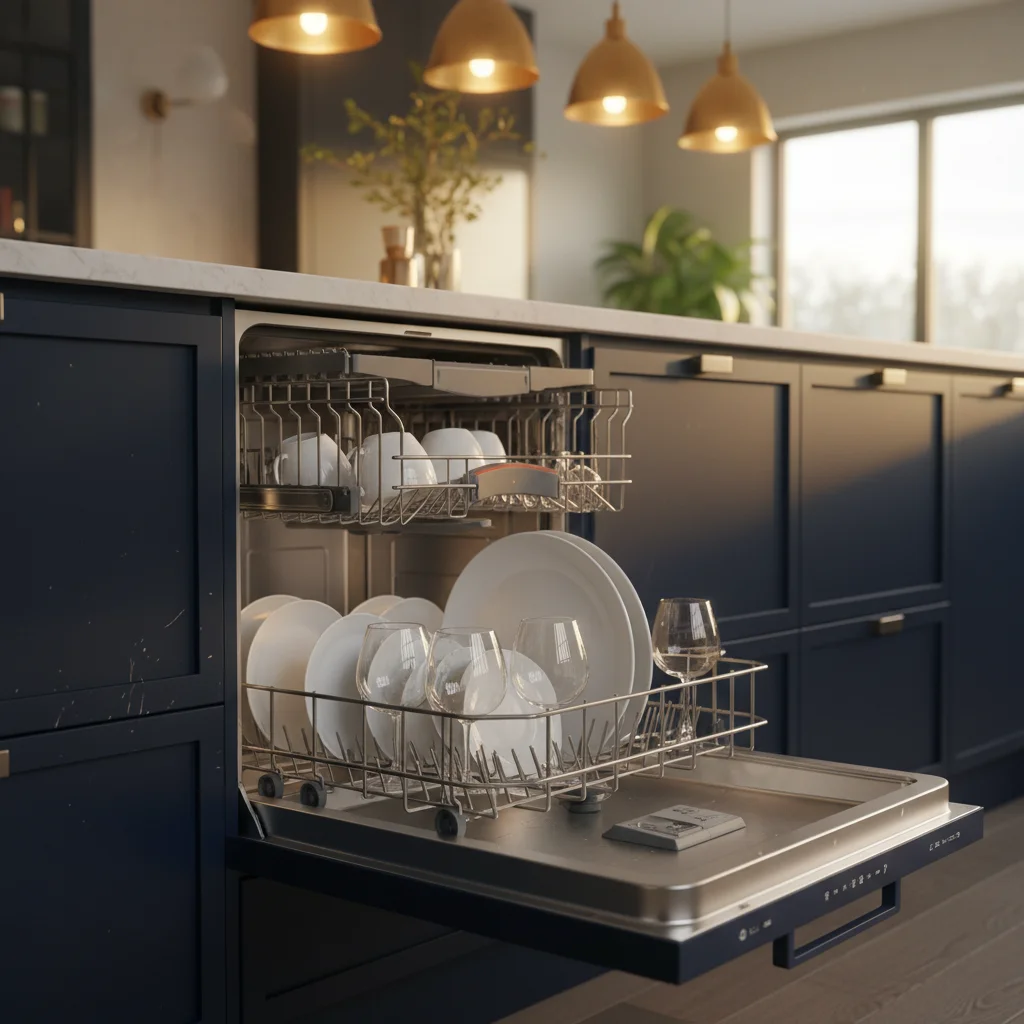
Washington Park kitchens are a particular animal. The neighborhood is built around the park in tree-lined blocks of brick Denver Squares — those boxy foursquares with deep porches — and 1920s bungalows, a huge share of them gut-renovated over the past two decades. When owners remodel here, they go all in, and the dishwasher usually arrives as part of a matched suite: integrated and panel-ready, tucked beside the Sub-Zero, under stone counters with original hardwood inches away.
That setting changes the repair. These bungalows are single-story with the basement directly under the kitchen, so drains and water lines frequently route downward — which is why a leak here often surfaces below the floor instead of on it. Reaching an integrated unit means clearing a finished cabinet run, not yanking out a freestanding box. We plan for that before we touch anything.
Most common faults we see in Wash Park
A recognizable short list comes up again and again across the squares and bungalows:
- Cloudy, filmy, or spotted dishes — usually hard-water scale on the spray arms and heating element, a clogged arm, or a tired rinse-aid system.
- Dishes still wet at the end — a weak heat-dry, a failed vent, or a faulty heating element, made slightly worse by Denver’s thin air.
- Standing water that won’t drain — a clogged filter or sump, a jammed drain pump, a scaled check valve, or a bad high loop at the sink.
- Water showing on the basement ceiling — a cracked hose or weeping connection on a line that routes down through the bungalow floor.
- A unit that won’t start or quits mid-cycle — typically the door latch, the control board, or the thermal fuse.
- A door that leaks at the bottom seal — a gasket gone hard and cracked from the dry climate.
Parts and longevity
When a part genuinely needs replacing, we fit OEM-grade or manufacturer-compatible components matched to your model — drain pumps, inlet valves, control boards, door latches, and heating elements being the ones that decide how long the next repair holds off. Just as often, the smarter move is to descale and clean rather than replace: a heating element or check valve choked with mineral buildup gets a far longer second life from a proper cleaning than from a new part that will simply scale up again on the same water.
The altitude and water angle
Two Denver realities shape nearly every Wash Park dishwasher call. First, the hard water — roughly 150 to 250 ppm — steadily coats spray arms, the heating element, the inlet screen, and the check valve, which is the root of most film, drainage, and weak-dry complaints we see. Second, the 5,280-foot altitude: with air about 15% thinner, heat-dry cycles work a touch harder to flash water off dishes, so a marginal element or vent shows as “wet dishes” sooner than it would at sea level. And the very dry climate ages the door gasket fast, so bottom-seal leaks turn up earlier here than in humid regions. We test for all three instead of treating a symptom in isolation.
How to book
If your dishwasher is leaking, won’t drain, or is leaving dishes dirty, don’t let it sit and soak a Wash Park floor or basement. Call (720) 770-4189 — answered 24/7 — or book online anytime. Repairs run daily from 8:00 AM to 6:00 PM, and most Washington Park visits are same-day or next-day. The $89 diagnostic is credited toward the repair, with a clear price before any work begins.