The repair, explained
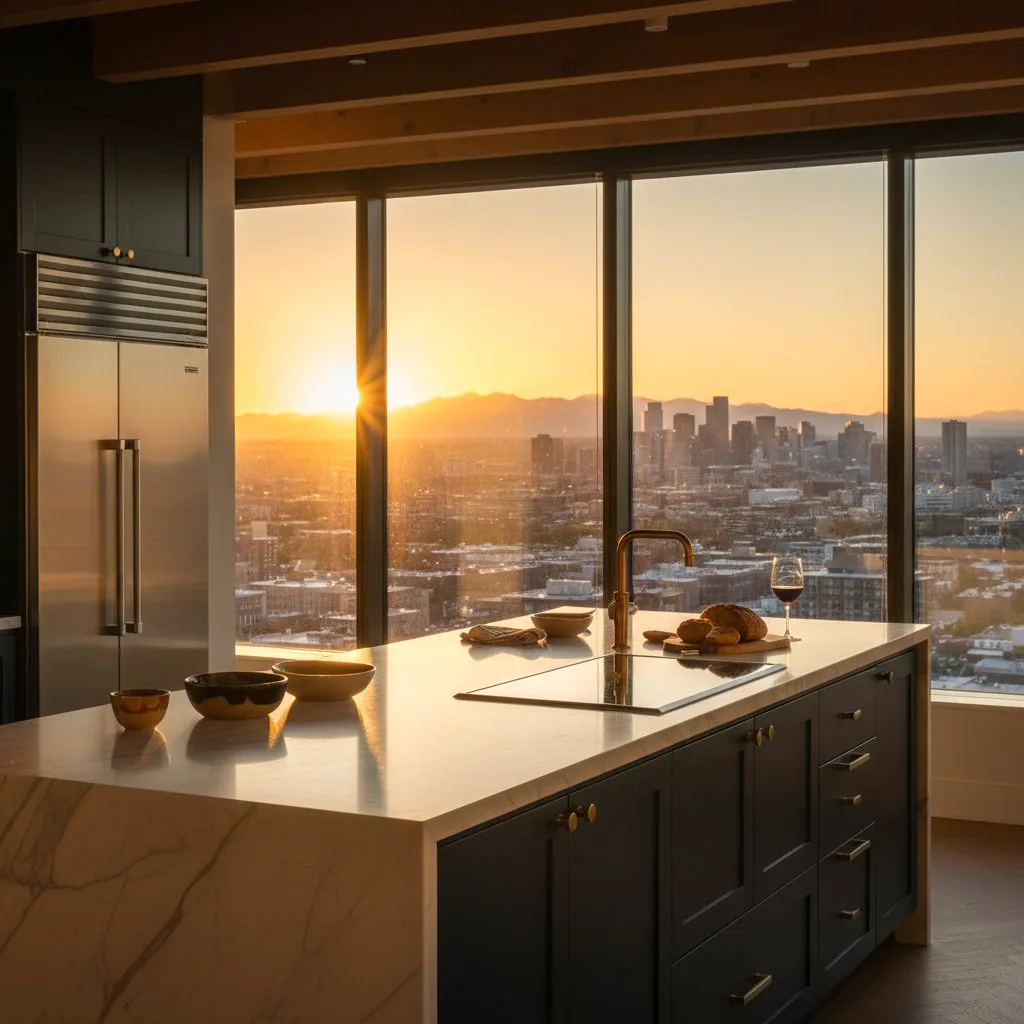
A premium appliance going down in a Thornton kitchen is a different problem than a basic fridge quitting in a rental, and the fastest way to make a repair go sideways is to treat them the same. The newer the home, the more likely the kitchen was specified as a package — a built-in refrigeration column holding a tight set point, a pro-style range with sealed burners and a convection oven, a panel-ready dishwasher hidden behind a cabinet front, and a control board quietly coordinating fans, sensors, and defrost cycles in the background. That is a system, not a single box. When one piece of it slips, the right move is not to swap whatever looks worn — it is a diagnosis that traces which component in the chain actually failed, confirms it, and only then talks price.
Thornton makes that distinction unusually concrete because so much of its housing stock is recent, and recent builds in the north metro increasingly arrive with upgraded kitchens. A family touring a new subdivision off 144th picks finishes at a design center, and the appliance line they choose is frequently a step or two above the base package — a column refrigerator instead of a freestanding one, a gas range with a real BTU output, an integrated dishwasher that disappears into the millwork. Five years later, when the defrost system glitches or a burner won’t light cleanly, that upgrade decision is exactly why the repair needs a specialist who understands the platform rather than a generalist guessing at it.
So every Thornton call runs in the same order: understand the appliance, isolate the genuine fault, then give a clear, up-front price before any work starts. The $89 diagnostic service call covers that inspection and is credited toward the repair if you go ahead. No phone guesses on equipment we haven’t laid eyes on, and no number that grows once the work is done.
A north-metro suburb still under construction
Thornton has a character most of the metro lost decades ago: it is still actively growing. The original city took shape around 88th and Washington in the 1950s and 60s as one of Denver’s first true post-war suburbs, and those established neighborhoods still anchor the south end. But the story that defines Thornton today is the steady push north — subdivision after subdivision rising past 120th, 144th, and out toward 168th, Larkridge, and the open prairie that used to mark the edge of the metro. The light-rail line that now reaches Eastlake and the northern stations only accelerated it. Whole grids of streets that were farmland a decade or two ago are now packed with new rooftops.
For appliance repair, that growth pattern converges on a single fact: Thornton’s newer construction increasingly ships with upgraded kitchen packages. That is the through-line that makes this a premium-appliance town rather than a basic-appliance one, and it shows up differently across the city’s eras.
- Newer subdivisions north of 120th are where the upgraded packages cluster. Production builders in these neighborhoods offer design-center tiers, and a meaningful share of buyers step up to built-in or column refrigeration, a pro-style gas range, and a panel-ready dishwasher. These units are integrated into the cabinetry from day one — flush fronts, hidden service panels, airflow paths engineered around exact clearances.
- The established Thornton core around 88th and Washington tells the opposite story in reverse. Many of those original homes have been remodeled over the years, and a fair number now hide a current built-in fridge or a modern range inside a kitchen the 1960s floor plan never anticipated — a retrofit, with all the tight-access quirks that come with one.
- Move-up and second-owner homes from the 1990s and 2000s sit in between, and their builder-grade kitchens are now old enough that the original premium appliances are reaching the age where control boards, compressors, and igniters start to fail. These are some of our most common Thornton calls.
- Panel-ready and integrated dishwashers turn up far more here than the metro average, simply because so many of these kitchens were designed as a coordinated package rather than assembled piece by piece.
We service every part of that spectrum. What defines Thornton from a repair standpoint is not one appliance type — it is a fast-growing suburb where each new wave of construction raises the share of kitchens carrying serious built-in equipment, and where the homeowner reasonably expects whoever shows up to actually know the platform.
Symptoms and causes: reading the fault behind the complaint
Most service calls open with a symptom a homeowner can say in one sentence — “it’s getting warm,” “the ice maker stopped,” “the oven runs hot,” “a burner clicks but won’t catch.” The real work is connecting that plain complaint to the actual mechanical cause, because a single symptom almost always has several possible roots, and each one carries a different fix and a different price.
Here is how that mapping tends to play out on the appliances we see most across Thornton:
- A built-in fridge that slowly drifts warm. This is rarely a dead compressor. Far more often it is a stalled condenser fan, a condenser choked with dust because a retrofit boxed it into tight cabinetry, a tired evaporator fan, a failing defrost cycle that’s icing the coil, or — less commonly — a sealed-system refrigerant problem. Five candidate causes, five very different repairs.
- An ice maker that quits or makes cloudy, undersized cubes. In a north-metro kitchen the first suspect is almost always scale from hard water clogging the inlet valve or fill tube, followed by a frozen line, a worn module, or a water filter long past its date.
- A pro-style burner that lights lazy, yellow, or not at all. On a newer Thornton range this can be a clogged igniter or burner port, but at altitude it is frequently the air-to-fuel mixture itself running off the sea-level spec — a combustion-and-elevation issue, not a failed part.
- An oven that overshoots or undershoots its setpoint. Usually a drifting temperature sensor, a tired bake or broil element, or a control board that’s lost calibration — diagnosable, and rarely the catastrophe homeowners fear.
- A panel-ready dishwasher that won’t drain, dry, or finish a cycle. Often a clogged drain path or check valve, a failing pump, a door-latch or control fault, or a vent and heating issue made worse by the bone-dry Colorado air.
The point of running through the candidates is precision. We don’t replace the most expensive part on a hunch; we find the one that actually failed, confirm it, and quote that.
Why a specialist, not a general handyman
A standard freestanding appliance is engineered to be rolled out, opened from the back, and serviced in twenty minutes. The upgraded equipment in Thornton’s newer kitchens is the opposite: it is sealed into a system. A built-in refrigerator is tied to a control board, an airflow path designed around specific clearances, and a custom cabinet enclosure that has to come apart in the right order. A pro-style range routes gas through sealed burners calibrated to a particular flame; an integrated dishwasher is bolted into the cabinetry behind a panel that matches the surrounding doors. Get the diagnosis wrong, or get the access wrong, and you can spend more time undoing damage than fixing the original fault.
A generalist who works on whatever comes through the door tends to do two things that cost Thornton homeowners money. First, they guess at the part — swap a compressor when the real culprit was an $80 fan, or replace a control board when a sensor had drifted. Second, they force the access — pry a built-in out of its enclosure without understanding the pull, and scratch the cabinet fronts that came with the upgrade package. A specialist who lives on this equipment reads the install before touching it, knows how the platform is supposed to behave, and reaches the fault without disturbing the kitchen someone paid extra to build.
Denver factors first: altitude, hard water, and dry air
Most of the repair advice floating around online was written for sea-level kitchens, and Thornton is anything but. The city sits at and above Denver’s mile-high mark, and elevation is not a slogan here — it is a variable in nearly every diagnosis we make.
Thin air at roughly 5,280 feet. The atmosphere this high is about 15% less dense than at the coast, and refrigeration lives or dies on moving air to shed heat. Condensers and cooling fans push that thinner air, so a built-in fridge or wine column that’s even slightly dusty or a touch short on clearance starts struggling to reject heat sooner than the identical unit would near an ocean. Refrigerant charge and compressor heat rejection both respond to the thinner atmosphere. It’s exactly why a service procedure written for a humid Midwestern town can steer a technician wrong in a Thornton kitchen — and why a tightly packed built-in in a new subdivision can run warm without any single part being obviously broken.
Combustion shifts on every gas appliance. Less-dense air carries less oxygen per cubic foot, which changes how a gas range, cooktop, or oven actually burns. The orifice sizing and air-to-fuel mixture dialed in at sea level can throw lazy, yellow-tipped, or sooty flames at this altitude. When a pro-style range in a newer Thornton home suddenly burns unevenly, the cause is frequently combustion-and-altitude rather than a failed burner — and that’s something we can correct rather than replace.
Hard water and a bone-dry climate. Denver-area water tends to run hard, commonly in the 150 to 250 ppm range, and that mineral load is rough on ice makers, dishwasher internals, and the thin water lines feeding built-in refrigerators and in-door dispensers. It’s the leading reason ice production tails off, or cubes come out cloudy and small, in Thornton kitchens. On top of that, Colorado’s very dry air and intense high-altitude UV harden and crack door gaskets faster than a humid region ever would — and a seal that’s stopped sealing lets warm air leak in, makes the compressor run longer, and drives the whole system harder. We check seals on every refrigeration diagnosis for precisely that reason.
What a visit looks like, step by step
A Thornton service call is built to be predictable. Here is the order it runs in.
- Booking. Call (720) 770-4189 — answered 24/7 — or book online. We capture your address, the appliance, what you’re seeing, and the model and serial number if you can find them, so the technician arrives ready for your specific unit.
- Arrival and inspection. A technician comes to your Thornton home during repair hours, daily 8:00 AM to 6:00 PM. They confirm the symptom, then work the system methodically rather than swapping parts on a guess.
- Diagnosis. This is the $89 service call. We isolate the genuine fault and account for the local factors above — altitude, water, dry-air gasket wear — before reaching a conclusion.
- Up-front quote. You get a clear, total price for the repair before any work begins. If you approve, the $89 is credited toward that total.
- The repair. With OEM-grade or manufacturer-compatible parts matched to your model, we complete the fix and protect the cabinetry and flooring around the unit on the way out.
Appliances and components we service in Thornton
- Built-in and column refrigerators — sealed systems, condenser and evaporator fans, defrost circuits, control boards
- Freezer drawers and under-counter units — common in the larger newer builds
- Wine and beverage centers — dual-zone cooling, sensors, and seals
- Pro-style gas and dual-fuel ranges — sealed burners, igniters, combustion at altitude
- Cooktops and ovens — temperature sensors, bake and broil elements, control logic
- Ice makers — inlet valves, fill tubes, and modules fighting hard-water scale
- Panel-ready and integrated dishwashers — pumps, drain paths, latches, and heating
Pricing: up front, after we actually look
Pricing on this site is deliberately simple, because surprise charges are the thing Thornton homeowners tell us they fear most. The diagnostic service call is $89. It covers a full on-site inspection, and if you approve the repair, that $89 comes off the final total. The exact repair price is quoted only after a technician has inspected the unit in your home — never guessed over the phone and never padded after the work is done. You see the complete number before anyone picks up a tool, and you decide from there.
We won’t quote a repair price sight unseen, and that’s on purpose. The same warm-fridge complaint can be a $90 fan or a sealed-system job, and pretending to know which over the phone helps no one. An honest number requires looking first.
A few questions Thornton homeowners ask
Is “24/7” the phone or the repair work? The phone is answered 24/7, so you can call (720) 770-4189 any hour. Repairs themselves are performed daily, 8:00 AM to 6:00 PM. Call in the middle of the night if your freezer fails — we’ll get you on the schedule and out as soon as a slot opens.
My subdivision is brand new — is my upgraded kitchen package within your wheelhouse? Yes, completely. Built-in refrigeration, pro-style ranges, and integrated dishwashers from the new north-metro builds are exactly the equipment we specialize in. The newer and more upgraded the kitchen, the more it benefits from a specialist over a generalist.
Do you cover the far north end past 144th and 168th? We do. Our service area runs the full length of Thornton, from the original core near 88th up through the newest subdivisions toward Larkridge and the prairie edge. If your address says Thornton, you’re inside it.
Why does altitude keep coming up? Because it genuinely changes diagnosis. Thinner air affects how refrigeration sheds heat and how gas appliances burn, and a technician who ignores that will misread faults that are really elevation effects. It’s one of the main reasons local repair beats a generic procedure.
Ready to get it handled? Call (720) 770-4189 any time, or book online. We’ll confirm a same-day or next-day window, send a technician to your Thornton home, diagnose the real fault for $89 — credited toward the repair — and give you an up-front price before a single part is touched.