Wine Cooler Repair in Stapleton, Denver

For the wine units tucked into Central Park's planned-community kitchens, we measure the actual bottle-zone temperature, trace why it drifted, and put a firm price in front of you before any panel comes off.

Wine Cooler Repair in Stapleton, Denver

Quick Answers

Where can I get a wine cooler fixed in Stapleton, Denver?
Denver Sub-Zero Repair is an independent specialist covering the entire Central Park / Stapleton grid in northeast Denver, from Eastbridge and Bluff Lake over to Northfield. We handle built-in wine columns, freestanding dual-zone cabinets, and under-counter drawers. Call (720) 770-4189 — the line is staffed around the clock and most appointments land same-day or next-day.
What is the most common wine cooler problem in Central Park homes?
A unit that no longer holds serving temperature. The light works and the fan spins, but the bottle zone reads in the low-to-mid 60s instead of the 50s, which on a compressor cooler usually traces to a worn sealed system, a failing thermistor, or a starved evaporator fan. We confirm the real temperature first, then isolate the cause.
How much does it cost to diagnose a wine cooler in Stapleton?
A flat $89 brings a technician on site to find the actual fault, and that amount is credited toward the repair once you approve it. The repair price itself is quoted only after the inspection, because a thermoelectric drawer and a compressor-driven column fail along entirely different paths and cost differently to fix.

When a wine cooler in a Central Park home stops doing its one job — holding a steady serving temperature — we start with the actual numbers. A technician measures the real bottle-zone reading against the set point, separates a genuine cooling failure from a sensor that’s simply lying, finds the fault, and quotes a firm price before a single panel is touched.

The repair in plain terms

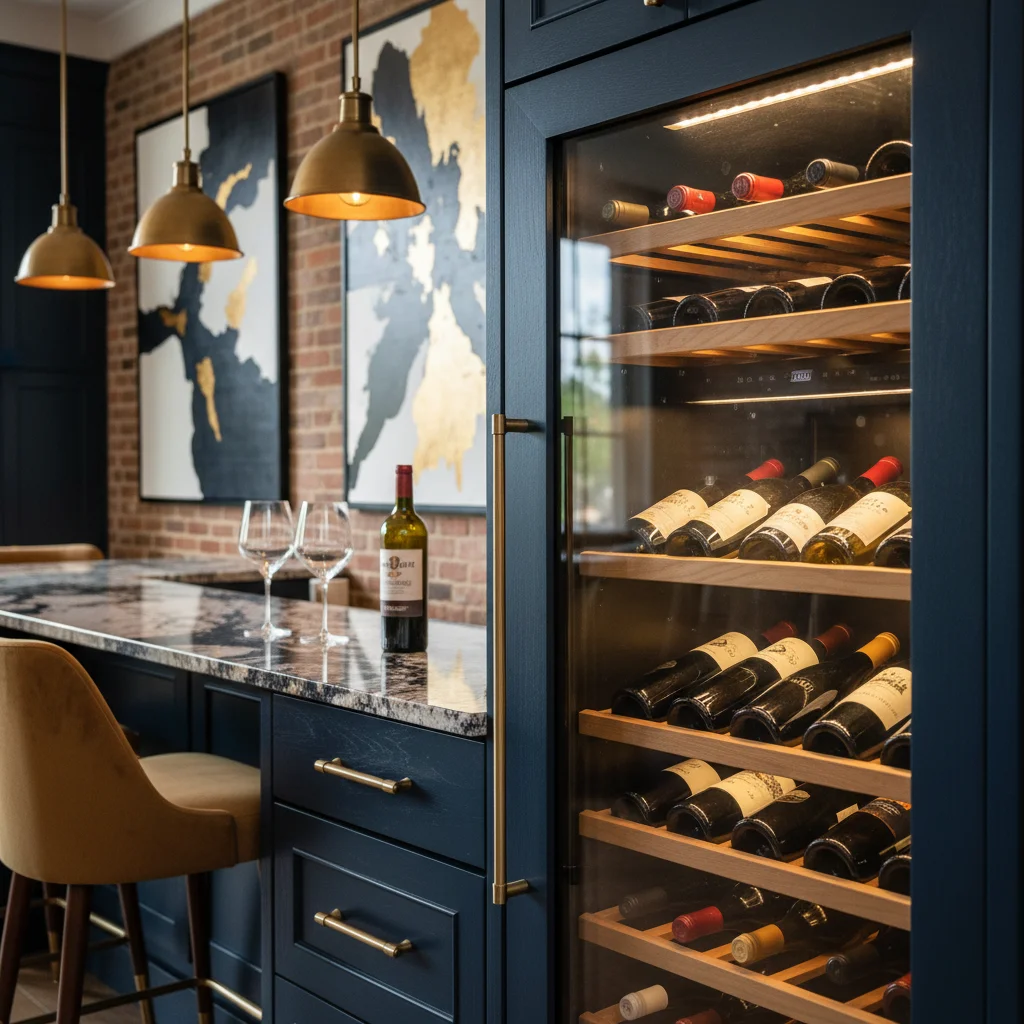
Stapleton was rebuilt on the footprint of the old airport and now carries the Central Park name, and it’s one of the few Denver neighborhoods where wine refrigeration was a standard fixture rather than a later upgrade. A large share of these homes left the builder with a coordinated kitchen suite already installed — and for many that meant a wine column, a dual-zone cabinet, or an under-counter drawer slotted in alongside the fridge and range. So the cooler we’re called to is rarely a unit the owner shopped for and rolled into place. It’s original equipment, often flush with the cabinetry, and it has to be read together with the millwork it lives in.

What tends to go wrong

Because Central Park went up in distinct build phases, kitchens on a given street tend to age in step — and the original compressors, thermistors, fans, and gaskets reach the end of their service life at roughly the same time. The calls cluster into a familiar set:

  • Won’t hold serving temperature — the bottle zone creeps into the 60s while the cabinet keeps running, pointing at the sealed system, a thermistor, or the evaporator fan.
  • One zone warm, the other fine — each chamber of a dual-zone is controlled separately, so a stuck damper or dead fan can warm the reds while the whites stay perfect.
  • New noise across an open floor plan — a compressor mount or fan that’s gone loud, magnified by Central Park’s open-concept kitchens.
  • Frost, sweating glass, or water at the base — a door gasket that no longer seals, letting warm room air bleed onto cold surfaces.
  • A thermoelectric drawer that powers on but never pulls down — common on slim under-counter units that struggle to shed heat at altitude.

How we inspect it and set the price

The $89 diagnostic covers a full on-site inspection, and it credits straight toward the repair the moment you approve the work. A technician confirms the true cabinet temperature, checks airflow around a flush-set column, tests the compressor and sealed system under load, diagnoses each zone separately on dual-zone cabinets, and inspects the gasket for dry-climate shrinkage. The exact repair price is named only after that — because a thermoelectric drawer and a compressor column fail differently and cost differently — so the number you approve is the number you pay.

The Denver factors underneath

At 5,280 feet the air is roughly 15% thinner, so every condenser rejects less heat than its maker assumed at sea level. A freestanding cabinet can usually absorb that loss; a column boxed flush into builder millwork — the Central Park norm — has far less margin, and a marginal unit slides out of range. Denver’s very dry air hardens door gaskets years early, the usual story behind frost and a sweating glass, and strong high-altitude UV through a sun-facing window finishes off a tired seal. On any humidified cooler, the hard local water near 150–250 ppm scales the valve and tubing over time.

Often part of the same kitchen

We fit OEM-grade, manufacturer-compatible parts matched to your model and serial — compressors and sealed systems, thermistors and control boards, fans, dampers, thermoelectric modules, gaskets, and fill valves. Since the cooler usually shares its vintage with the original suite, one Central Park visit can also cover the nearby built-in fridge, ice maker, or range.

Book your Central Park visit

Repairs run daily, 8:00 AM to 6:00 PM, and the phone is answered 24/7, so same-day or next-day slots are usually open. Call (720) 770-4189 or book online anytime. The $89 diagnostic brings a technician to your Stapleton door, pinpoints the cause, and credits toward the repair the moment you give the go-ahead.

Frequently Asked Questions

The wine cooler came pre-installed when we bought our Central Park house. Do you still work on it?

Yes — that builder-installed unit is exactly the kind of equipment we open most often here. Central Park homes frequently shipped with a coordinated kitchen package, so the original wine column or under-counter drawer is original to the house. We pull the model and serial off the unit itself and match parts to it, no matter who set it in years ago.

My wine cooler holds about 62 degrees and won't go lower. Is that worth fixing?

Usually, yes, and it's worth acting on quickly. A few degrees of drift means the cooling stage is straining, not idle, and on a stocked cabinet those bottles are aging faster than you want. The cause is commonly a tired compressor, a leaking sealed system, a stuck thermistor, or a fan that has stopped circulating cold air. We diagnose which before quoting.

Why is my cooler suddenly humming loudly in an open-plan Stapleton kitchen?

Central Park's open floor plans give a new compressor or fan vibration nowhere to hide — what would be background noise in a closed galley telegraphs straight across the great room. The sound is often a worn compressor mount, a fan blade ticking its shroud, or a unit working harder to reject heat in thin air. We pinpoint the source rather than guess.

Do you service the flush, panel-front wine columns built into Central Park cabinetry?

Yes. The integrated, cabinet-matched column is one of the most frequent calls in this neighborhood. Builder kitchens hide the service access inside a finished millwork run so the unit reads as furniture, so we locate that access and protect the surrounding panels and flooring before easing anything forward.

Does Denver's hard water affect a wine cooler?

It does on any unit plumbed for humidification or a water line. Denver's supply runs roughly 150 to 250 ppm, and that mineral scale narrows fill tubes and fouls valves over time. We descale or replace the affected parts and check the line, rather than leaving scale to choke the system again within a season.

Is the $89 service call really subtracted from the repair?

Yes. The $89 pays for a complete on-site diagnosis, and the moment you approve the repair that amount comes off the total. You see the full price before any work begins, and nothing new is added to the bill afterward.

Your Sub-Zero Deserves Better

Denver's experienced independent repair specialists are standing by. Same-day appointments available throughout the metro area.