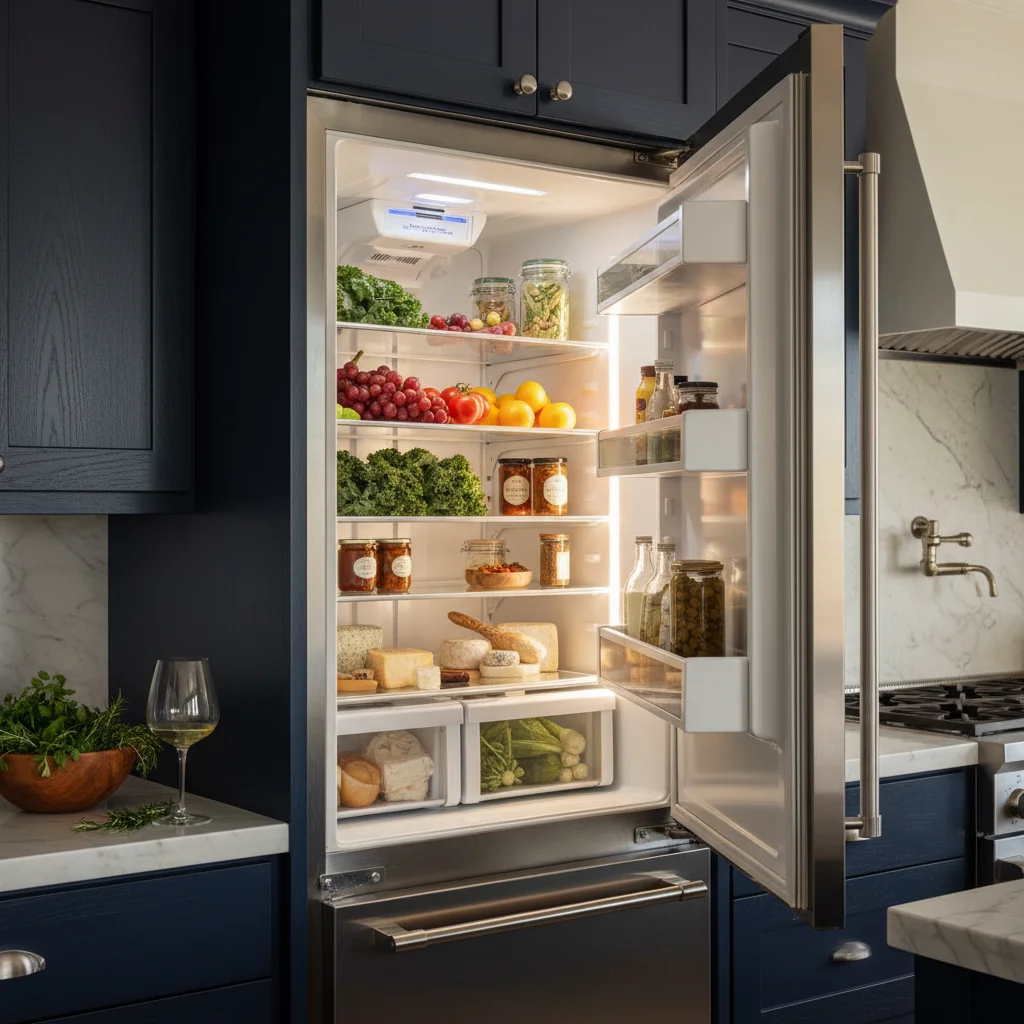
Walk into almost any Central Park kitchen and the refrigerator wasn’t a separate purchase — it arrived as one piece of a matched suite when the house did. That single fact shapes the whole repair. The fridge is usually a built-in column or a panel-ready unit slotted into a cabinet cutout sized to the millimeter, sharing its vintage with the dishwasher, the range, and the rest of the package. So when one starts to drift, it’s rarely a standalone box you can roll out and look behind.
The repair, explained
Stapleton was rebuilt on the old airport land and now carries the Central Park name, and it’s unusual among Denver neighborhoods because the serious kitchen came standard rather than as a later remodel. A built-in refrigerator breathes, hides its condenser, and fails in a different order than a freestanding model parked against a wall. The cabinet cutout, the airflow through it, and the toe-kick grille all become part of the diagnosis. We treat the appliance and the woodwork around it as one system, because that’s how it behaves.
Symptoms and causes
Refrigerator calls across Central Park tend to fall into a familiar set:
- Cools but never gets cold — fresh food sitting near 45°F instead of 37°F, often a dust-blanketed condenser or a tired evaporator fan.
- Warm top, cold bottom — on a single-evaporator built-in, a stuck air damper or stalled circulating fan starving the fresh-food compartment while the freezer holds zero.
- Runs nonstop — a condenser choking on trapped heat inside a tight cutout, or a weakening condenser fan.
- Frost on the freezer’s back wall or water under the drawers — a defrost heater, sensor, or control board mistiming the cycle, plus a clogged drain.
- Slow, hollow, cloudy ice — hard-water scale in the valve, fill tube, and mold.
Because so many of these fridges arrived together with the homes, we often see the same fault repeat across one build vintage — useful, since it tells us what to bring.
Why a specialist
A panel-ready fridge eased out of narrow builder millwork is not a generalist’s afternoon. Reaching a boxed-in condenser, reading the sealed system under load, and returning the unit to a tight cutout without scuffing cabinetry take hands-on time with this exact equipment. Denver’s conditions raise the stakes: at 5,280 feet the thinner air sheds about 15% less heat, punishing a fridge already fighting a snug cabinet; the dry, high-UV climate hardens door gaskets early so warm room air leaks in; and hard water at 150–250 ppm scales every water path. We arrive with the parts those patterns predict.
What a visit looks like
- Confirm the symptom. We measure real fresh-food and freezer temperatures instead of trusting the door display.
- Read the install. Clearances, grille airflow, and condenser access come first — in a flush-set column, restricted breathing is the prime suspect.
- Trace the system under load. Compressor, fans, dampers, defrost circuit, and control board get checked as one path, then the water valve, line, and seals.
- Quote before we open it up. You get the cause in plain words and one firm price, with surrounding panels and flooring protected.
Parts are OEM-grade or manufacturer-compatible from verified suppliers, matched to your exact model and serial.
Pricing
The on-site $89 diagnostic brings a technician to your Central Park door, pins down the real fault, and comes straight off the repair once you approve the work. The exact repair price is set only after that inspection — a built-in can hide a costlier fault, or a far simpler one, than its display suggests — so the number you hear is the number you pay.
Quick answers before you call
Too new to fail? No — wear runs on hours, not on the build date. Warm on top only? Airflow and damper first, sealed system second. Cloudy ice? Denver scale, nearly every time. Will you mark the cabinetry? No; we protect surfaces and ease the unit out gently.
A built-in that’s drifting warm only grows more expensive the longer it runs flat-out. Call (720) 770-4189 any time — the phone is answered 24/7 — or book online. Repairs run daily, 8:00 AM to 6:00 PM, and the $89 diagnostic credits toward the fix.