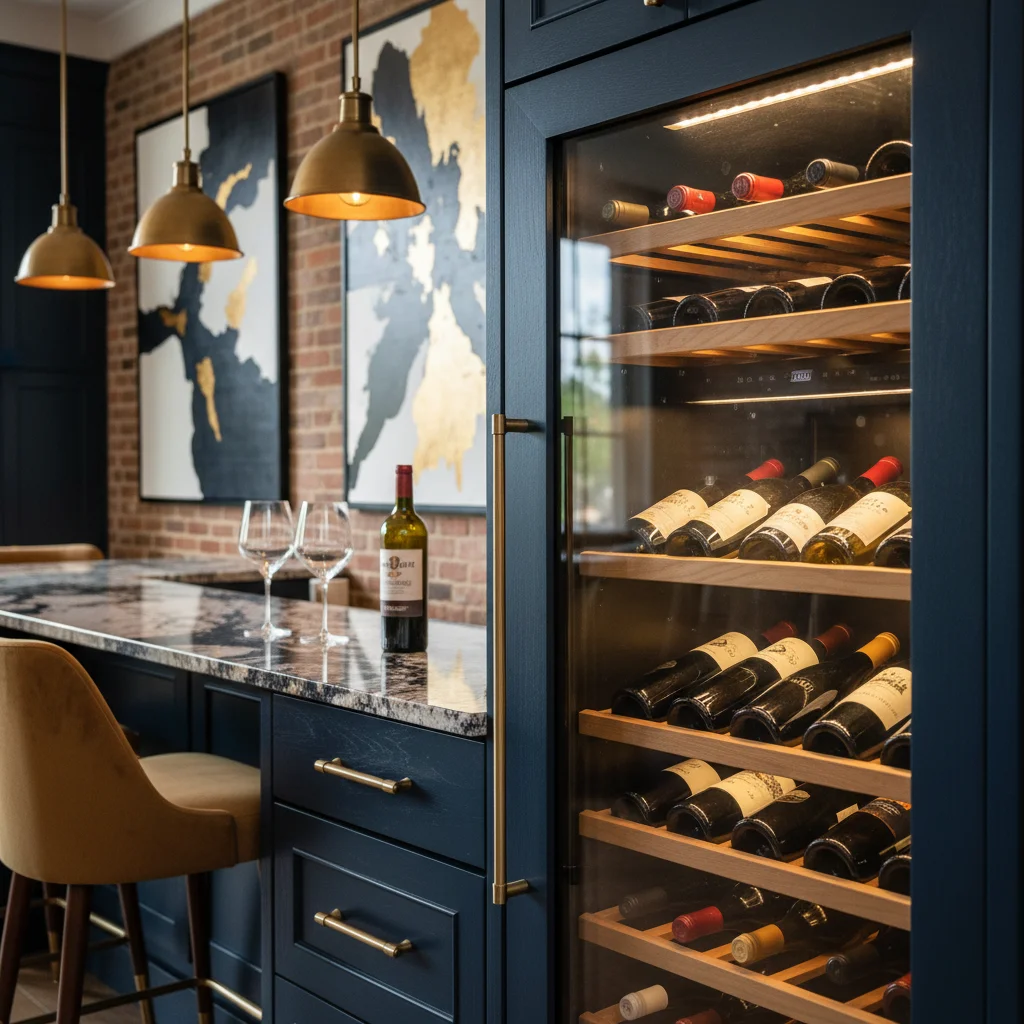
It is Saturday evening, guests are due, and the wine column built into your kitchen island has started running without pause — a low, steady drone where it used to cycle on and off in quiet stretches. The display still shows 55 degrees, but a bottle pulled from the top rack feels closer to room temperature, and the compressor clearly never rests. In a serious Greenwood Village collection, a unit that runs forever yet can’t pull down is its own slow disaster: the motor wears, the energy climbs, and the wine warms anyway. Our work begins the moment that cooler stops behaving, and you get a firm price before a single panel moves.
What we’re actually looking at here
Greenwood Village sits in the southeast metro, wrapped around the Denver Tech Center, and its lots run large — gated enclaves, custom acreage builds, and estate kitchens designed as a single architectural piece. Wine storage here is almost never a plug-in box on the floor. It is a flush-inset column framed into millwork, a bank of refrigerated drawers under a stone counter, or a walk-in cellar built into a lower level. So when a cooler misbehaves, the question is two-sided: what failed inside the unit, and what is the cabinet or room around it doing to push it there.
The faults we see most
Across these estates and Tech Center enclaves, the same patterns recur:
- A compressor that runs nonstop and still can’t hold the set point, or short-cycles without ever pulling down.
- One zone of a dual-zone unit drifting warm while the other stays exactly on target.
- A new hum, buzz, or vibration that telegraphs through custom cabinetry in an otherwise silent kitchen.
- Frost on the rear wall, a sweating glass door, or water collecting at the base.
- A cellar that keeps its temperature but loses humidity, slowly drying the corks.
How a visit unfolds
We diagnose in a fixed order rather than swapping parts and hoping:
- We confirm what the unit is actually doing — measuring rack temperature against the display, watching the compressor cycle, and noting how the install is breathing.
- We separate cabinet from machine: airflow around a boxed condenser gets checked alongside the sealed system, since a starved condenser mimics a refrigerant problem.
- We isolate to one part — sensor, board, fan, damper, thermostat, gasket, or compressor — and confirm it before naming a cost.
- We hand you an up-front, all-in price. The $89 diagnostic credits straight toward the repair the instant you approve it.
Why altitude and water matter here
At 5,280 feet the air is about 15% thinner, so every condenser rejects less heat than its maker expected at sea level. Wall that condenser into millwork or seat a cooling head in a basement cellar — exactly how Greenwood Village tends to build — and that slim margin can decide whether the unit holds or climbs out of range. Denver’s dry air hardens door gaskets early, the usual culprit behind frost and a sweating door, and on a humidity-controlled cellar it fights the humidifier without rest. Hard local water near 150 to 250 ppm then scales humidifier valves and feed lines until flow chokes. We read all three forces directly into the diagnosis.
Brands and units we open
These kitchens are a stronghold of full Sub-Zero and Wolf installations, and the panel-ready wine column is a frequent call. We also service dual-zone coolers, under-counter wine drawers, freestanding cabinets, and integrated cellar cooling from other major makers. Whatever the badge, we fit OEM-grade or manufacturer-compatible parts matched to your model and serial — compressors, fan motors, thermistors, control boards, dampers, humidifier parts, and gaskets — so the repair holds the first time.
Book a technician
Repairs run daily from 8:00 AM to 6:00 PM, and the phone is answered 24/7, so same-day or next-day appointments are usually open. Mention any gate or cellar access when you schedule. Call (720) 770-4189 or book online anytime. The $89 diagnostic brings a technician to your Greenwood Village door, finds the real cause, and credits toward the repair the moment you say go.