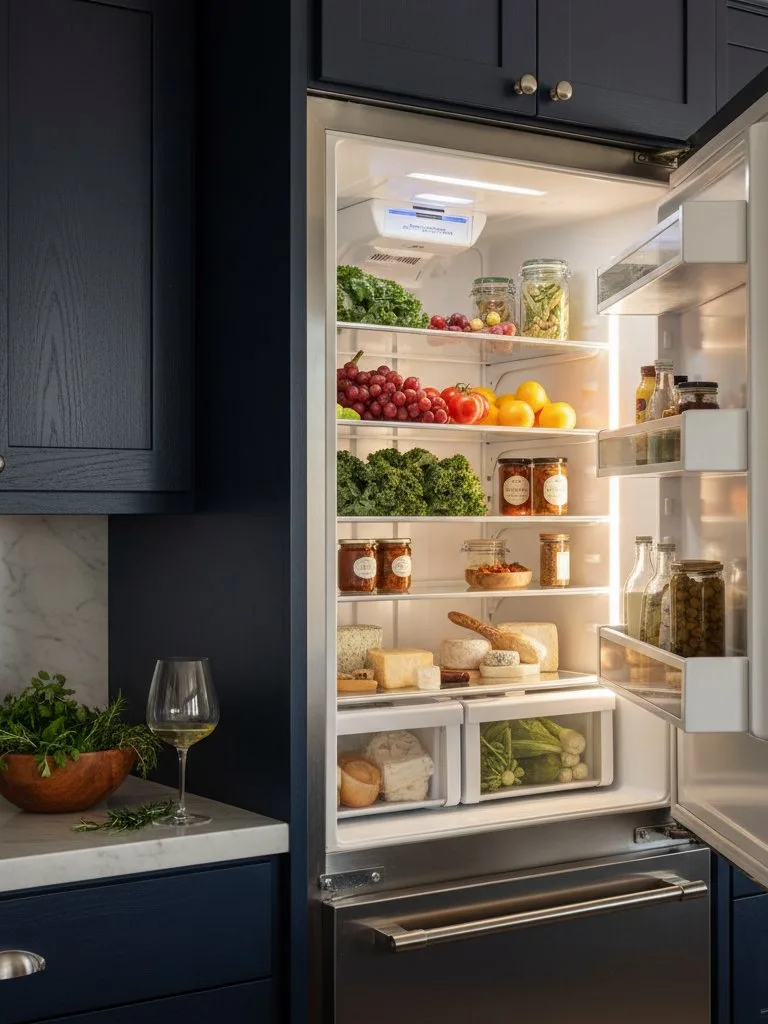
A freezer fails quietly. There’s no alarm, no flashing code across the door — just a slow slide, over a few unwatched days, from a hard zero up into the soft teens. In a Greenwood Village kitchen, where the freezer is usually a built-in column boxed into a custom cabinet run, the first sign is often a tub of ice cream gone to soup. By then the rest of the compartment has paid for the delay. The whole job is to catch the drift early and put one honest number in front of you before the food or the fix costs more than it should.
What you’re noticing
Maybe the cubes come out small and slushy. Maybe a wall of frost has crept across the back of the compartment, or the unit hums constantly without ever pulling fully cold. On an estate freezer stocked with a season’s worth of game, bulk meat, or a beverage drawer’s worth of inventory, a single warm weekend turns a quiet annoyance into a real loss.
What it usually points to
The estates and gated enclaves of the Tech Center corridor are full Sub-Zero and Wolf country, and that shapes every freezer call here. These aren’t big-box uprights — they’re precision columns, drawer stacks, and integrated beverage units with tight sealed systems and condensers tucked into millwork. When one drifts warm, the cause sits in a short list:
- A frosted evaporator behind a dead defrost heater, sensor, or control board
- A stalled or weak evaporator fan choking off cold-air circulation
- A condenser packed with cabinet dust, shedding far less heat than it should
- A sealed system running slightly low on refrigerant charge
Our approach
Reading the altitude into every measurement
At Greenwood Village’s mile-plus elevation the air is roughly 15% thinner than at sea level, so a freezer’s condenser rejects noticeably less heat. A built-in already sealed inside cabinetry feels that penalty hardest, and a charge a touch low tips over sooner here than it ever would at the coast. We check the condenser, compressor behavior, and charge with thin air factored in, because “normal” numbers look different at 5,280 feet.
Tracing frost, water, and seals
Dry Front Range air hardens door gaskets early, and a stiff seal lets humid room air leak in to feed frost — so we test the defrost circuit and the gasket together. On any ice-making unit we follow the water path, since hard local water (about 150–250 ppm) scales fill valves, lines, and molds until ice slows to a crawl.
One price, set on site
After the inspection you get a single up-front number. The $89 diagnostic comes off that total the moment you approve the work — no blind phone quotes, nothing tacked on later.
Coverage and brands
We cover all of Greenwood Village: the gated estates near the Denver Tech Center, the acreage lots south of Orchard, and the neighborhoods threaded along the Highline Canal. Our focus is built-in Sub-Zero and Wolf freezing — columns, drawers, and integrated beverage units — and we service the parts that decide whether a freezer holds: compressors, evaporator and condenser fan motors, defrost heaters, sensors, control boards, dampers, gaskets, and ice-maker valves and molds. Replacements are OEM-grade or manufacturer-compatible parts from verified suppliers, matched to your model and serial.
Get it fixed
If your freezer is creeping warm, don’t wait for the contents to thaw — an estate built-in holds a lot of food, and a stocked beverage unit holds far more in value. Call (720) 770-4189 any time; the phone is answered 24/7. You can also book online. Repairs run daily from 8:00 AM to 6:00 PM, the on-site diagnostic is $89, and that amount is credited toward the repair once you approve it.