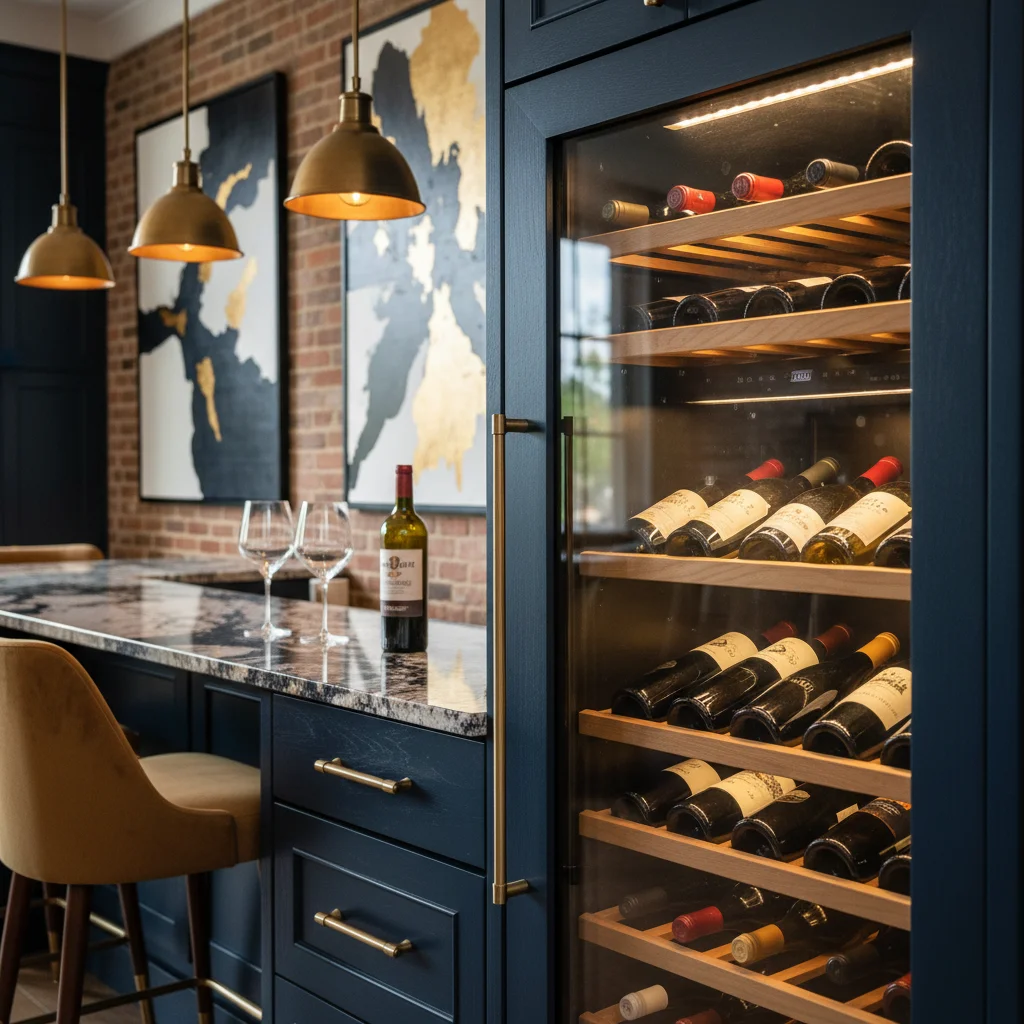
It is a Friday evening in Anthem, you reach into the wine column for something to open, and the bottle near the door is noticeably warmer than the one in back. The display still reads 55, the light is on, the fan is humming — yet the cabinet is no longer holding a single, even temperature top to bottom. That uneven warmth is the early warning, and it is the moment to call, before a slow drift turns into a cabinet full of cooked bottles.
What this page covers
Broomfield’s northwest-metro neighborhoods skew toward larger, kitchen-forward homes — the master-planned streets of Anthem and Broadlands strung along the Boulder corridor, where a full premium kitchen often includes a dedicated wine column or a pair of under-counter drawers. Out here the cooler is rarely something you can roll away from a wall. It is integrated into millwork, sharing a run of cabinetry with a built-in fridge and a range, which means a wine-cooler fault is partly an appliance problem and partly an installation one. We read both.
Faults we see most in Broomfield
- The cabinet drifts off its set point, or a dual-zone runs cold on one side and warm on the other.
- A sensor reads correctly on the display while the bottles tell a different story.
- A glass door fogging, frosting at the evaporator, or pooling water at the base.
- A thermoelectric under-counter drawer that powers up but never pulls down to temperature.
- A new buzz or rattle carrying through the cabinetry, or a unit that short-cycles without reaching target.
In a Broadlands island, a column wedged flush into custom millwork breathes through one narrow grille, so a borderline unit there gives up its temperature margin sooner than the same model standing free.
How we run the diagnosis
- We put a probe in the cabinet and compare the true temperature to the set point, separating a real cooling failure from a sensor lying on the display.
- We check the install — grille clearance and the airflow a flush Anthem or Broadlands cabinet actually allows the unit.
- We test the sealed system and compressor under load, watching how the unit rejects heat at 5,280 feet instead of at the sea-level numbers it was rated for.
- On dual-zone units we diagnose each chamber on its own, since dampers, thermistors, and fans fail one side at a time.
- We inspect the door gasket for the dry-climate shrinkage that lets warm air leak past the seal.
The altitude and water factors
Three Front Range forces sit under most of these failures. At roughly 5,280 feet the air is about 15% thinner, so a condenser sheds less heat than its maker assumed — and inside enclosed Anthem millwork, that lost margin is often the gap between steady cellar temperature and a slow climb. The dry, high-UV air hardens door gaskets early, which is the usual story behind a fogged door and a frosted evaporator. And Broomfield’s hard water, commonly 150 to 250 ppm, scales any line feeding a humidified cabinet and films the condenser over time.
Related work in the same kitchen
A wine cooler usually lives beside the rest of a premium install, and we handle those too: built-in refrigerator columns, under-counter fridge drawers, ice makers fighting hard-water scale, and high-end ranges where altitude shifts gas combustion. One visit can often cover more than the cooler. As an independent shop serving the Denver metro since 2012, we’re not affiliated with any manufacturer.
Schedule a Broomfield visit
Repairs run daily from 8:00 AM to 6:00 PM, and the phone is answered 24/7, so same-day or next-day slots are usually open. Call (720) 770-4189 or book online anytime. The $89 diagnostic brings a technician to your door — Anthem column or Broadlands under-counter drawer — pinpoints the true cause, and credits straight toward the repair the moment you approve it. Up-front pricing, no surprise line items.