Overview
That scene plays out across Broomfield more than you’d think. Up on the ridgelines, Anthem Highlands and the 55-plus Anthem Ranch filled out with the square footage that lets a kitchen stretch into a full premium suite — a wall oven, a wide range, sometimes a stacked oven-and-microwave tower. Down in Broadlands and McKay Landing, the larger Boulder-corridor homes were spec’d much the same way, with the oven flush-set into custom cabinetry beside integrated refrigeration. Along the older blocks near the original downtown, plenty of high-end ovens arrived later, dropped into earlier kitchens during a remodel. Where your oven lives shapes how it fails, and that’s where our visit starts.
Common problems we trace in Broomfield
The complaint usually points straight at the cause:
- The panel signals preheat-complete but the cavity is still cold, so food cooks slow and pale — typically a sensor reading low or an igniter losing its margin
- A gas oven lights late with a faint gas smell and a soft thump — a fading bake igniter
- The oven sails past its setpoint and bakes hot — often a door gasket stiffened by the dry corridor air
- A double-oven tower works on one cavity while the other stays dead — usually that cavity’s element, igniter, or relay
- A self-clean cycle latches and stalls partway through — a strained latch or tripped thermal fuse in a tight, flush install
- A built-in oven flashes a stored fault code you’ve learned to dismiss
Our diagnostic process
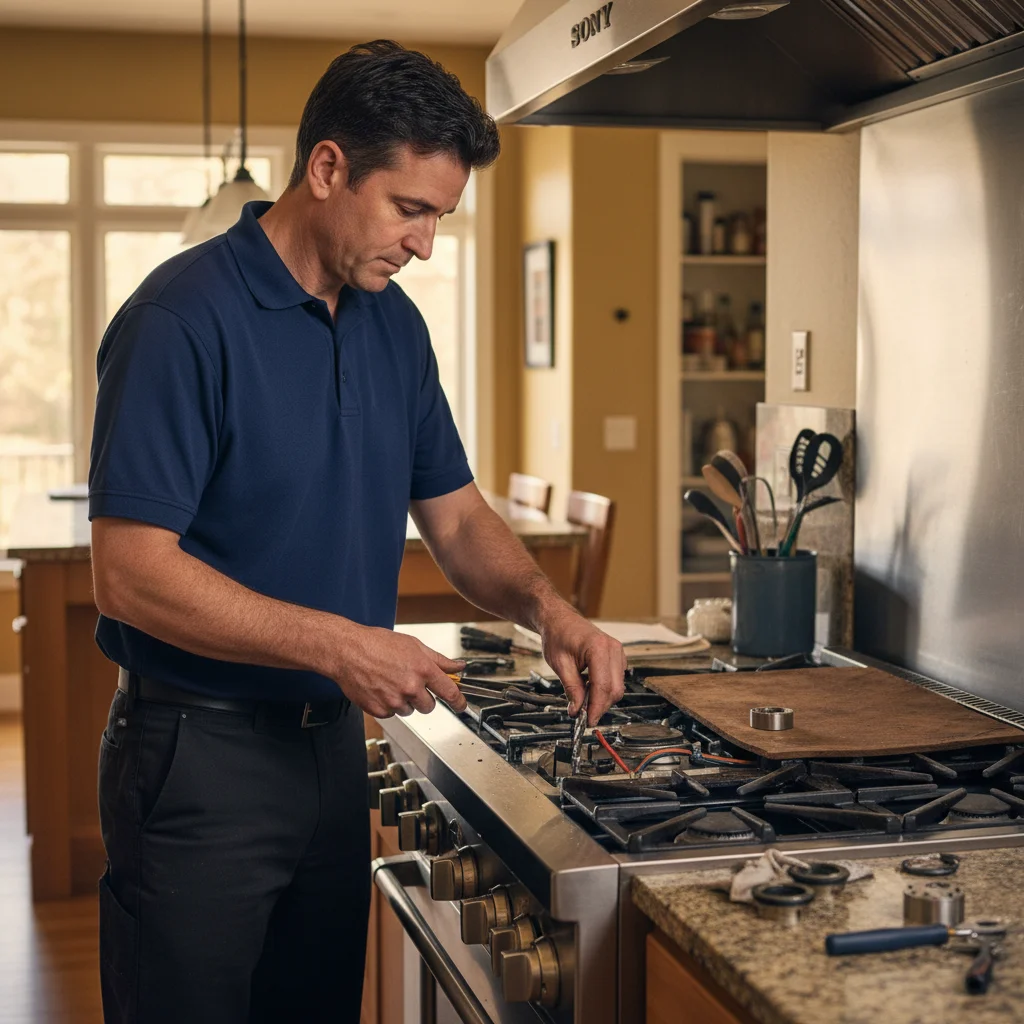
- Reproduce the fault, then read the install. We trigger the symptom first, then look at how the oven breathes inside its cabinetry — a boxed-in Anthem wall oven can cook its own controls and imitate a part failure.
- Measure instead of guess. We read bake igniter draw, sensor resistance, and elements under power, and pull stored fault codes where the model keeps them, enough to separate a real failure from a misread.
- Check the seal and the burn. We test the door gasket for heat leak and, on gas, inspect flame quality for the altitude-rich burn that fakes a hardware fault.
- Quote one firm price. You get the cause in plain language and a single up-front number, surrounding millwork protected, before anything comes apart. The $89 service call covers the inspection and comes off the repair once you approve it.
Denver-specific factors
Broomfield’s setting works against an oven in three quiet ways. The city rides high ground between Denver and Boulder near 5,280 feet, where the air is roughly 15% thinner — so a burner orifice sized for sea level runs rich, throwing yellow flame, soot, and heat that drifts across the cavity. On dual-fuel ranges the electric oven then leans harder on its sensor and fan to compensate, which is why we correct combustion before condemning a part. The dry, high-UV climate ages door gaskets early, letting a flush-set built-in leak heat and run its thermostat ragged. And on the steam-assist features common in newer Anthem and Broadlands ovens, the hard north-metro water — often 150 to 250 ppm — scales reservoirs and supply lines.
Brands and related repairs
We work built-in single and double wall ovens, freestanding and slide-in ranges, dual-fuel and gas units, and the pro-style cooking suites these upgraded kitchens were built around — fitting OEM-grade, manufacturer-compatible igniters, bake and broil elements, sensors, gas valves, and control boards matched to your exact model and serial. Because so many Anthem and Broadlands kitchens set the oven in the same run as built-in refrigeration, if your fridge is drifting warm or an ice maker has scaled up, we can look at both on one visit.
Booking your Broomfield repair
On-site repairs run daily, 8:00 AM to 6:00 PM, and the phone is answered 24/7, so you can call the moment the oven acts up. Call (720) 770-4189 or book online. A technician will reach your Broomfield door — an Anthem wall oven, a Broadlands built-in, or a remodeled kitchen near the original downtown — find the real fault, and quote it honestly, with your $89 service call credited toward the repair.