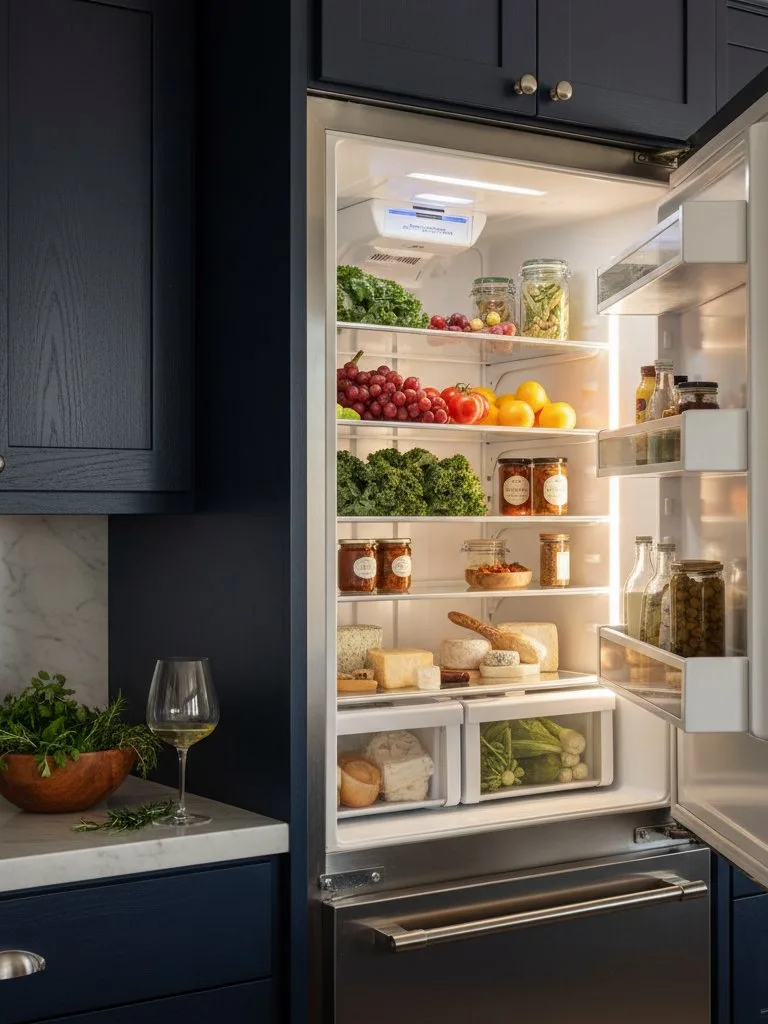
A standalone garage freezer and the freezer built into an Anthem kitchen are two different machines wearing the same name. The garage box is a single insulated cabinet with one job. The built-in along the Boulder corridor is a temperature zone inside a coordinated premium refrigeration suite — paired with a fridge column, tied into the home’s water line, often flush with custom cabinetry and reachable only from the front. When that kind of unit drifts warm, you can’t just unplug it and shove in a spare. That’s the gap this page is about.
What the repair actually involves
On a built-in Broomfield freezer, the work is rarely “replace the freezer.” It’s isolating which subsystem failed — the sealed cooling loop, the defrost circuit, the evaporator airflow, or the controls — without disturbing the cabinetry it lives in. We service it as the engineered, front-accessible unit it is: read the data tag, bring the chassis out on its own slides if access requires it, and test the live system rather than swapping parts on a hunch.
What you’re noticing, and what’s behind it
Symptoms in Anthem and Broadlands kitchens tend to land in a few recognizable shapes:
- Compressor runs nonstop, food slowly softens — poor heat rejection: a clogged condenser, dead condenser fan, or low refrigerant charge.
- Ice building under the drawer or on the compartment floor — a frozen defrost drain backing up meltwater.
- One column cold, the paired freezer zone warm — a stalled evaporator fan or a damper stuck shut.
- Thin, hollow, slow-arriving ice — mineral scale in the fill valve, line, and mold.
- Seal feels loose, edges sweat or frost — a door gasket dried out and shrunk by the climate.
Why an altitude-aware specialist matters here
Broomfield sits high enough that the physics shift. Thinner mountain-corridor air carries away less heat, so a condenser that would coast at sea level runs closer to its limit — wedge it into a tight Anthem cabinet and a borderline charge or a dusty coil tips into failure. The same dry, intense Front Range sun and low humidity stiffen door gaskets early, and the hard local water scales every path the ice maker depends on. A generalist who ignores those three factors fixes the obvious part and leaves the real cause running. We arrive expecting them.
What a visit looks like
- You call (720) 770-4189 (answered 24/7) or book online, and we set a same-day or next-day window.
- The technician confirms the install type — integrated, panel-ready, or freestanding — and notes access.
- We run the $89 on-site diagnosis: internal temperatures, stored fault codes, and a check of the sealed loop, defrost circuit, fans, damper, and gasket together.
- You get a plain explanation and one firm price. Approve it and the $89 credits toward the work, finished with parts matched to your model.
Straightforward pricing
The diagnostic is $89, credited to the repair on approval. We don’t name a repair figure until a technician has the unit open, because a sealed-system leak and a tripped defrost sensor aren’t remotely the same job. Parts are OEM-grade or manufacturer-compatible from verified suppliers. One number, up front, nothing tacked on.
Quick answers before you call
Can you save the food? A packed freezer holds roughly a day once it climbs off zero — call early and we’ll prioritize a thawing load.
Do you cover both the built-in and the garage backup? Yes, often on the same trip.
Serving Broomfield since when? We’ve worked the Denver metro since 2012, Anthem and Broadlands included.
Don’t let a warm freezer become a cleared-out one. Call (720) 770-4189 any hour, or book online — repairs run daily, 8:00 AM to 6:00 PM, with the $89 diagnostic credited toward the fix.