A wine cooler almost never quits all at once. The light still glows, the fan still whirs, and the cabinet that held a steady 55 for years now reads 62 — and every bottle on the rack is warming toward it. In a stocked unit that slow drift is the whole problem, and waiting only raises the cost: a fouled condenser becomes a compressor running itself into the ground, and a small sealed-system leak turns a part swap into a far bigger job. The fix is simple — get a technician in front of the cooler the moment the temperature stops holding, and stop the climb before the rack pays for it.
What you are seeing
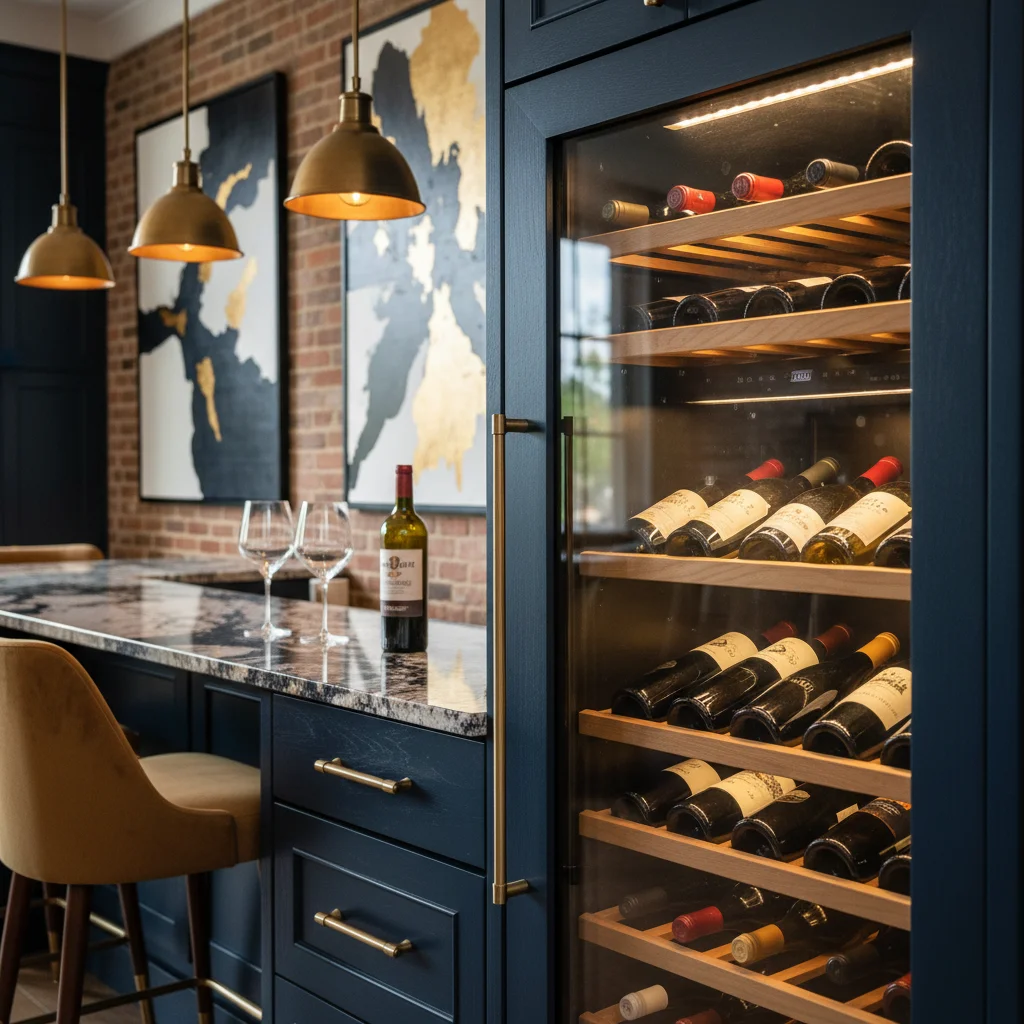
Aurora sprawls from the old core by the Anschutz Medical Campus east past Southlands, and the wine coolers track that spread. Near Fitzsimons and Original Aurora we see freestanding and under-counter units aged into their fan-and-gasket years. Out toward Tallyn’s Reach and Murphy Creek the kitchens skew newer, with built-in columns and panel-ready coolers tucked flush into custom millwork. Different installs, same cluster of complaints:
- The cabinet won’t hold its set point, or one half of a dual-zone runs warm while the other stays right.
- A new hum, rattle, or buzz resonating through cabinetry that used to be silent.
- Frost on the back wall, condensation on the glass, or water pooling at the base.
- A thermoelectric drawer that powers on but never pulls down to temperature.
- Lights work, yet cooling never kicks in — or the unit short-cycles and never reaches its number.
What it usually means
A wine cooler balances three things: a cooling source (a compressor sealed system or a thermoelectric module), a sensing-and-control loop, and an insulated cabinet. A symptom on the glass traces back to one of those, and Aurora’s environment tips the odds.
Heat rejection is the altitude story. At roughly 5,280 feet the air is about 15% thinner, so it carries off less of the heat a compressor has to dump. A dust-packed condenser, a tired fan, or a column wedged into cabinetry with one cramped grille all leave the system fighting to shed warmth — a margin already thin here. That is why an Aurora cooler creeping into the 60s so often turns out to be airflow, not a failed compressor.
Dry air and hard water do the quiet damage. Colorado’s arid climate hardens and shrinks door gaskets, so warm room air bleeds onto cold glass and frosts the evaporator. And Aurora’s hard water, commonly 150–250 ppm, leaves scale wherever a cooler touches a water line.
Our approach
Diagnose the symptom, not the parts catalog
We start with what the cooler is actually doing — climbing, frosting, humming, short-cycling — and read any stored fault codes before touching a screwdriver. That keeps us from swapping a thermistor when the real culprit is a stalled fan or a tired seal.
Account for the install and the altitude
A built-in column out in Southlands is evaluated with its cabinet airflow in mind; a thermoelectric drawer near Anschutz gets its heat sink and ventilation checked first. We weigh the thin-air heat-rejection penalty and the dry-climate gasket wear every time, because a repair that ignores Aurora’s conditions just comes back.
Quote before we open it
After the $89 diagnostic you get the full repair price up front. Approve it and the $89 comes straight off the total; decline and you owe only the diagnostic. Nothing new appears on the bill.
Coverage & brands
We cover Aurora end to end — Anschutz/Fitzsimons, Original Aurora, Heather Gardens, Saddle Rock, Tallyn’s Reach, Southlands, Murphy Creek, and the E-470 builds. We service compressor-driven wine columns, dual-zone coolers, panel-ready built-ins, and thermoelectric drawers across premium and standard brands, using OEM-grade parts matched to your model. Denver Sub-Zero Repair is independent and not affiliated with any manufacturer.
Get it fixed
If your Aurora wine cooler is drifting off temperature, frosting up, or humming where it used to be silent, don’t let the rack ride it out. Call (720) 770-4189 — answered 24/7 — or book online for a same-day or next-day visit. The $89 diagnostic tells you exactly what failed and what it costs to fix.