A dead range has a way of surfacing at the worst moment — a front burner that won’t catch the night before guests arrive in Saddle Rock, or an oven that bakes cold mid-prep for a school event near Southlands. Before you write it off, know this: most range faults are a single worn part, not a dying appliance. Our job is to find which part, explain it plainly, and quote one firm price before a tool comes out. No phone guesses, no swapping components on a hunch.
Quick orientation
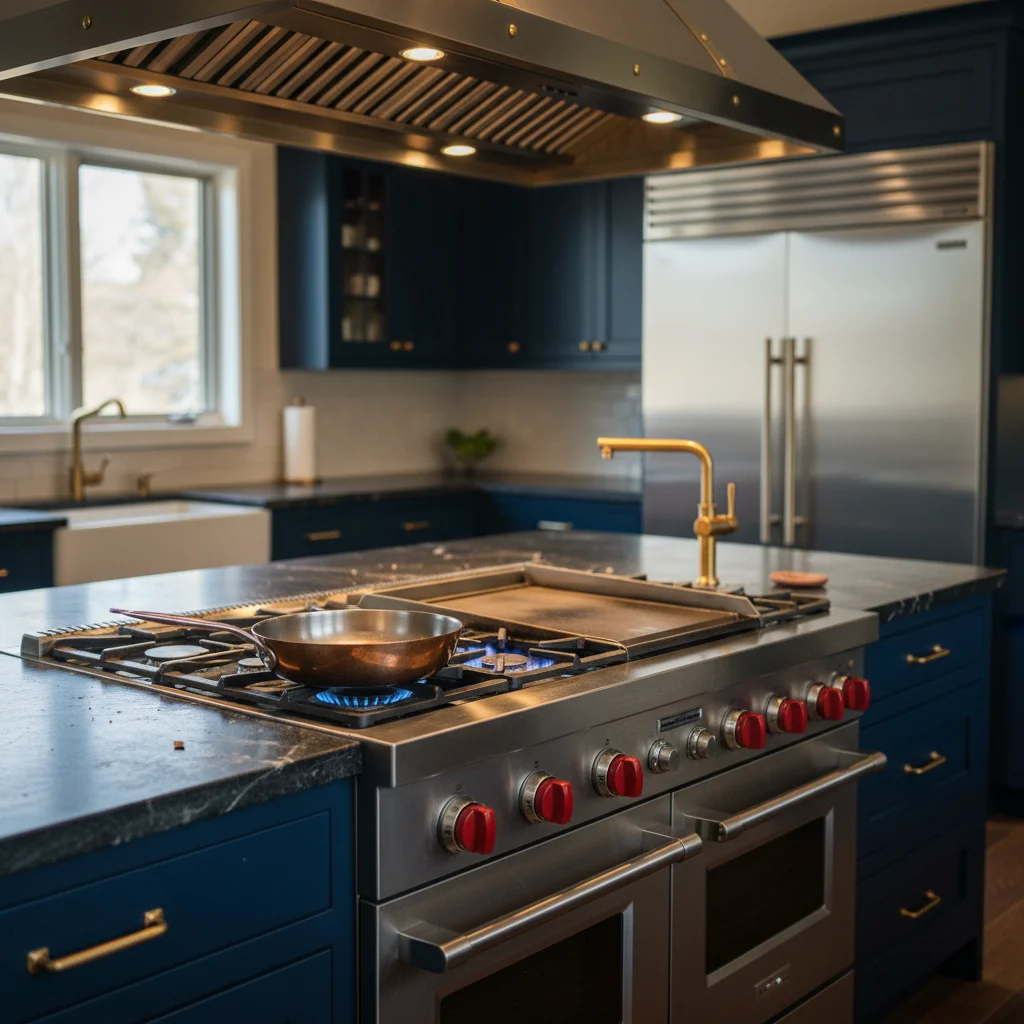
Aurora is large and varied, and so are its kitchens — which is exactly why a generic checklist falls short here. In Original Aurora and the older streets around the Anschutz Medical Campus, we see well-built ranges from the ’90s and 2000s that have aged into worn electrodes, fatigued igniters, and tired relays. Out east toward Tallyn’s Reach, Murphy Creek, and the Southlands-adjacent subdivisions, the homes are newer and the kitchens skew premium: dual-fuel and pro-style ranges with sealed burners, convection ovens, and touch controls. That east-side growth has pushed premium-appliance demand across Aurora upward, and it’s the work we lean into.
A range behaves like two machines sharing one frame — a cooktop above and an oven below — and either half can quit while the other runs fine. Because they often share a board, a gas line, or a spark module, we diagnose the whole unit.
Most common faults
- A single burner won’t light — a clogged port, worn electrode, cracked insulator, or moisture in the switch. Aurora’s thin air narrows the margin a weak igniter has to fire.
- One burner clicks endlessly while the others behave — usually a shorted electrode or a sticking igniter switch, often after a spill works into it.
- A burner won’t hold a low simmer — a gummed or drifting valve, most noticeable on the precise low settings premium ranges are built for.
- The oven half bakes cold or unevenly — a fatigued bake igniter on gas, or a drifting temperature sensor or burned-out element on electric.
- An error code locks the range out — typically the sensor circuit, a stuck door latch, or the control board itself.
- A persistent gas smell even with everything off — we treat this as urgent.
Parts and longevity
Once we’ve isolated the fault, we install OEM-grade and manufacturer-compatible parts from verified suppliers, matched to your exact model and serial. On the parts that decide how long a repair holds — spark electrodes, burner valves, bake igniters, oven sensors, heating and induction elements, and control boards — the correct component for your range is the difference between a fix that lasts and a callback. That matters more on the premium dual-fuel and pro-style ranges common in Tallyn’s Reach and Saddle Rock, where boards and probes aren’t interchangeable across brands and are far too costly to replace on a guess.
The altitude and water angle
Three Front Range conditions shape every Aurora diagnosis, and we check them before pulling a single part:
- Altitude. At 5,280 feet the air is roughly 15% thinner, so a factory-tuned burner runs rich — a lazy, sooty flame — and a marginal bake igniter loses its firing margin. On a range built for sea level, that often means a tuning correction, not a replacement.
- Hard water. Aurora’s supply commonly runs 150–250 ppm, and that scale builds up on any water-fed feature — the lines to a steam oven, a pot filler, or a built-in proofing function.
- Dry, high-UV air. Colorado’s arid climate hardens and cracks oven door gaskets early, so heat leaks and the oven cycles harder, skewing your baking and overworking the thermostat.
Skip any of these and the repair comes back next season, which is why we read the environment into the diagnosis from the start.
How to book
Call (720) 770-4189 any hour — the phone is answered 24/7 — or book online to lock in a same-day or next-day visit anywhere in Aurora, from the Anschutz campus to Tallyn’s Reach. On-site repairs run daily from 8:00 AM to 6:00 PM, the diagnostic is a flat $89 applied toward the repair, and you’ll always have an up-front price before we begin. Independent, and serving the Denver metro since 2012.