A broken oven rarely picks a convenient day. It tends to quit the afternoon before a dinner party in Saddle Rock, or mid-batch when a family near Southlands is baking for a school event. The temptation is to wait — to nurse a few more meals out of an oven that runs cold, takes forever to preheat, or throws an error code you have learned to ignore. That delay almost always costs more than the repair. A gas igniter that has weakened to the point of slow ignition is dumping unburned gas into the cavity on every cycle. A bake element arcing at one end can short the control board behind it. A door seal that no longer closes tight runs the whole oven hot and overworks the thermostat. What starts as a $200-range fix can turn into a control-board replacement if it is left alone. The good news: most Aurora oven problems are entirely fixable, often same or next day, once someone actually diagnoses the root cause instead of swapping parts on a hunch.
What you are noticing
Aurora is a big, varied city, and the ovens in it are just as varied — which is exactly why a generic checklist falls short. In Original Aurora and the older neighborhoods near the Anschutz Medical Campus, we see a lot of well-built ranges from the 1990s and 2000s that have crossed into the age where igniters, elements, and relays wear out. Out east in Tallyn’s Reach, Murphy Creek, and the Southlands-adjacent subdivisions, the homes are newer and the kitchens skew toward premium dual-fuel and built-in wall ovens with convection fans, touch controls, and meat probes — more capability, and more electronics that can drift out of spec. Across all of it, the symptoms people call us about cluster into a handful of patterns:
- The oven won’t heat at all, or heats so weakly that a 350°F bake takes 25 minutes to climb past 200°F.
- Slow ignition on a gas oven — you hear the gas, smell it briefly, then a soft whump as it finally lights.
- Uneven baking, where one side of a sheet pan browns and the other stays pale, or the convection mode no longer circulates evenly.
- The temperature is simply wrong — a cake that scorches at the “right” setting, or a roast that never finishes, pointing at a failing sensor or thermostat.
- An error code on the display (F-codes, E-codes, or a flashing PF) that locks out the oven entirely.
- The oven door won’t lock for self-clean, or the latch jammed and now nothing works.
- A persistent gas smell even when the oven is off, which is a safety issue we treat as urgent.
If any of those sound like your kitchen, the underlying cause is usually one of a dozen well-understood failures — and the Aurora-specific factors below change which one is most likely.
What it usually means
An oven is really three systems stacked together: a heat source (an electric element or a gas burner fed by a safety valve and igniter), a sensing-and-control loop (a temperature probe, a thermostat, and a control board that cycles the heat), and a sealed cavity (door, hinges, and gasket) that holds that heat steady. A symptom on the surface almost always traces back to one of those three, and Aurora’s environment nudges the odds.
On gas ranges and dual-fuel ovens, ignition is the usual suspect — and altitude makes it worse. Aurora sits at roughly a mile above sea level, where the air carries about 15% less oxygen than it does at the coast. Less oxygen means combustion is less forgiving, so a bake igniter that has weakened with age — drawing too little current to reliably open the gas valve — crosses the line into slow or failed ignition sooner here than the same part would in a low-altitude city. The factory orifice sizing on ranges built for sea level can also run slightly rich at this elevation, which fouls igniters and burner ports faster. When an Aurora customer tells us the oven takes three or four tries to light, or lights with a noticeable thump, the igniter is the first thing we measure, with the gas valve and orifices right behind it.
On electric and dual-fuel ovens, it is usually the element, the sensor, or the board. A bake or broil element that has burned through, blistered, or arced at one end is the most common no-heat call. Uneven results and “wrong temperature” complaints more often come from a failed oven temperature sensor (an RTD probe whose resistance has drifted) or a thermostat that no longer cycles accurately. Error codes typically point at the sensor circuit, a stuck door latch, or the control board itself — and a board that keeps failing is sometimes the victim of an element that has been arcing against it for weeks, which is exactly why waiting is expensive.
Aurora’s dry air and hard water quietly attack the cavity and the cooktop. Colorado’s climate is genuinely arid, and that dryness hardens and cracks oven door gaskets faster than humid regions, so heat leaks out and the oven runs hot to compensate — wearing the thermostat and skewing your baking. On the supply side, Aurora’s water tends to run hard, commonly in the 150–250 ppm range, and while that scale is most famous for clogging dishwashers and ice makers, it also leaves mineral buildup on range-top burner caps and on any steam or proofing features built into higher-end ovens. We factor all of this in, because a repair that ignores the climate is a repair that comes back next season.
How we approach an Aurora oven repair
A diagnosis that starts with the symptom, not the parts catalog
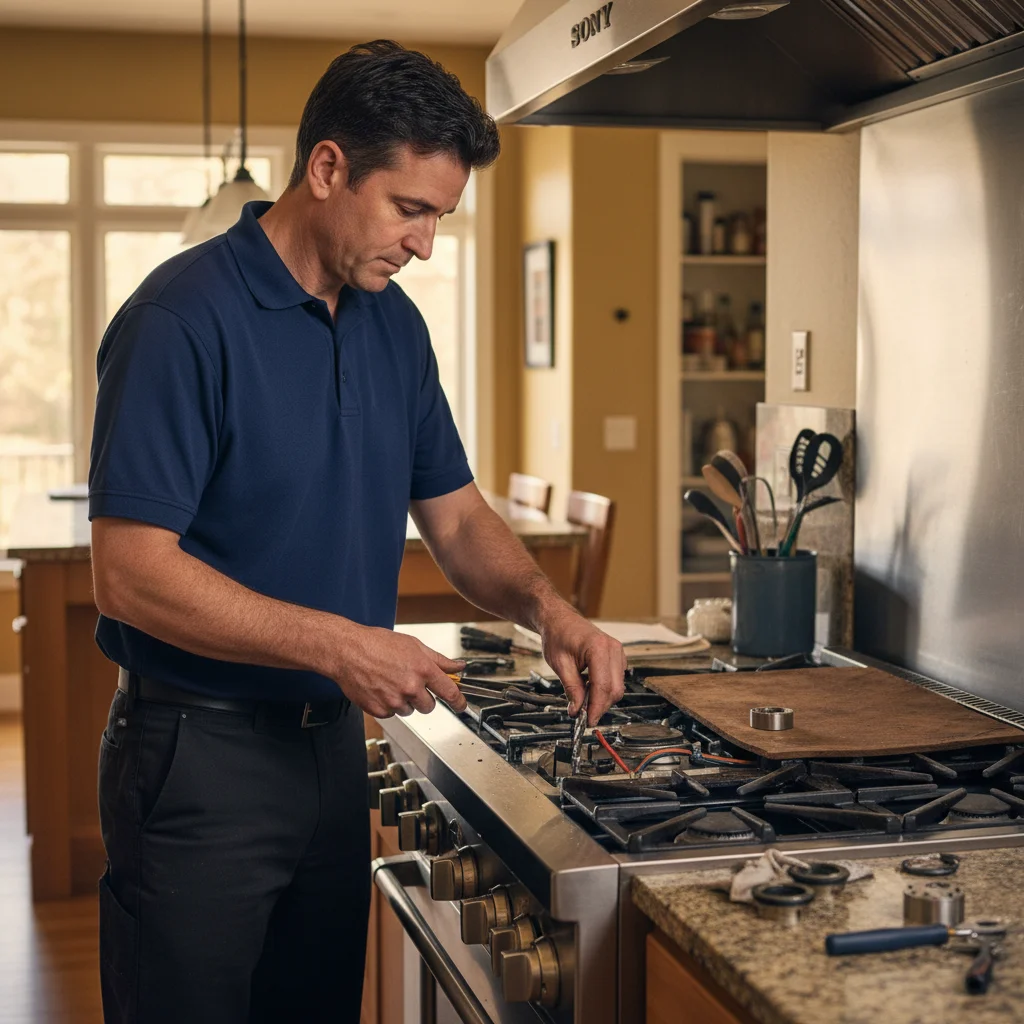
When the technician arrives, the first job is to reproduce and confirm what you are seeing, then read any stored fault codes off the control board. From there we work the system in order — heat source, then sensing-and-control, then the cavity — measuring rather than assuming. On a gas oven that means checking the igniter’s actual current draw against spec, confirming the safety valve opens, and inspecting the orifices and burner ports for the fouling that altitude-rich combustion encourages. On an electric or dual-fuel oven it means testing the element for continuity and grounding, checking the temperature sensor’s resistance, and verifying the board is sending and seeing the right signals. The $89 service call covers this full inspection.
Up-front pricing before any work begins
Once we know the real fault, you get a plain-English explanation and an exact price — before we touch a tool. There is no menu of mystery fees, and the $89 diagnostic is credited toward the repair if you choose to proceed. Because oven faults span everything from a $150 igniter to a control board, we quote only after the inspection rather than guessing over the phone. That is the honest way to price a repair, and it protects you from paying for a part that was never the problem.
The right part, matched to your model
We install OEM-grade and manufacturer-compatible parts from verified suppliers, matched to your specific oven. For the components that determine whether a repair lasts — igniters, bake and broil elements, gas valves, temperature sensors, door latches, and control boards — the correct part for your exact model is what keeps you from calling again in six months. For premium built-in wall ovens common in Tallyn’s Reach and Saddle Rock homes, that model-specific sourcing matters even more, because their boards and probes are not interchangeable across brands.
Work scheduled around Aurora, daily
Repairs run every day from 8:00 AM to 6:00 PM, and because the phone is answered 24/7 you never have to wait for business hours to get on the calendar. We cover the whole city, so whether you are near Fitzsimons and the medical campus, out by the Southlands shopping district, or in one of the newer builds climbing toward E-470, we route a technician to you — typically same or next day.
Coverage and the brands we service
We repair ovens and ranges throughout Aurora, including the Anschutz/Fitzsimons area, Original Aurora, Hampden and Mission Viejo, Heather Gardens, the Saddle Rock and Tallyn’s Reach neighborhoods, Murphy Creek, and the growing subdivisions out along Southlands and E-470. As that east side keeps filling in with higher-end kitchens, premium-appliance demand in Aurora has climbed, and we have leaned into exactly that work.
On the equipment side we handle electric, gas, and dual-fuel ranges; built-in single and double wall ovens; and convection, steam-assist, and self-clean models. Brands we routinely service include Wolf, Sub-Zero’s companion Wolf ranges, Thermador, Viking, Miele, Gaggenau, Dacor, Bosch, JennAir, KitchenAid, Monogram, Fisher & Paykel, Frigidaire, GE, Whirlpool, and Samsung — bringing brand-specific knowledge to each instead of a one-size-fits-all approach.
A quick note on independence: we are not affiliated with, endorsed by, or sponsored by Sub-Zero Group, Inc. or any oven manufacturer. We are an independent Aurora-area repair service that has worked the Denver metro since 2012.
Get your Aurora oven fixed
If your oven is running cold, baking unevenly, refusing to ignite, or flashing a code, the cheapest moment to fix it is now — before a borderline part takes the control board with it. We will diagnose the actual cause, quote an up-front price, and use the right OEM-grade parts for your model, with the $89 service call applied to the repair.
Call (720) 770-4189 any time — the phone is answered 24/7 — or book online to lock in a same-day or next-day visit anywhere in Aurora, from Anschutz to Tallyn’s Reach.