Why a Thermador refrigerator drifts off temperature
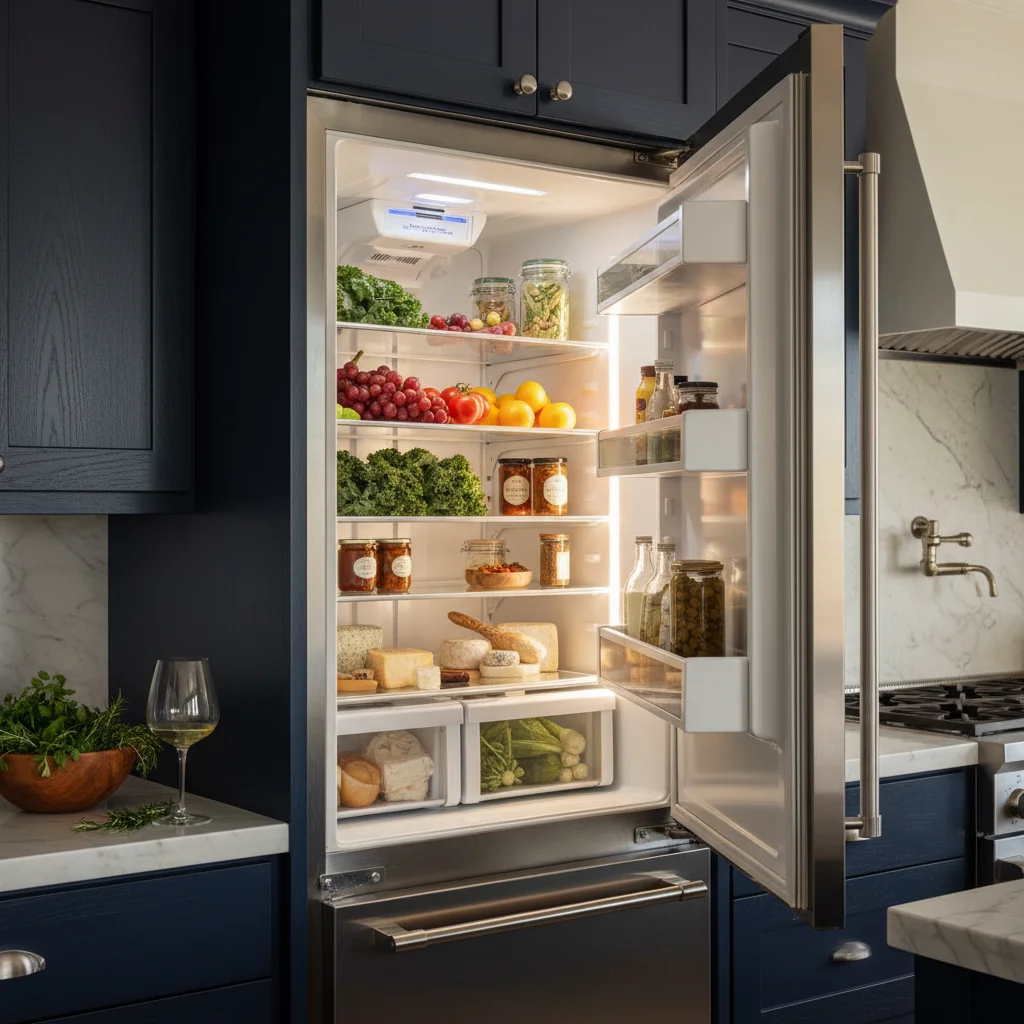
Thermador refrigeration is built around a modular idea: instead of one cabinet doing everything, you assemble a wall of Freedom columns — a refrigerator here, a freezer there, maybe a wine column between them — each one a largely self-contained machine sunk flush into the cabinetry. That design is wonderful for kitchens and slightly unusual for repair, because a single column carries its own compressor, evaporator, electronic control, and airflow path. When something goes wrong, the failure is almost always local to one column and one part inside it, not a vague whole-system collapse.
The flip side of all that precision is that the symptom you notice often sits a layer above the part that failed. A column that “runs warm” might be losing cold because its evaporator fan slowed, because the defrost cycle quit and ice choked the coil, because an air diffuser flap stuck, or because the sealed system lost charge. Those are four different repairs with four different prices, and they feel identical from the outside. That is the entire reason we diagnose deliberately rather than reach for the obvious board: on equipment engineered to run fifteen or twenty years, the expensive mistake is replacing a control when a $40 sensor or a stuck damper was the true cause.
Denver factors come first, not as an afterthought
This is where servicing a Thermador refrigerator in Denver genuinely diverges from servicing one near the coast, and it is exactly what an out-of-town dispatch tech tends to miss. Our altitude, water, and dry air all act on refrigeration in concrete ways, so we fold them into the diagnosis from the first minute.
Thinner air at 5,280 feet. Denver’s atmosphere is roughly 15% less dense than at sea level, and a refrigerator sheds its heat into that air. The condenser’s whole job is to reject the heat the compressor pulls out of the box, and thinner air carries heat away less efficiently. A sealed system that was comfortably within spec at a lower elevation can sit closer to its limit here, which means a marginal condenser fan, a dust-clogged condenser, or a slightly low charge shows up as warm-running and long cycles sooner than it would near sea level. On Thermador columns, where the condenser and electronics are packed tightly behind a flush installation, that margin matters even more — we check head pressure, airflow, and fan behavior against altitude rather than against a sea-level baseline.
Hard water, roughly 150 to 250 ppm. Much of the metro runs hard, and that mineral load goes straight after anything that touches water. On a Thermador refrigerator that means the ice maker’s inlet valve, the ice mold and harvest mechanism, the dispenser line, and the water filter housing. Scale builds gradually and quietly, so it is easy to ignore until the ice slows to a trickle, the cubes come out hollow or cloudy, or a line seeps. Whenever we work on an ice-making or water-dispensing column, we inspect the full water path and flag a sensible filter-and-descale interval for local water instead of just changing the part in front of us.
Very dry air. Denver’s low humidity is hard on rubber, and refrigerator gaskets pay the price. The magnetic door seal on a built-in or integrated column has to seat fully against the cabinet to hold cold air in; our dry climate stiffens, shrinks, and cracks that gasket years ahead of schedule. A seal that no longer closes cleanly lets warm, moist room air leak in, which raises run time, invites condensation and frost, and can mimic a cooling fault that is really a $0-refrigerant gasket problem. We check seal contact on every refrigeration call because here it fails early and often.
Strong UV and a punishing dry-cold winter round out the local picture, accelerating wear on exposed trim and any externally routed components. None of this is exotic — it is simply Colorado, and building it into the diagnosis is what an altitude-aware specialist offers that a national call center cannot.
How we diagnose a Thermador refrigerator
Our method is deliberate by design. On modular refrigeration, guessing is expensive, so we work the unit in a fixed order and only name a cause once the evidence agrees.
- Confirm the real symptom. We measure actual compartment temperatures rather than trust the door display, and we separate “warm fridge, cold freezer” from “both warming” from “freezing food in the fresh-food zone.” Each points at a different system.
- Identify the column and its system. Because Freedom units are modular, we first establish which column is misbehaving and whether its sealed system is one independent loop or shares logic with a neighbor. This alone rules out half the possible causes.
- Read what the unit reports. We pull stored fault codes, check sensor and thermistor resistance against spec, watch the evaporator and condenser fans, and verify the defrost cycle actually runs and clears the coil.
- Work the airflow and sealed-system paths. We trace cold air from evaporator to diffuser to the compartment, check the damper, and inspect the condenser and compressor behavior — head pressure, current draw, and frost patterns tell us whether a charge or restriction problem is hiding underneath.
- Check the water path on ice and dispenser models. Inlet valve, lines, filter, and ice assembly get inspected for the hard-water scale that is so common here.
- Quote one up-front price. You hear the cause, the part, and the total before any wrench moves. Nothing proceeds without your okay, and the $89 diagnostic folds into that total if you go ahead.
Components we service on Thermador refrigeration
Every call is its own puzzle, but the faults below recur often enough that an experienced tech can usually narrow the field before a panel comes off. Across Freedom columns, built-ins, and bottom-freezer units, these are the parts and complaints we handle most:
- Evaporator and condenser fan motors — a slowed or seized fan is a leading cause of a column that runs warm or struggles to recover after the door is opened; the condenser fan especially fights Denver’s thin air.
- Defrost system — defrost heaters, thermostats, and timers/control logic that, when they quit, let the evaporator coil ice over until airflow chokes and the compartment warms.
- Thermistors and temperature sensors — a sensor reading out of range makes the control run the system wrong; we test resistance rather than assume, and we check the connector, since a corroded contact mimics a dead sensor.
- Air dampers and diffusers — the flaps that meter cold air between zones; a stuck damper produces warm spots or a compartment that overcools.
- Control, inverter, and power boards — verified against the actual circuit before replacement, never assumed to be the fault just because a code appears.
- Sealed-system issues — low charge, restrictions, or compressor faults, diagnosed against altitude-adjusted expectations rather than a sea-level baseline.
- Door gaskets and hinges — the dry-climate failure described above, plus sagging doors on heavy column units that no longer self-close.
- Ice makers and water systems — inlet valves, fill tubes, ice molds, dispenser lines, and filters, with the hard-water scale check Denver demands.
- Lighting, display, and control-panel quirks — dark LED lighting, unresponsive touch controls, or display segments that have failed.
Parts that respect the lifespan
A Thermador refrigerator is built to anchor a kitchen for fifteen to twenty years, and a proper repair should honor that. We install OEM-grade and manufacturer-compatible parts from verified suppliers, matched to your exact model and serial number where it matters most — fans, defrost components, sensors, boards, dampers, gaskets, and water-system parts. A bargain fan or off-spec sensor might run fine for a week and put you back on the phone by the next holiday; a correctly matched part is what keeps a fix from boomeranging. Repairing the true cause matters just as much: if a sensor reads high because its connector corroded, we address the connector too, because replacing the sensor alone is only a patch.
Same-day scheduling across the Denver metro
Getting a Thermador refrigerator looked at is quick, and when a column has stopped cooling we treat it as urgent.
- Call (720) 770-4189 — answered 24/7, so you reach a real person whenever it suits you. Repairs themselves run daily from 8:00 AM to 6:00 PM.
- Or book online through the scheduler and pick a window that works for you.
- Meet the technician, who diagnoses the real cause on site and gives you a firm, up-front price. The $89 service call covers that visit and is credited toward the repair if you proceed.
We are an independent repair company — not affiliated with, endorsed by, or sponsored by the manufacturer. What we bring instead is brand-specific experience with Thermador refrigeration, parts matched to your model, and altitude-aware diagnostics from a team that has serviced premium appliances across the Denver metro since 2012. You get same-day or next-day scheduling, a genuine diagnosis instead of a parts-cannon approach, and pricing you approve before any work begins.
Whether your Freedom column is running warm before a holiday, a built-in is frosting over, the ice maker has slowed to a crawl on Denver’s hard water, or a door gasket has finally given up in our dry air, we will find what actually failed and tell you the price before we fix it. Call (720) 770-4189 or book online to get your Thermador refrigerator back to temperature.