What this repair actually involves
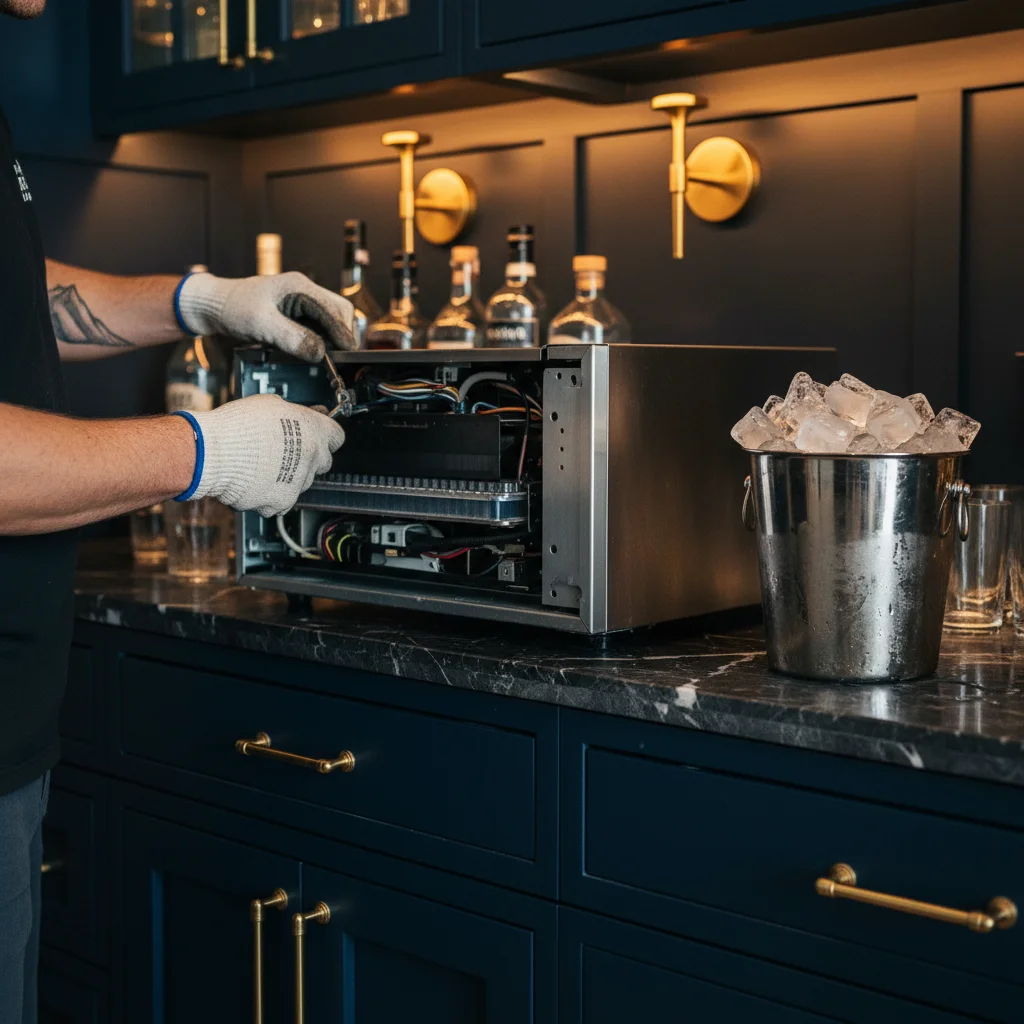
An ice maker is not a simple add-on. Inside a Sub-Zero, it’s a small, tightly choreographed water machine: a valve meters a measured slug of water into a chilled mold, the refrigeration side freezes it on a timed cycle, a heater briefly warms the mold to release the cubes, and a motor sweeps or drops them into the bin before the whole sequence repeats. Every stage depends on the one before it being exactly right. Too little water and you get hollow cubes; too slow a fill and the tube can freeze; a weak harvest and the cycle jams with finished ice still stuck in place.
That sequencing is why an ice maker fails differently from, say, a fan or a light. The symptom you see — no ice, bad ice, a puddle — is the end of a chain, and the real fault usually lives a step or two upstream. Fixing it well means following the water and the cycle in order rather than reacting to the symptom. That’s the whole job: figure out which link broke, replace that link, and let the rest of the well-built machine keep doing what it was designed to do.
We’re an independent repair service for the Denver metro, working on these units since 2012. We are not affiliated with, endorsed by, or sponsored by Sub-Zero Group, Inc. What we bring is brand-specific habit: knowing how Sub-Zero feeds, freezes, and harvests ice, where it tends to scale up, and how those tendencies get worse a mile above sea level.
How Sub-Zero builds the ice maker
A few design realities shape almost every ice-maker call we take:
- Metered water fill. A water inlet valve admits a precise volume per cycle. The cube size and quality are only as good as that fill, so anything that throttles the water — a stiff valve, a clogged filter, a scaled tube — immediately shows up in the ice.
- Timed freeze and harvest. The mold freezes on a schedule, then a small heater warms it just enough to break the cubes loose so a motor can eject them. If the harvest stage is weak or mistimed, ice piles up mid-cycle.
- Filtered water path. Many models pull through a replaceable water filter. A spent or partially blocked filter starves the maker and is one of the most overlooked causes of “it just makes less ice now.”
- Integrated controls. The ice routine is managed alongside the refrigerator’s controls, so a sensor or board fault can stop ice without the rest of the fridge missing a beat — which is exactly why a careful read of what’s happening matters before any part is condemned.
- Bin-level sensing. A sensor or arm tells the maker when the bin is full so it stops. When that sensing misreads, you can get a maker that quits early or one that overflows.
Knowing that chain is most of the diagnosis. The rest is knowing how Denver’s water and air lean on each stage.
Symptoms and what’s usually behind them
Sub-Zero ice makers tend to fail in recognizable patterns. Here’s what we see most across built-in columns, side-by-side units, and under-counter ice and refrigerator drawers:
- No ice at all. The big-ticket symptom. Common causes are a failed or fully scaled water inlet valve, a frozen fill tube, an exhausted filter choking flow, a bin sensor or arm stuck in the “full” position, or a control fault that stopped calling for a cycle. We verify there’s water reaching the mold before assuming the maker itself is dead.
- Small, hollow, or undersized cubes. Almost always an underfill. The mold isn’t getting its full charge of water, usually from a partly clogged valve, a restricted filter, or scale narrowing the fill path. In Denver, scale leads this list.
- Cloudy or off-tasting ice. Tied to water quality — dissolved minerals and an old filter. The fix is in the water path, not the freezing mechanism.
- Ice maker jams with cubes still stuck. A harvest-stage problem: the mold heater, the harvest thermostat, or the ejector motor isn’t releasing and clearing the finished batch. The maker freezes the next fill on top of the old one and locks up.
- Slow production. Often a borderline water restriction or a refrigeration/airflow issue keeping the mold from reaching freeze temperature on time. Slow output is frequently scale in its early stage — worth catching before it becomes “no ice.”
- Leaking or overflowing. A cracked or misaligned fill tube, a valve that won’t fully close and keeps dribbling, a frozen line backing up, or a bin-level fault that lets the maker keep running. Water on the floor warrants shutting the unit off until it’s looked at.
- Loud grinding or clicking during harvest. A worn ejector motor or gear, or cubes fused together because a previous fill was off. New noise on a normally quiet Sub-Zero is a real signal.
Diagnosing it in the right order
The reason a specialist matters here is that several of these symptoms share a cause, and several causes produce the same symptom. “No ice” can be a $0 reset of a flipped bin arm or a scaled inlet valve or a control fault — and you cannot tell which from across the room. So the work runs in sequence: confirm water is arriving and at what volume, check the filter and valve, inspect the fill tube for ice or scale, watch a freeze-and-harvest cycle if time allows, and read any stored fault information from the controls before touching the expensive parts. Replacing a control module on a maker that simply has a clogged filter is exactly the kind of mistake we’re built to avoid.
Why brand and altitude knowledge changes the diagnosis
This is where a Denver Sub-Zero ice-maker call genuinely differs from a generic appliance fix, and it’s the part most general shops gloss over.
Hard water, 150–250 ppm — the dominant factor. The Front Range runs mineral-rich water, and an ice maker is the appliance component that suffers most from it. Every cycle pulls fresh water through the valve, filter, and fill tube, and every cycle leaves a little more scale behind. That scale narrows passages, slows the fill, and pushes cube quality down long before the maker stops outright. The same “no ice” symptom that means a dead motor in humid, soft-water regions very often means scale here — so we inspect the water path specifically against Denver’s chemistry instead of assuming the mechanism failed.
Thinner air at 5,280 feet. Denver’s air is roughly 15% less dense than at the coast, and a refrigerator rejects heat by moving air across its condenser. Ice makers need the mold to hit freeze temperature on schedule, and a system that’s even slightly down on heat rejection — a dusty condenser, a tired fan — reaches that temperature more slowly here than the identical unit would at sea level. The result is slow or short-cycling ice that looks like an ice-maker fault but is really an altitude-stressed cooling issue. We account for that rather than chasing the maker when the cooling side is the actual constraint.
Very dry climate. Denver’s low humidity hardens rubber and seals faster than damp regions do. On the ice system that shows up at fittings, grommets, and the fill-tube connection, where a stiffened, shrunken seal can start to weep or let a line shift out of position — turning a quiet drip into the puddle you eventually notice on the floor.
Put together, these three pressures mean an honest Denver diagnosis isn’t the same as a generic one. A fix that ignores scale, altitude, and dryness is the fix that comes back next summer. Avoiding that for you is the entire point.
What a service visit looks like
The visit is deliberately methodical. A technician confirms the symptom with you, then works the ice maker the way it actually operates — water in, freeze, harvest, eject — rather than guessing. In practice that means:
- Verify the water supply and fill volume. Is water reaching the mold, and is it getting the full metered charge? An underfill found here explains most hollow-cube and slow-ice complaints on the spot.
- Inspect the filter, valve, and fill tube. This is where Denver scale and ice blockages hide. A clogged filter or a partly seized valve is a common, fixable root cause.
- Check the harvest stage. Heater, thermostat, and ejector motor — the parts responsible for releasing and clearing cubes — get checked when the symptom points to a jam.
- Read the controls and sensors. Bin-level sensing and any stored fault data are reviewed before a control board is ever blamed, because boards are the costly part and rarely the real failure.
- Explain it plainly and quote one price. You hear what failed, why, and exactly what the repair costs — agreed before any work starts.
The on-site diagnostic is a flat $89, and it’s applied straight to the repair if you go ahead.
Parts and keeping the next failure away
A Sub-Zero is an investment appliance, and on the ice system the parts decision is what separates a repair that holds for years from one that returns in a few months. We use OEM-grade and manufacturer-compatible parts from verified suppliers, matched to your exact model on the components that carry the load — water inlet valves, filters, fill tubes, harvest thermostats, ejector motors and gears, bin sensors, and control modules.
A few longevity notes specific to ice makers in Denver:
- The filter is the real maintenance item. In hard water it’s the first line of defense, and it’s also the most ignored. A fresh filter on a sensible schedule prevents a surprising share of slow- and no-ice calls.
- Scale is progressive. Slow ice today is often the early warning of no ice in a few months. Catching and clearing scale at the valve and fill tube early is cheaper and less disruptive than waiting for a full stop.
- Harvest parts are wear parts. The motor and gears that eject cubes do mechanical work every cycle, so on a long-lived unit they’re a reasonable thing to eventually renew — and far cheaper than a whole new assembly.
- Boards are rarely the first answer. Sensors, valves, and water restrictions impersonate control failures constantly. Reading the diagnostics before replacing a board saves you money and keeps a healthy part in the machine.
Because the refrigeration and cabinet are built to last, the right ice-maker part installed correctly usually means the unit goes back to making clean, full cubes for a long stretch — which is exactly what you bought a Sub-Zero for.
Common questions, answered quickly
Is it worth repairing an older Sub-Zero ice maker? Usually yes. These units are designed to be serviced and to last, so a targeted part replacement is typically far more sensible than replacing the appliance — especially when the root cause is something as ordinary as Denver scale.
Can I just descale it myself? You can keep the filter fresh, which helps a lot. But once scale has reached the valve or fill tube, or once the harvest stage is involved, it’s a hands-on diagnosis to find and clear safely without forcing a part.
Why does my ice taste like the freezer? Stale ice and an old filter. Fresh ice and a current filter usually fix it; if not, the water path is worth checking.
Book your repair
Getting a Sub-Zero ice maker looked at is simple, and we keep the pricing transparent from the first call.
- Call (720) 770-4189 — answered 24/7, so a real person is on the line any time, day or night.
- Book online at https://nexfield.pro/crm/book?u=33 in a couple of minutes.
- Repairs run daily, 8:00 AM to 6:00 PM, with same-day or next-day appointments across the Denver metro.
- The diagnostic is a flat $89, applied toward the repair, with the exact repair price quoted only after an on-site inspection.
If your Sub-Zero has stopped making ice, is turning out hollow cubes, is leaking, or is grinding through its harvest cycle, the sooner we trace the water path the smaller and cheaper the fix tends to be. Call (720) 770-4189 or book online, and let’s get your ice maker back to making full, clear cubes the way Sub-Zero intended.