What ice maker repair actually involves
Most appliances either hold a temperature or run a motor. An ice maker does something stranger: it meters a precise slug of water, freezes it on a schedule, then physically harvests and ejects it — over and over, hundreds of times a day. That means a single unit combines a water-supply circuit, a freeze stage, and a mechanical harvest into one tightly timed loop. When any link slips, the whole cycle stalls, and the symptom you see at the bin rarely tells you which link failed.
That is why ice maker work is its own discipline rather than a footnote to refrigerator repair. A fridge can warm up for half a dozen reasons; an ice maker can fail for two dozen, and many of them sit upstream in plumbing the freezer never touches. We follow the water from the household line through the inlet valve, fill tube, mold or evaporator plate, harvest mechanism, and bin sensor — and we test each stage rather than condemning the obvious part first.
We routinely service in-freezer cube makers in built-in refrigerators, in-door dispensing systems, under-counter clear-ice and nugget machines, and dedicated production units. Each harvest design behaves differently, so the diagnostic path changes with the module.
Symptoms and what usually causes them
Ice makers tend to announce trouble in a handful of recognizable ways. Here is how the common complaints map to real failure points:
- No ice at all — a closed or scaled water inlet valve, a frozen fill tube, a tripped or failed thermostat, a stuck harvest motor, or a control module that has stopped cycling.
- Small, hollow, or partial cubes — restricted water flow, almost always from mineral scale in the valve or a fill tube that is partly iced over. Low line pressure can mimic it.
- Cloudy, white, or bad-tasting ice — dissolved minerals from hard water, a saturated water filter past its life, or biofilm in the reservoir and supply tubing.
- Ice maker freezes into a solid block — a failed harvest cycle, a stuck thermostat, or a heater that is not warming the mold enough to release cubes.
- Slow production — scale narrowing the water path, a marginal sealed system on a clear-ice machine, or a freezer that is not cold enough to keep up.
- Water leaking or pooling — a cracked or loose water line, a stuck-open inlet valve, or a misaligned fill cup overshooting the mold.
- Loud grinding or clicking on harvest — a worn harvest motor, gear, or ejector arm binding against ice that did not fully release.
The thread running through most of these is water chemistry. Denver’s supply is hard — frequently 150 to 250 ppm of dissolved minerals — and an ice maker concentrates whatever is in that water as it freezes. Scale plates out on valves, fill tubes, and freeze surfaces, narrowing passages a little more each month until cubes shrink and cycles drag. We see scale-driven failures here on a timeline that would take far longer in a soft-water city.
Why a specialist matters at this altitude
Two things about the Front Range change how an ice maker behaves, and both reward a technician who knows to look for them.
The first is hard water, covered above — it is the single biggest driver of ice maker faults in this region, and it hides in places a quick look misses, like the inside of a fill tube or the seat of an inlet valve.
The second is altitude. At 5,280 feet the air is roughly 15% thinner than at sea level, which changes how any refrigeration system rejects heat. On standalone clear-ice and nugget machines — which run their own sealed refrigeration loop — that thinner air means the condenser sheds heat less efficiently, so a unit that is even slightly dusty, low on charge, or short on airflow falls behind on production here before it would elsewhere. Denver’s very dry air also hardens the gaskets and seals around freezer compartments faster, which can let warm air creep in and slow the freeze stage. A specialist factors all of this into the diagnosis instead of treating a Denver ice maker like a sea-level one.
Just as important, a specialist resists the temptation to swap the whole ice maker module — often the most expensive part — when the real fault is a $40 valve or a fill tube that needs thawing and descaling. Diagnosing the actual failure point is what keeps the repair honest and the cost down.
What a service visit looks like
When a technician arrives, the goal is to find the true cause once, not to chase symptoms. A typical visit runs like this:
- Confirm the symptom and the model. Cube quality, production rate, leaks, and noises each point in different directions, and the harvest design varies by unit.
- Read any stored fault codes. Many premium ice makers and the refrigerators housing them log errors that narrow the search immediately.
- Trace the water path. We check line pressure, the inlet valve, the fill tube, and the filter — the upstream causes behind most “no ice” and “small cube” calls.
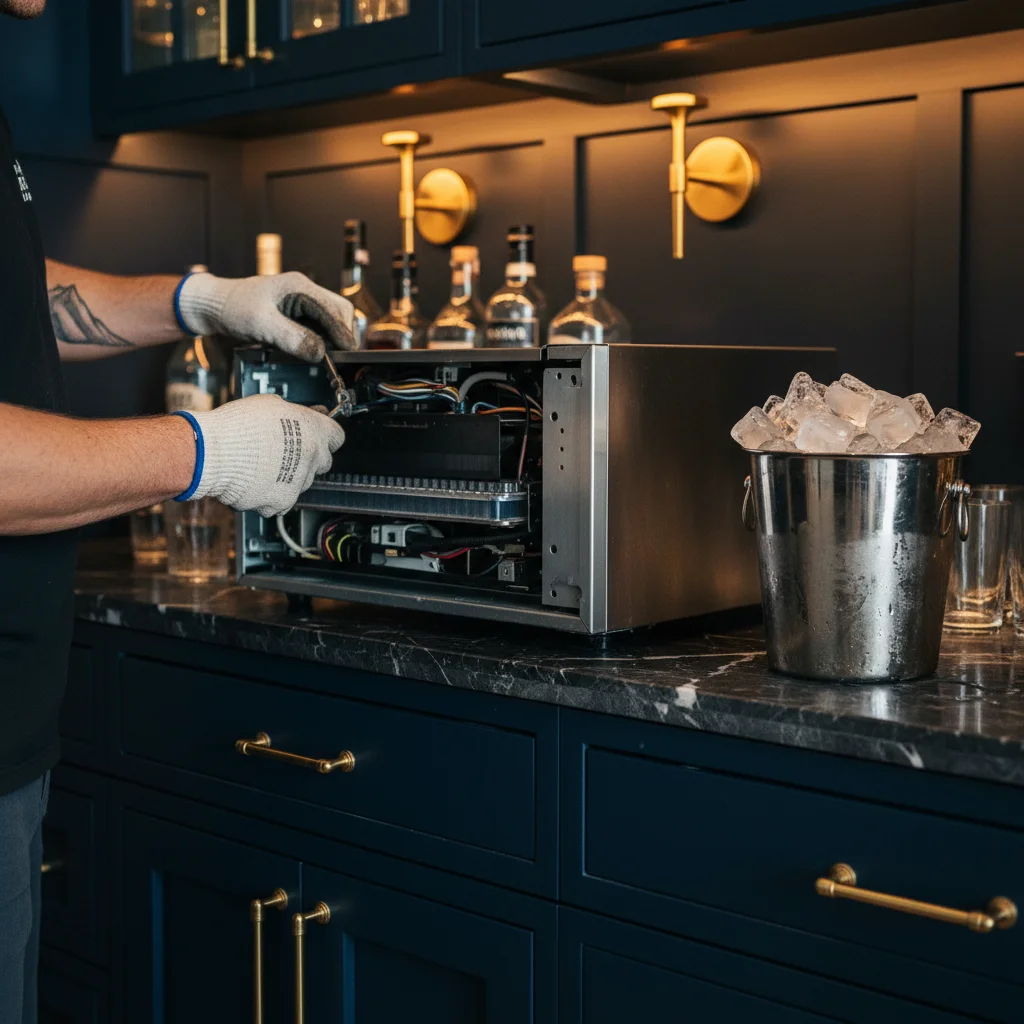
- Test the freeze and harvest stages. Thermostat, mold heater, harvest motor, ejector, and bin sensor are checked in sequence to see which step stalls.
- Assess scale and contamination. We inspect for mineral buildup and biofilm and descale or sanitize the water path when that is the root cause.
- Explain the cause and quote up front. You hear what failed and what the repair costs before any work begins — no number changes after the fact.
Most repairs are completed on the same visit when the part is a common one we carry; for model-specific components we match the exact part to your unit so the fix lasts.
The components we actually service
It helps to know what is inside the unit, because the part that fails is rarely the part you can see. On a typical premium ice maker we work on:
- Water inlet valve — the solenoid valve that meters water into the unit each cycle. It is the single most scale-prone part on Denver water; minerals build on its seat until it under-fills or sticks.
- Fill tube and fill cup — the path that carries water to the mold. A partial freeze here is a textbook cause of small, hollow cubes, and it is often misread as a module failure.
- Mold or evaporator plate — where the water actually freezes. Scale on the freeze surface insulates it and slows production; on clear-ice machines this is a precision component.
- Thermostat and mold heater — the pair that decides when ice is ready and warms the mold just enough to release it. A failure here causes solid blocks or a unit that never harvests.
- Harvest motor, gear, and ejector arm — the mechanism that pushes finished ice into the bin. Worn gears grind; a binding ejector clicks and stalls.
- Bin sensor or shutoff arm — tells the unit when the bin is full. A misread sensor can stop production even when the bin is empty.
- Control module — the timing brain. We replace it when it has genuinely failed, not as a first guess.
- Water line and filter — the upstream supply. A kinked line, low pressure, or a saturated filter starves the whole system.
Because these parts are interdependent, a clean diagnosis means testing them in order rather than replacing the most expensive one and hoping the symptom goes away.
Keeping ice flowing in Denver’s conditions
Once your ice maker is repaired, a few habits keep Denver’s water and dry air from undoing the work. We will walk you through what is relevant to your specific unit, but in general: change the water filter on schedule rather than waiting for taste to change, since a spent filter passes more minerals downstream. Plan on periodic descaling — far more often than a manufacturer’s sea-level guidance suggests — because local water concentrates scale quickly. Keep the condenser area on standalone machines clean, since thin mountain air gives a clogged condenser less margin. And if cubes start shrinking or clouding, treat it as an early warning rather than a cosmetic quirk; catching a scaling valve early is a small fix, while ignoring it invites a stalled cycle and a bigger one. None of this replaces a professional service, but it stretches the time between visits and protects the repair you paid for.
Pricing
The diagnostic service call is a flat $89, and it is applied toward the repair if you move forward. Because ice systems span everything from a single inlet valve to a complete sealed module, we do not quote a repair price sight-unseen — the exact figure comes only after an on-site inspection, and what you are quoted up front is what you pay. We use OEM-grade and manufacturer-compatible parts from verified suppliers throughout.
Brands we service and quick answers
We repair ice makers across the premium lineup: Sub-Zero, Wolf, Thermador, Viking, Miele, Gaggenau, Dacor, Monogram, JennAir, Bosch, KitchenAid, Fisher & Paykel, and Liebherr, along with the under-counter clear-ice and nugget machines built into high-end kitchens. Each brand’s harvest method and control logic differ, and we bring that model-specific knowledge to every call.
A few questions we hear often:
- Is no ice always a broken module? No — far more often it is an upstream water fault, which is cheaper to fix.
- Can scale really stop an ice maker? Yes. On Denver water, scale is the most common reason cubes shrink and cycles slow.
- Do you handle the water line and filter too? Yes, those are part of the same circuit and we service them as one system.
- Standalone ice machine or in-fridge unit? Both — we diagnose to the specific design.
Ready to get clean, full ice flowing again? Call (720) 770-4189 — answered 24/7 — or book online. Same-day and next-day appointments are available across the Denver metro, with repairs running daily from 8 AM to 6 PM.