
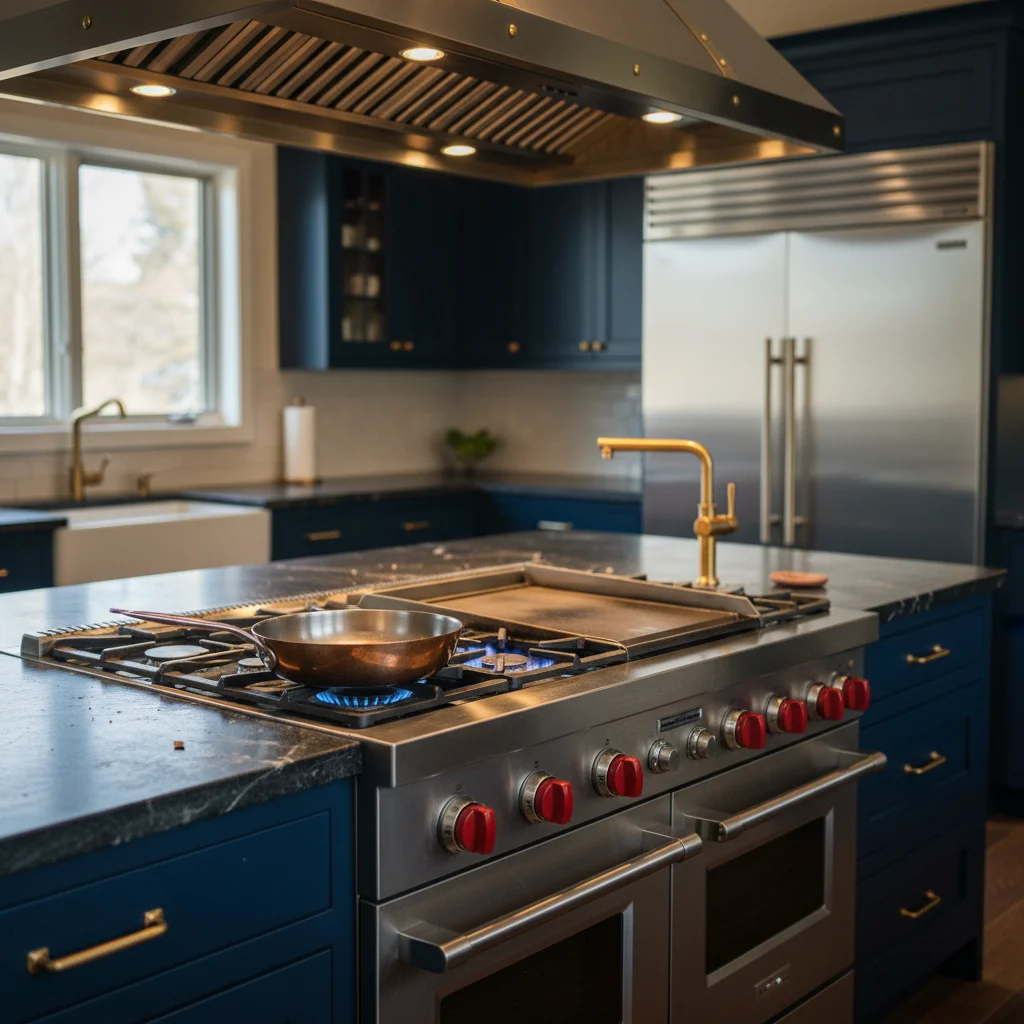
A dead Hestan burner or a drifting oven rarely stays a small problem. A spark electrode that fires but won’t catch keeps dumping unburned gas into the kitchen; an oven that bakes 35 degrees cool gets “fixed” by cranking the dial, which cooks the igniter faster and turns a one-part visit into two. Calling early almost always means a shorter, cheaper repair — so here is what’s likely happening and how we sort it.
What you are seeing
Hestan ranges show trouble in a handful of recognizable ways:
- A burner clicks and sparks but never lights, or lights only after several tries.
- A flame that burns lazy, yellow, or roaring instead of tight and blue, often with sooting on the brass cap.
- A high-output burner that won’t drop to a clean low simmer without sputtering out.
- An oven slow to preheat, or one that clicks and smells faintly of gas before catching.
- Uneven baking — one rack or one side always off — even though the oven seems to reach temperature.
- The oven drifting hot or cold with no error, quietly throwing off roasting and baking.
What it usually means
Hestan builds these ranges around sealed brass burners fired by a spark electrode, sitting under heavy continuous grates, paired with a convection oven. That construction is durable, but it concentrates failures in specific places. Constant sparking with no flame is almost always a carbon-fouled or damp electrode, a cap nudged off its seat, or a spark module misfiring across the burner bank — corrections more often than part replacements. A lazy yellow flame points to an air-fuel mix running rich, frequently because the range was never re-tuned after a move to Colorado. On the oven side, slow preheat and no-ignite usually mean a weakening igniter that no longer pulls enough current to open the safety gas valve, while uneven or off-temperature baking traces to a slowing convection motor or a temperature sensor out of spec.
Our approach
Diagnose before we touch a part
We never lead with a part order. A technician confirms what the range is actually doing, then walks the gas path or the oven circuit in sequence — spark at the electrode, gas at the orifice, cap seating, igniter draw, sensor resistance. You get the real cause and one firm price before any wrench turns. The on-site diagnostic is a flat $89, credited toward the repair.
Tune for 5,280 feet
Denver leans on a gas range hard. At 5,280 feet the air is roughly 15% thinner, so each sealed burner gets less oxygen and the factory mix skews rich — the reason a Hestan that burned crisp blue at sea level runs lazy here. That thinner air also changes heat circulation inside the convection oven, so a marginal fan or drifting sensor bakes worse than it would lower down. Denver’s very dry climate stiffens the oven door gasket sooner, leaking heat and stretching preheats, and where a setup adds a plumbed feature, hard water at 150–250 ppm leaves scale. We build all of that into the diagnosis.
Fit parts that hold
We install OEM-grade or manufacturer-compatible components matched to your model and serial — spark electrodes and modules, oven igniters, gas valves and orifices, temperature sensors, and convection motors. On a range this heavily built, the chassis outlasts everything; it’s the ignition and control parts that wear, and the correct one is what keeps us from coming back.
Coverage & brands
Denver Sub-Zero Repair is an independent company that has worked the Denver metro since 2012, serving the city and surrounding suburbs. We are not affiliated with, endorsed by, or sponsored by Hestan or any manufacturer. Alongside Hestan we service other premium gas and dual-fuel ranges with the same altitude-aware diagnosis.
Get it fixed
If your Hestan won’t light, burns yellow, won’t simmer, or bakes unevenly, the sooner we look the smaller the repair tends to be. Call (720) 770-4189 any time, or book online, and we’ll get your range searing, simmering, and baking the way Hestan built it to — tuned for Denver, not sea level. The diagnostic is a flat $89, applied straight to the repair.