When a Hestan problem is quietly costing you more than the repair
A Hestan kitchen is a real investment, and the most expensive thing you can do with one is wait. A range burner that lights with a delay, an oven that drifts ten degrees, a column refrigerator that hums a little longer than it used to — none of those feel like emergencies on day one. They feel like things you can live with until the weekend, or the month, or the next time you have people over.
The trouble is that almost every Hestan fault gets worse and more expensive the longer it sits. A weak igniter that releases unburned gas before it catches puts a small but real safety stress on the cooktop and burns out faster every cycle. A refrigerator running on a marginal sealed system pulls more current and frosts more aggressively, and what could have been a fan or a sensor turns into spoiled food and a harder repair. A door gasket that has started to dry and stiffen in Denver’s arid air lets heat leak out of an oven or cold leak out of a fridge, so the unit runs nearly constant trying to keep up — driving up your power bill the whole time and wearing out the parts you were trying to protect.
The fix is not to panic; it is to diagnose early and correctly. Below is what the common Hestan symptoms tend to mean, how we run the job, and why an independent specialist who actually knows Denver’s altitude is the right call. To skip ahead and book, the line is (720) 770-4189, answered around the clock, and the booking link sits at the bottom of the page.
What you are actually seeing
Hestan is a relatively young name with deep roots. The brand grew out of a commercial-kitchen and professional-cookware lineage and brought that thinking into the home: heavy welded chassis, restaurant-style sealed burners with high BTU output, machined brass burner components, and a level of fit-and-finish meant to look as much like a piece of equipment as an appliance. The cooking line is the heart of it — pro ranges, rangetops, and wall ovens — alongside outdoor grills and built-in column refrigeration. The whole point of a Hestan is that it behaves like commercial gear, and that character shapes exactly how it fails.
Here is what tends to walk through the door as a complaint:
- Ignition that hesitates, clicks repeatedly, or won’t catch. You hear the spark but the burner takes several tries, lights with a soft whump, or refuses entirely on one position while its neighbors are fine.
- A flame that looks wrong. Yellow or orange tips instead of a tight blue cone, a flame that lifts off the port, lazy rollover, or a simmer setting that keeps snuffing itself out.
- An oven that bakes off. Long preheats, food that browns unevenly side to side, a cavity that reads one temperature on the dial and behaves like another, or a broiler that’s lost its punch.
- Refrigeration that’s slipping. A column unit that won’t hold its setpoint, frost building where it shouldn’t, a compartment that’s warmer than the other, or an ice maker slowing to a trickle.
- Grill burners that are weak or uneven. Cold spots across the grate, one burner that won’t light, a rotisserie or sear burner that’s quit, or ignition that struggles outdoors.
Each of those is a category, not a diagnosis. The job is to figure out which specific part inside that category is actually out of spec.
What those symptoms usually mean
On equipment built this way, the surface symptom is often a layer removed from the part that failed. A few of the patterns we see most on Hestan:
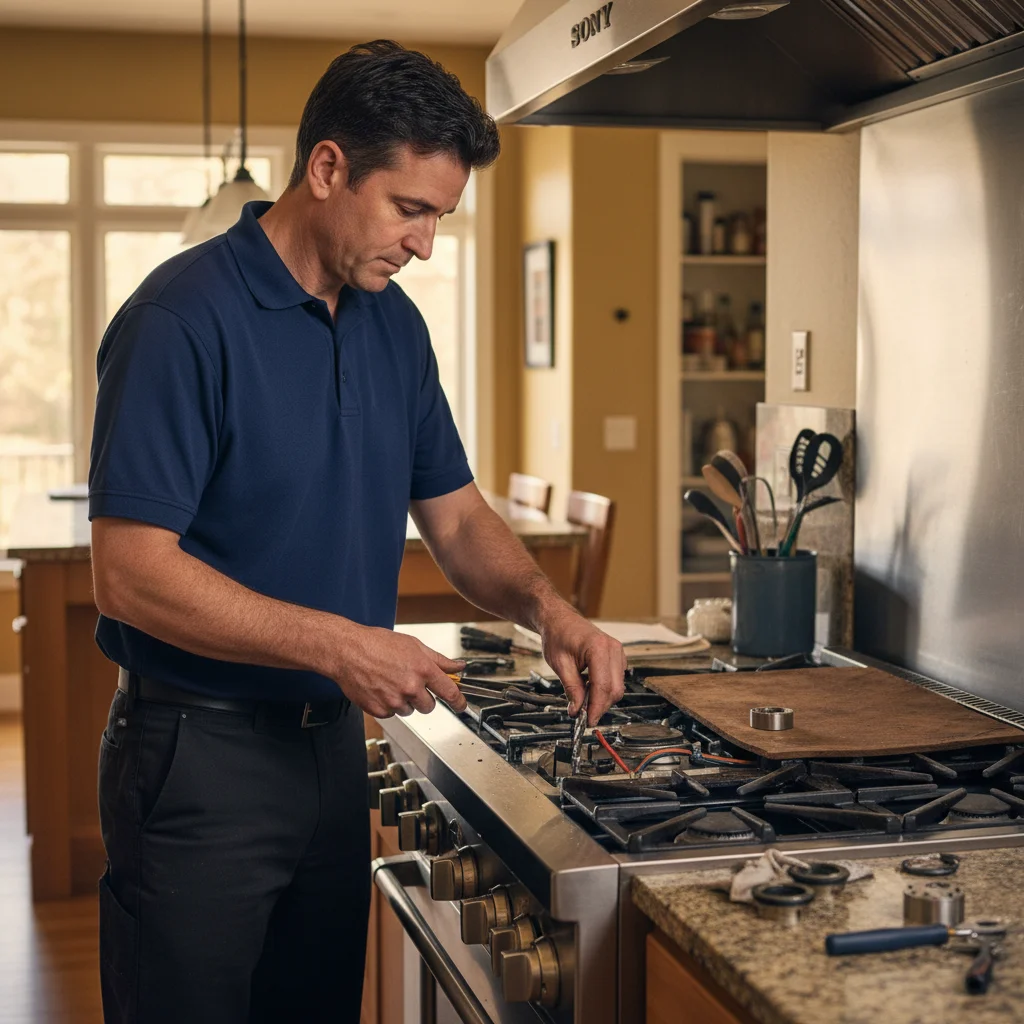
Ignition complaints are usually about spark, gas, or the path between them. A burner that won’t light reliably can come down to a fouled or worn igniter, a cracked ceramic on the spark electrode, a spark module that’s weakening, a partially blocked burner port, or a gas valve that isn’t opening fully. On the oven side, a hot-surface or spark igniter that has aged will glow or click but no longer draw enough current to pull the safety valve fully open, so the oven lights slowly or not at all. Replacing the whole burner assembly when a single igniter was the problem is the kind of overkill we’re built to avoid.
Flame-quality complaints are frequently mixture, not failure. This is where Denver matters more than anywhere else, and we’ll come back to it. Yellow tipping, lifting, and a stubborn simmer are classic signs that the air-fuel ratio is off — which at altitude can be a tuning issue rather than a broken component. A good diagnosis separates “this burner needs an altitude-correct orifice and a shutter adjustment” from “this burner has a genuine fault,” because those are very different invoices.
Uneven or off-temperature baking points to the oven’s control loop. A Hestan oven leans on a temperature sensor, a heating element or gas burner, and usually a convection fan to hit precise, even results. When any one of those drifts — a sensor reading a few degrees off, an element with a weak spot, a fan motor that’s slowed — the cavity bakes worse, and the symptom you notice is rarely the part that’s actually tired. We verify the real cavity temperature with our own instruments before condemning anything.
Refrigeration symptoms are about the sealed system and its helpers. Cooling loss on a column unit can be a failing evaporator or condenser fan, a defrost fault, a drifting thermistor, a door-seal leak, or a genuine sealed-system problem. These look alike from the outside, which is exactly why guessing is expensive. We diagnose the sealed system precisely instead of treating every cooling complaint as a guaranteed compressor job.
Our approach
Our method is deliberate rather than fast, because on gear this well-built the costly mistake is replacing an expensive assembly when a small part was the real culprit.
We read the unit honestly, then follow the evidence
We start by reproducing the exact symptom rather than taking the complaint at face value — “the oven is slow” and “the oven runs cold” lead to different parts. From there we measure: igniter current and behavior, spark quality, gas pressure at the manifold, sensor resistance, fan operation, cavity temperature, and any error codes the control will give up. The part we replace is the one the evidence points to, and we explain what we found in plain language before we touch your wallet.
We treat Denver’s altitude, water, and dry air as primary, not a footnote
This is where servicing a Hestan in Denver genuinely diverges from servicing one at sea level, and it’s the piece a national dispatch tech routinely misses.
- Thin air at 5,280 feet. A mile up, the air is roughly 15 percent less dense than at the coast. Gas burns leaner of oxygen here, so unless a Hestan’s orifices and air shutters are sized and set for altitude, the mixture skews rich — which is why a restaurant-grade burner that ran a tight blue flame at sea level can burn yellow, lift, or refuse to hold a low simmer after a move to Colorado. The same thin air changes how an oven sheds heat, so a slightly tired convection fan or a sensor drifting a few degrees bakes worse here than it would near the ocean. Altitude even reaches the refrigeration: thinner air carries compressor heat away less efficiently, so a column sealed system already working near its edge shows symptoms sooner in Denver. We build all of this in from the first minute.
- Hard water at roughly 150–250 ppm. Much of the metro runs hard, and that mineral load scales up anything that touches water. On a Hestan kitchen that means a plumbed column refrigerator’s ice maker and water line, plus any paired dishwasher. Scale creeps in quietly until an ice maker slows to a trickle or a line clogs. We flag it on sight and suggest a descale interval that fits local water rather than a generic one.
- Very dry climate. Denver’s low humidity is hard on rubber. Oven door seals and refrigerator gaskets dry out, stiffen, and crack sooner here than in humid regions, which shows up as an oven that won’t hold heat or a fridge that runs almost constantly. A door complaint that looks cosmetic is frequently an early seal failure worth catching before it quietly inflates your energy bill.
- Strong UV and hard dry-cold winters. These accelerate wear on exposed trim, grill components, ventilation, and any externally routed parts — which is exactly why a Hestan outdoor grill in Colorado ages differently than the same grill in a milder climate.
We protect the repair with the right parts
We fit OEM-grade and manufacturer-compatible parts from verified suppliers, matched to your exact model and serial number. On the components that decide how long a Hestan repair holds — igniters and spark modules, gas valves, oven sensors, convection motors, and control boards — correct fitment comes ahead of lowest price. A burner tuned with an altitude-appropriate orifice, set with a proper flame, is the difference between a fix that lasts and one that drifts back in a month.
We quote up front, with no surprises
The $89 diagnostic buys a full on-site inspection and a written price, and that fee is credited toward the repair once you approve it. The exact repair number is set only after the inspection, because an honest quote on a Hestan can’t be invented over the phone. Once you approve the work, the price doesn’t move.
Coverage and brands
We service Hestan across the Denver metro — the city core plus the surrounding suburbs — and we work on the full range of the brand’s home equipment:
- Pro ranges in 30-, 36-, 48-, and 60-inch widths, including the high-output sealed burners and the convection ovens beneath them.
- Rangetops and cooktops, gas and the matching surface configurations.
- Wall ovens, single and double, including convection and broil faults.
- Outdoor gas grills, including burner, igniter, rotisserie, and side-burner issues.
- Built-in column refrigeration and dual-zone units, including ice makers and water lines.
Hestan is one of several premium and pro-style brands we specialize in. We also regularly service Sub-Zero, Wolf, Viking, Thermador, Gaggenau, Miele, Dacor, and Jenn-Air, which means the altitude-aware diagnostic habits we bring to a Hestan are the same ones we’ve sharpened across the whole high-end category. If you run a mixed kitchen — a Hestan range next to a different make of refrigerator, say — one visit can usually cover both.
We’ve served Denver-area kitchens since 2012, repairs run daily from 8:00 AM to 6:00 PM, and the phone is answered 24/7 so you can call the moment something goes wrong, even if the actual visit lands the next morning.
Get it fixed
A Hestan is built to last decades, and a correct, early repair keeps it on that track. The longer a weak igniter, a drifting oven, or a slipping column sits, the more it tends to cost — in parts, in energy, and in the odds of a small fault cascading into a big one.
Here’s the simple path:
- Call (720) 770-4189 — answered 24/7 — or use the online booking link at the bottom of this page to grab a same-day or next-day slot.
- A specialist inspects the unit on-site for the flat $89 diagnostic and tells you exactly what’s wrong and what it costs to fix.
- You approve the written price — the $89 is credited toward the repair — and we fix it once, with parts matched to your model and a flame and calibration set for Denver’s altitude.
No guessing over the phone, no invented quotes, no pressure. Just an independent specialist who knows both this brand and this city. When your Hestan needs attention, call (720) 770-4189 and get it handled right the first time.