If your refrigerator is warming up in a Capitol Hill apartment, the neighborhood itself is often part of the story — and so is the air outside your window. At 5,280 feet, Denver’s atmosphere is roughly 15% thinner than at sea level, which means every condenser and cooling fan in the building moves less dense air and carries away less heat. In a wide suburban kitchen that margin barely shows. In a Cap Hill galley where the fridge is wedged into a plaster alcove with an inch of clearance, the same thin air is the difference between a unit that holds 37°F and one that drifts into the low 40s by mid-afternoon.
Denver’s altitude, hard water, and dry air come first
Before we look at any single part, we account for the three environmental factors that quietly shape how refrigerators fail in this part of the city.
Thin air at altitude. A refrigerator dumps heat from its condenser coils into the kitchen. At mile-high elevation there are fewer air molecules to absorb that heat, so the compressor runs longer and hotter to hold the same cabinet temperature. A coil that’s even lightly dusty — or an alcove install with no breathing room, which describes a huge share of Capitol Hill kitchens — pushes a borderline system over the edge. That’s why a fridge can run fine for years and then “suddenly” stop cooling during a warm stretch: the altitude penalty was always there, and the margin finally ran out.
Hard water, around 150–250 ppm. Denver’s supply is mineral-rich, and Capitol Hill’s older buildings often add sediment from aging galvanized or copper lines. That scale collects in ice-maker fill tubes, water inlet valves, dispenser solenoids, and inline filters. The classic symptoms are slow or hollow ice, a dispenser that dribbles, or an ice maker that jams every few weeks. Swapping the ice maker without addressing the scale just buys you a few months.
Very dry climate. Denver’s low humidity hardens and shrinks door gaskets faster than a coastal climate would. A gasket that no longer seals lets warm room air leak in, which forces the compressor to run more — compounding the altitude problem above — and frosts up the evaporator. On built-in and column units with magnetic door seals, a tired gasket is one of the most common and most overlooked causes of a fridge “that just doesn’t get cold enough.”
Taken together, these three forces explain why a refrigerator that performed fine in a humid, sea-level city can act up after a move into a Capitol Hill flat. The unit didn’t change — its operating environment did, in three directions at once. We weigh all of them in the diagnosis instead of treating your fridge like it lives at sea level.
Why refrigerators fail in Capitol Hill kitchens specifically
Capitol Hill’s housing stock is unusually dense and unusually old for Denver: pre-war brick condos, stately Victorian and Queen Anne mansions carved into flats, and mid-century apartment blocks lining the streets between the State Capitol and Cheesman Park. The kitchens that came with those buildings — or were squeezed into them during a conversion — create a recognizable set of refrigerator problems.
- Boxed-in installs with no clearance. When a refrigerator is built into a cabinet run or shoved into a former pantry nook, its condenser can’t pull cool air or exhaust warm air. Heat recirculates, the compressor overworks, and the sealed system ages prematurely. This is the single most common pattern we see in renovated Cap Hill condos.
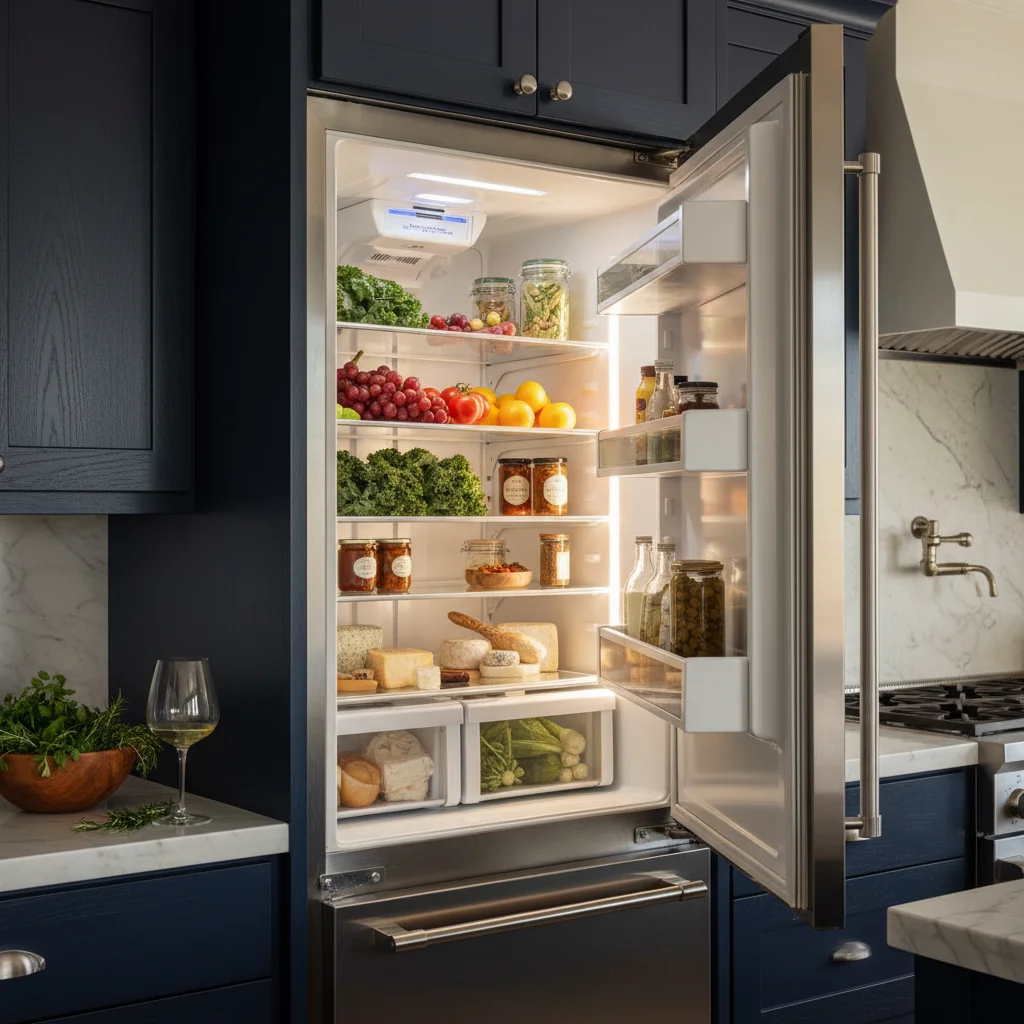
- Compact built-ins in custom cabinetry. Renovations near the Capitol and along the historic blocks frequently spec integrated column refrigerators and under-counter drawers to fit period kitchens. These have tighter sealed systems and harder-to-reach condensers than freestanding units, and they reward a technician who knows the layout.
- Galley kitchens with shared walls. A narrow galley traps heat, especially when an oven or radiator shares the run. The refrigerator’s cooling load goes up exactly where it has the least room to cope.
- Older electrical and shared circuits. Many walk-ups run the kitchen on circuits that predate the appliances on them. A start relay that fails or a compressor that short-cycles can be a symptom of voltage or wiring quirks as much as the fridge itself, so we check the supply as part of the diagnosis.
- Aging water supply lines. Behind-the-wall plumbing in century-old buildings adds sediment to already-hard Denver water, which is why ice and water faults show up so often here.
How we diagnose a Capitol Hill refrigerator, step by step
We don’t guess and swap. Every visit follows a deliberate sequence so we find the real failure point the first time.
- Confirm the symptom and the install. We start by listening to what you’re seeing — warming cabinet, frost buildup, a constant hum, water on the floor — and we look at how the unit is installed. In Capitol Hill that means checking clearances and whether the alcove or cabinet is choking the condenser before we blame a component.
- Read the temperatures and any stored fault codes. We measure actual fresh-food and freezer temperatures, then pull electronic diagnostics or stored error codes on units that report them. That separates a true cooling failure from a thermostat or sensor reading the wrong number.
- Inspect the sealed system and airflow path. We trace the condenser, evaporator, compressor, fans, and defrost components as one connected system. At altitude, airflow and heat rejection are where marginal units fail, so this is where we spend the most time.
- Test the electrical components under load. Start relay, compressor windings, evaporator and condenser fan motors, defrost heater and sensor, and the control board — checked while the unit is actually running, not just at rest.
- Check the water path on ice and dispenser models. We inspect the inlet valve, fill tube, filter, and lines for the mineral scale that hard Denver water leaves behind.
- Verify the door seals and the cabinet’s heat environment. A dry-climate-hardened gasket or a heat-trapping alcove gets flagged here, because fixing the part without fixing the cause just brings us back.
- Explain the cause and quote an up-front price. You get a plain-language explanation of what failed and why, and a firm price before any repair begins. The $89 service call covers this diagnosis and is applied to the repair.
Refrigerator components we service
We repair and replace the parts that actually go wrong on freestanding and built-in refrigerators in this neighborhood:
- Compressors and start relays — for units that won’t cool, short-cycle, or trip on startup.
- Condenser and evaporator fan motors — common culprits behind warm cabinets and noisy operation, and especially sensitive at altitude.
- Sealed-system and refrigerant faults — leaks and restrictions that show up sooner in thin air.
- Defrost systems — heaters, sensors, and timers behind back-wall frost and ice buildup.
- Thermostats, thermistors, and control boards — the logic that tells the cabinet what temperature to hold.
- Door gaskets and seals — replaced when Denver’s dry air has hardened them past the point of sealing.
- Ice makers, water inlet valves, fill tubes, and filters — descaled or replaced to clear hard-water clogs.
- Defrost drains and drain pans — the usual source of water pooling under or in front of the unit.
Whether you have a panel-ready column built into a Capitol Hill remodel or a freestanding top-mount in a walk-up rental, we bring model-specific knowledge rather than a one-size-fits-all kit.
A note on the order we do things: when a unit is choked by a too-tight alcove, we’ll tell you plainly. Sometimes the most durable fix is improving airflow around the cabinet or correcting an install — not just replacing a fan motor that will burn out again in the same heat-trapped nook. In a neighborhood where so many refrigerators are wedged into spaces never designed for them, that distinction is what keeps a repair from becoming a repeat visit next summer.
What it costs to wait
In a compact Capitol Hill kitchen there’s rarely a spare freezer or a second fridge in the garage to fall back on, so a cooling failure turns into spoiled groceries fast. Catching a failing fan motor, a leaking gasket, or an early sealed-system restriction before it cascades into a dead compressor almost always means a smaller repair. That’s the main reason we push for same-day diagnosis rather than “let’s see if it gets better.”
Same-day scheduling across Capitol Hill
Capitol Hill’s central location — bounded roughly by Broadway, Colfax, and the parkways around Cheesman Park — makes it one of the quickest neighborhoods for us to reach, so same-day and next-day appointments are usually available. Our technicians perform repairs daily from 8:00 AM to 6:00 PM, and the phone is answered 24/7, so you can call the moment you notice your food is at risk.
A warming refrigerator only gets more expensive the longer it waits, especially in a small kitchen where there’s nowhere to move the food. If your unit has stopped holding temperature, is frosting over, or is running nonstop, call (720) 770-4189 or book online any time. The $89 diagnostic gets a technician to your door, identifies the real cause, and goes straight toward the repair once you approve it.