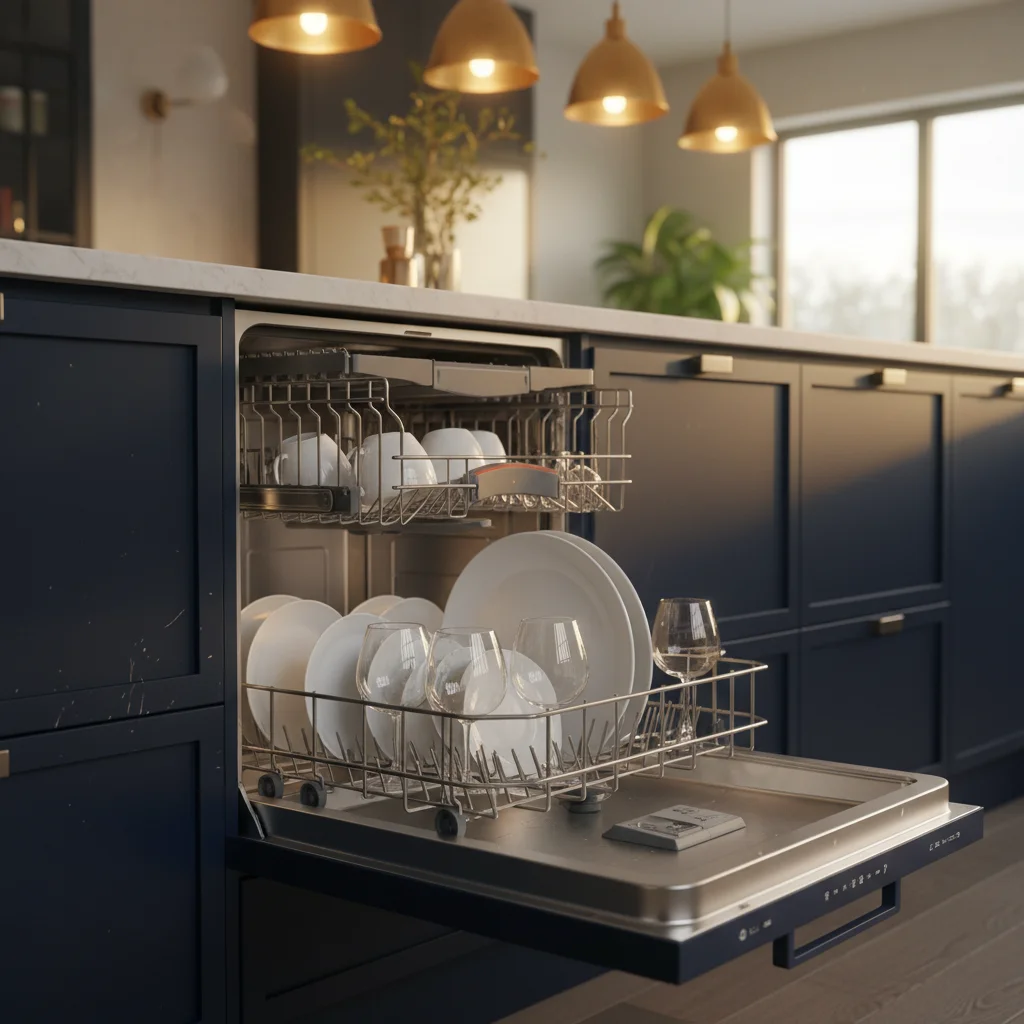
A dishwasher rarely fails politely in Capitol Hill. In a neighborhood of pre-war condos, carved-up Victorian mansions, and converted apartments, the unit is almost always built in tight under a counter — with original hardwood, a finished basement, or a downstairs neighbor just inches away. A pinhole leak in a supply hose or a worn door gasket doesn’t announce itself; it wicks into subfloor and cabinet kicks for days. By the time you see a warped board or a musty smell, the repair has quietly grown from a $20 hose into floor and cabinet work. Catching it early is the whole game, and it usually starts with one or two small symptoms.
What you are seeing
These are the complaints we hear most from Cap Hill kitchens:
- Standing water in the tub after a cycle, or water seeping onto the floor
- Dishes coming out gritty, filmy, or still wet
- A unit that won’t start, stops mid-cycle, or trips the breaker
- Grinding, humming, or a burning-electrical smell during drain
- A door that won’t latch or leaks at the bottom seal
What it usually means
Each of those points to a short list of likely causes, and the local conditions shift the odds.
A unit that won’t drain is most often a clogged filter, a jammed drain pump, or — common in older Capitol Hill buildings — a backed-up shared kitchen drain or a misrouted high loop, not a dead pump at all. Filmy or wet dishes usually trace to Denver’s hard water scaling the spray arms and heating element, a clogged arm, or a tired rinse-aid and vent system. Mid-cycle stops and no-start faults point to the door latch, the control board, or the thermal fuse. And leaks almost always come down to the door gasket, a cracked fill or drain hose, or a failing pump seal — and Denver’s very dry air ages rubber gaskets faster than a humid climate would, so seals here crack early.
Our approach
We don’t guess and swap parts. Every visit follows a deliberate order so we find the actual failure the first time.
We read the install, not just the unit
In Capitol Hill that means checking how the dishwasher is mounted in the cabinet run, where the drain ties into the sink, and whether an integrated panel has to come off. A choked or improperly looped drain in a century-old building fakes a lot of “pump” failures, so we rule out the plumbing before condemning a part.
We test the sealed and water systems for hardness
Denver’s 150–250 ppm water scales heating elements, spray arms, check valves, and inlet screens. We inspect and descale those instead of replacing a part that will just scale up again. At 5,280 feet the thinner air also means heat-dry cycles work a little harder, which we factor into “wet dishes” complaints.
We confirm the fix before we reassemble
Once a part is replaced or a clog cleared, we run a live cycle and check drain, fill, heat, and the door seal under load — important when reseating an integrated unit back into tight custom cabinetry without scratching the panel or counter.
Coverage & brands
We work across Capitol Hill — the condos near the State Capitol, the mansion flats around Cheesman Park, and the walk-ups in between — and we service built-in, integrated, panel-ready, and portable dishwashers from the major brands. We use OEM-grade, manufacturer-compatible parts matched to your model, and we quote up front. Repairs run daily, 8:00 AM to 6:00 PM, and most Cap Hill visits are same-day or next-day because the neighborhood sits right in the center of the city.
Get it fixed
If your dishwasher is leaking, won’t drain, or is leaving dishes dirty, don’t let it sit and soak a Capitol Hill floor. Call (720) 770-4189 — answered 24/7 — or book online. The diagnostic service call is $89, credited toward the repair, with a clear price before any work begins.