A wine cooler seldom fails loudly. A column that has slipped four or five degrees won’t trip an alarm or pool water on the floor — it just quietly warms the bottles you have been laying down for years, and in a stocked Belcaro cellar the first real warning can be a spoiled cork. Catching that drift early is the whole game, so the repair starts the moment the set point stops holding: get a technician in front of the unit, find what actually changed, and stop the slow bake before the rack pays for it.
Why these coolers go wrong
Across Belcaro the same handful of faults surface again and again:
- The cabinet won’t hold its set point, or one side of a dual-zone runs warm while the other sits exactly where it should.
- A new hum, rattle, or vibration that carries through custom millwork in an otherwise quiet estate kitchen.
- Frost building on the back wall, condensation sweating across the glass door, or water collecting at the base.
- The display and interior lights work, but the cooling stage never kicks in.
- Short-cycling — the unit clicks on and off without ever pulling the cabinet down to temperature.
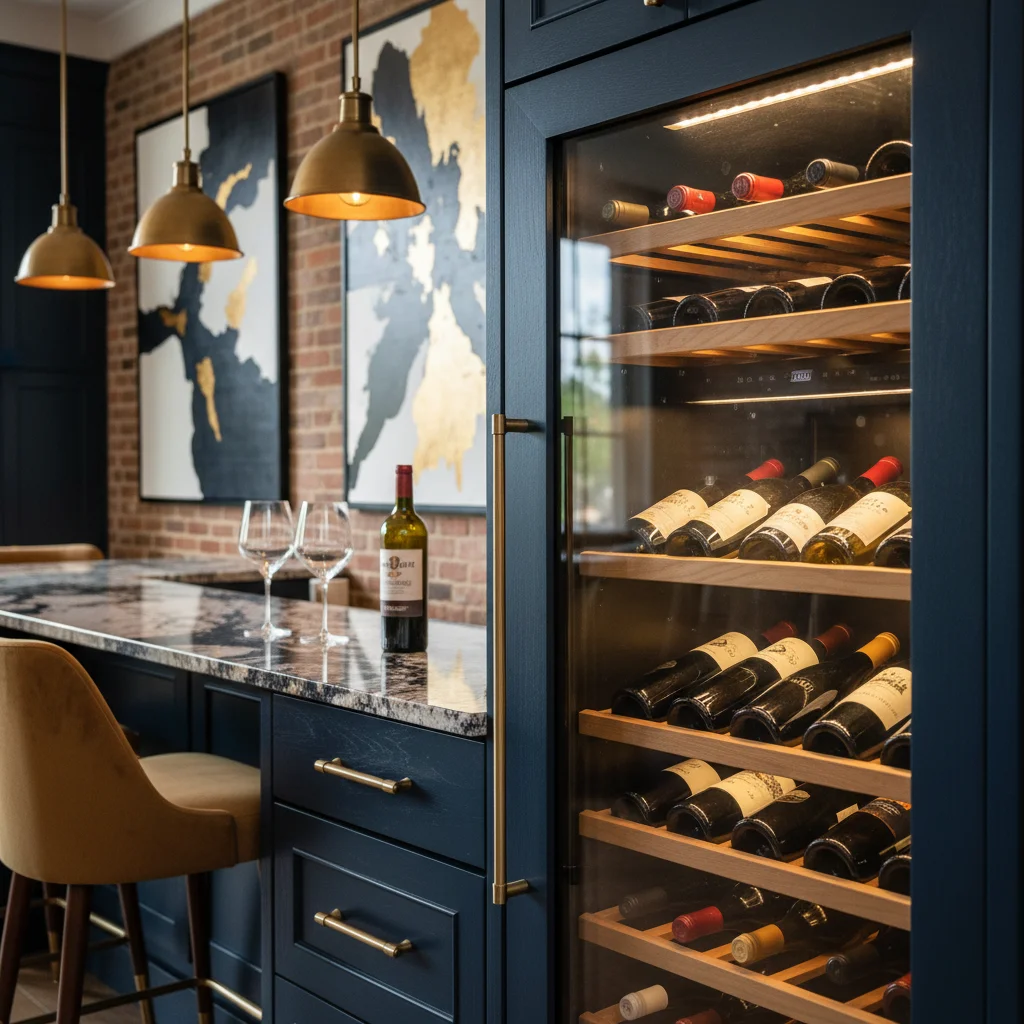
Belcaro adds its own twist. The homes between University and Colorado boulevards, around Belcaro Park and out toward the Polo Club, rarely run a freestanding box parked against a wall. Here the wine unit is an integrated column, a bank of under-counter drawers, or a wine wall set into cabinetry that was sometimes built before anyone thought about a condenser’s breathing room. So a “warm cooler” usually splits into two questions: what failed inside, and what is the installation doing to it.
The Denver forces behind the fault
At 5,280 feet the air is roughly 15% thinner, so every condenser sheds less heat than its maker assumed at sea level. In an open kitchen that margin quietly vanishes; in a column boxed into millwork with an inch of clearance — exactly how Belcaro’s custom kitchens are built — it can be the difference between steady cellar temperature and a slow climb out of range. Denver’s dry climate hardens door gaskets early, which is the usual story behind frost and a sweating glass door. And on water-fed beverage centers, the hard local supply at around 150–250 ppm lays down scale in the lines and valves worth checking before it chokes flow. We read those three forces — thin air, dry air, hard water — as part of the diagnosis, not as afterthoughts.
How we pin down the fault
- Confirm the actual cabinet temperature against the set point, separating a true cooling failure from a misreading sensor.
- Check the install: grille clearance, airflow around a flush-paneled cabinet, and how much heat the surrounding millwork is trapping.
- Test the sealed system and compressor under load, watching how the unit rejects heat at altitude rather than at a sea-level assumption.
- On dual-zone units, diagnose each zone separately — dampers, thermistors, and evaporator fans can fail one side at a time.
- Inspect the door gasket and seal for the dry-climate shrinkage that lets warm air leak in.
Components we service
What decides longevity isn’t the visit — it’s what goes back into the unit. We diagnose to a specific part and replace with OEM-grade or manufacturer-compatible components matched to your model and serial: compressors, condenser and evaporator fan motors, thermostats, thermistors, control boards, dampers, and door gaskets. On a flush-set column in a Belcaro estate kitchen, a generic substitute that almost fits is a repair you’ll be calling about again; a part spec’d to your cooler is one you forget you ever needed.
Booking a same-day visit
Repairs run daily from 8:00 AM to 6:00 PM, and the phone is answered 24/7, so same-day or next-day slots are usually open. Call (720) 770-4189 or book online anytime. The $89 diagnostic brings a technician to your Belcaro door, pinpoints the true cause, and goes straight toward the repair the moment you approve it — no guesswork, no surprise line items.