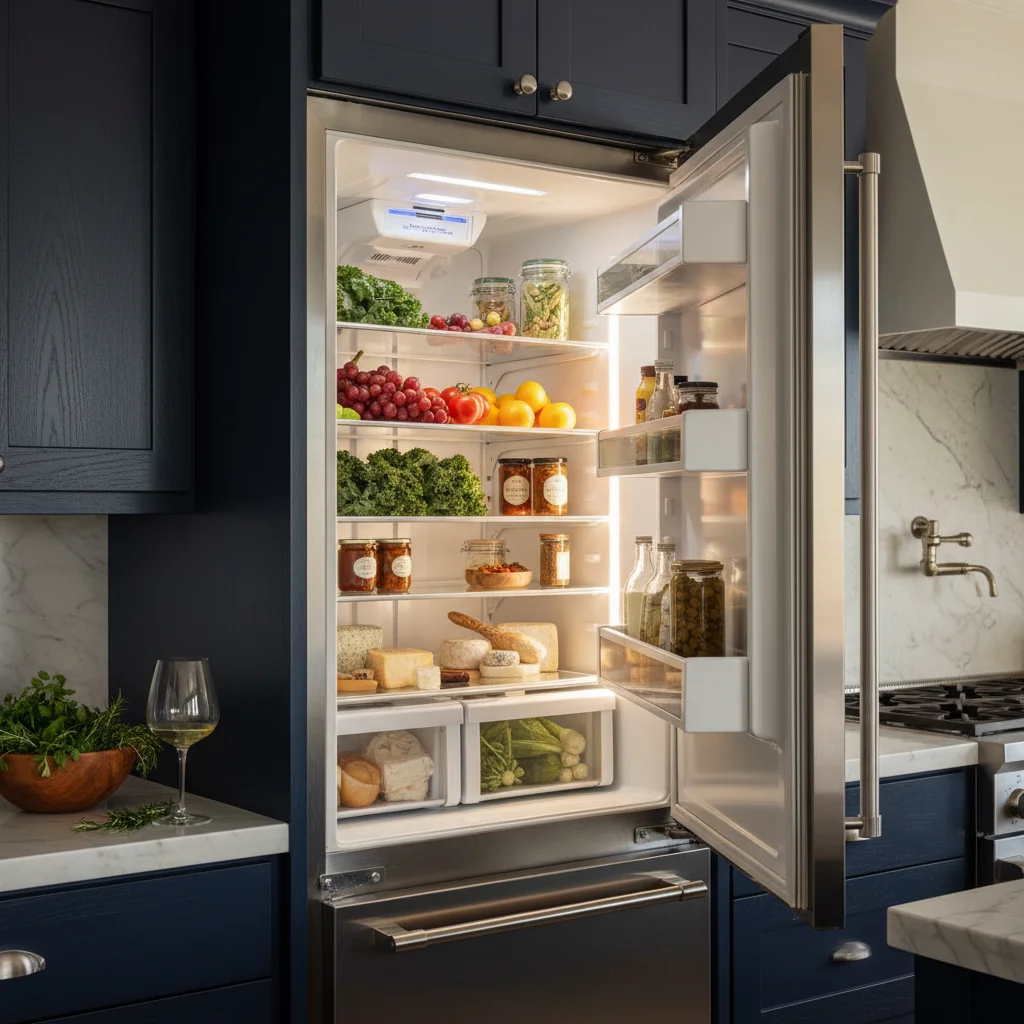
A warm fresh-food side in a Belcaro kitchen is unsettling precisely because the refrigerator is rarely something you can roll out and shrug at. More often it’s a column paneled into cabinetry, paired with a matching freezer and a wine column further down the run. Before we touch anything, the job is to separate the true fault from the symptom — and to put a firm price on the table first, so nothing on the final bill is a surprise.
Getting our bearings
The dense cluster of large-lot homes between University and Colorado, around Belcaro Park and out toward the Polo Club, holds some of south-central Denver’s most kitchen-forward construction. Custom layouts here lean on integrated refrigeration: flush columns, island drawers, panel-ready units, and dedicated wine storage in butler’s pantries. The hardware inside is modern and fixable. The finished panels and floors framing it are not. So a clean repair is two jobs braided together — name the real fault, and reach it without leaving a trace on anything that can’t simply be reordered.
Faults we see most on this side of town
The complaint is usually one word, “warm,” but inside a flush-set column it points in directions a freestanding fridge never would, and the install is often half the story:
- A column climbing out of range — typically a dust-packed condenser, a dead evaporator or condenser fan, a worn start relay, or a sealed-system leak. In a tight integrated cabinet, choked airflow is the first thing we rule out.
- A wine column that won’t settle on its set point — drift or a compressor that never rests usually means a thermistor, a cooling stage, a fan, or a gasket no longer sealing in dry air.
- Frost stacking on the freezer’s back wall — most often a defrost heater, defrost sensor, or a board mistiming the cycle.
- A compressor that runs without stopping — heat trapped behind the panel, a weak fan, or a seal that has stopped closing tight.
- Cloudy, undersized ice or a slow dispenser — almost always mineral scale in the fill tube and inlet valve.
Parts and how long the fix holds
What decides whether you call again next season isn’t the visit — it’s what goes back into the unit. We diagnose down to a single component and replace with OEM-grade or manufacturer-compatible parts matched to your model and serial: compressors, condenser and evaporator fan motors, control boards, start relays, defrost heaters and sensors, inlet valves, thermistors, and door gaskets. On a column set flush into a Belcaro kitchen, a near-fit generic is a repair you’ll be phoning about again in a year; a part spec’d to your unit is one you forget you ever needed. Where several cooling units share a run — a fridge column, a freezer column, and a wine unit, each with its own compressor and board — we diagnose every one on its own and service what we can in a single visit.
Why Denver’s air and water are part of the diagnosis
At 5,280 feet the air is roughly 15% thinner, so a condenser sheds noticeably less heat than its maker assumed at sea level. In an open kitchen that margin disappears quietly; in a column boxed into millwork with an inch of clearance — exactly how these kitchens are built — it’s the gap between holding temperature and a slow climb warm. The dry, high-UV climate hardens door gaskets early, which is the usual culprit behind a sweating door or a compressor that won’t cycle off. And the hard local water, around 150 to 250 ppm, lays scale in ice makers and the thin lines feeding built-in dispensers. We weigh all three — thin air, dry air, hard water — as part of the work, not as an afterthought.
How to book
Repairs run daily from 8:00 AM to 6:00 PM, and the phone is answered 24/7, so you can call the moment a column slips out of spec. A warming built-in only gets costlier the longer it waits, and a stocked wine column raises the stakes. Call (720) 770-4189 or book online. The $89 diagnostic brings a technician to your Belcaro door, pins the cause, protects the millwork, and goes straight toward the repair once you approve it.