The clock starts the moment it drifts
A Liebherr does one job with unusual seriousness: it holds a set temperature, steadily, for years. So when it slips even a degree or two, the consequences arrive faster than most homeowners expect. A BioFresh drawer that creeps from near-freezing up into the mid-forties quietly shortens the life of everything inside it. A wine cabinet that loses its grip on 55°F doesn’t announce the problem — it just lets a collection cook gently while heat and vibration flatten bottles you’ve been holding for a decade. A built-in column that frosts at the back of the evaporator can run for days before you notice the freezer is laboring, and by then the compressor has been working overtime to make up the difference.
That delay is the expensive part. A sensor reading a few degrees off, a condenser fan that has slowed, or a gasket that no longer seals are all small, affordable fixes when they’re caught early. Left alone, the same faults force the sealed system to run hard and hot, and a $150 repair turns into a compressor conversation. Calling at the first sign of drift — water where it shouldn’t be, a section that’s warmer than its setting, a unit that never seems to cycle off — is almost always cheaper than waiting for it to fail outright.
If you’d rather skip ahead and book, the phone is (720) 770-4189, answered around the clock, and the $89 service call covers a full on-site diagnosis that we credit toward the repair if you go ahead.
What you are seeing
Liebherr complaints tend to show up as a handful of recognizable symptoms. Knowing which one you’re looking at helps us point the diagnosis in the right direction before a panel ever comes off.
- A section that won’t hold its setting. The fridge compartment, a freezer drawer, or a wine zone reads several degrees off the temperature you dialed in — sometimes too warm, occasionally too cold.
- A wine cabinet drifting off 55°F. Either the whole cabinet creeps warm, or in a dual-zone unit one zone holds while the other wanders.
- Frost or ice where there shouldn’t be. A NoFrost unit building up a sheet of frost on the back wall, ice forming in a drawer, or the freezer caking up suggests the automatic defrost cycle has stopped doing its job.
- The unit runs constantly and never cycles off. A compressor that hums on and on, or a cabinet that’s warm despite running nonstop, points to something stealing efficiency rather than a dead compressor.
- Water pooling inside or leaking onto the floor. Usually a blocked defrost drain, a frozen drain line, or condensation that has nowhere to go.
- Ice maker or water dispenser problems. No ice, slow ice, hollow or cloudy cubes, or no water at the dispenser on plumbed models.
- Door, hinge, and gasket trouble. A door that won’t seat, a soft-close hinge that’s failing, or a gasket gone stiff and leaking conditioned air — easy to dismiss as cosmetic, costly in energy and runtime.
- A control display showing a fault code or flashing alarm. Liebherr units report stored faults, and the code is a starting point, not a verdict.
Liebherr is, at heart, a refrigeration company before it is an appliance brand — the firm’s deepest engineering lives in cooling, and it shows in how tightly these units are tuned. That precision is exactly why the symptom you notice is often a layer removed from the part that actually failed, and why a careful read matters more than a fast guess.
What it usually means
Every service call is its own puzzle, but certain failures recur often enough on Liebherr equipment that an experienced tech can usually narrow the field before disassembling anything. Here’s what these symptoms most often trace back to.
- A warm section with the compressor still running is frequently an evaporator or condenser fan that has slowed or stalled, a defrost fault choking airflow, or a temperature sensor feeding the control bad data. The cooling hardware can be healthy while a $40 fan or sensor sabotages the whole cabinet.
- A BioFresh zone running warm can be a damper or air-routing issue, a sensor specific to that drawer, or a humidity-control fault. Because BioFresh trades on holding food just above freezing at controlled humidity, even a small drift defeats the feature you paid for.
- NoFrost frosting over almost always means the automatic defrost cycle has broken down — a failed defrost heater, a defrost thermostat or sensor out of range, or a control board not commanding the cycle. The frost is a downstream symptom, not the root cause.
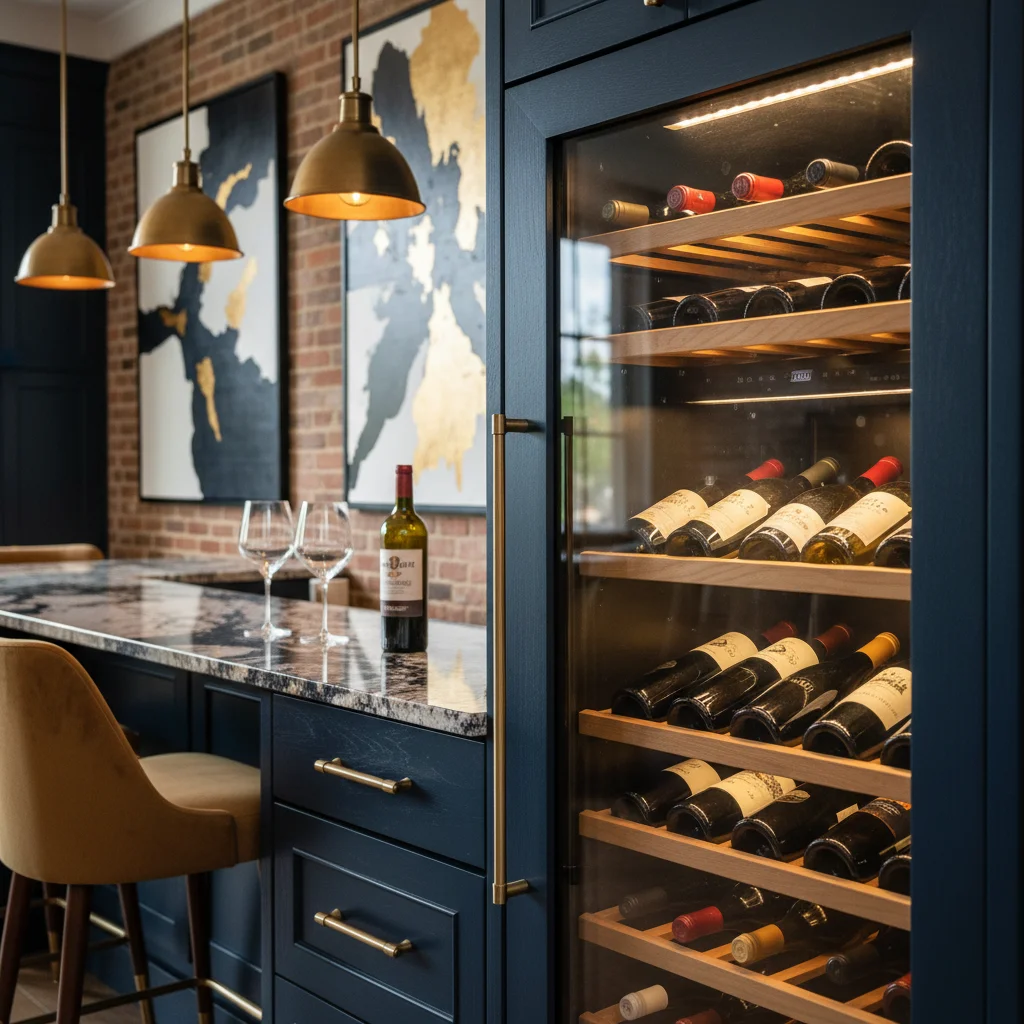
- A wine cabinet that won’t reach its set point commonly comes down to a fouled condenser starved of airflow, a fan motor on the way out, a worn door gasket bleeding conditioned air, or a refrigerant charge that has drifted. Dual-zone cabinets add a second circuit or damper that has to be tested on its own.
- Constant running and never cycling off points to lost efficiency: a dirty condenser coil, a weak fan, a door that no longer seals, or a sealed-system problem making the compressor work for cooling it can’t quite deliver.
- Water inside or on the floor is usually a clogged or frozen defrost drain. It’s a common, fixable fault — but ignored, the standing water can reach electronics or warp drawers.
- Ice and water faults trace to a stuck inlet valve, a clogged or scaled water line, or a frozen fill tube — and in Denver, hard-water scale is a recurring culprit we cover below.
The honest reason a wine cabinet drifts or a column frosts is rarely the most expensive part. The costly mistake is assuming it is. We diagnose to the actual failed component before quoting, because on equipment this well built, replacing a control board when a corroded sensor connector was the real problem is the difference between a fix that lasts and one that boomerangs.
Our approach
Liebherr builds for the long haul, and a proper repair should respect that. Our method is deliberate rather than rushed: confirm the symptom, let the unit tell us what it knows, trace the fault to one source, and put a firm number on it before any work begins.
How we run the diagnosis
- Confirm what’s actually happening. We verify the complaint instead of taking it at face value — “the fridge is warm” and “the fridge runs all the time” point to different parts, and sometimes a wine zone reading warm is a placement or loading issue rather than a fault.
- Read the unit. Stored fault codes, sensor resistance, fan current draw, defrost-cycle behavior, door-seal integrity, and where it applies, sealed-system pressures and the refrigerant charge.
- Trace to the source. We follow the airflow path, the electrical circuit, or the sealed system to the single component that’s out of spec — not the first plausible suspect.
- Quote up front. You hear the cause, the part, and the total before a wrench moves. The $89 service call covers that inspection and folds into the repair if you proceed. Nothing goes ahead without your okay.
Parts and longevity
We install OEM-grade and manufacturer-compatible parts from verified suppliers, matched to your exact model and serial number. That distinction matters most on the components that decide how long a fix holds — evaporator and condenser fans, temperature and defrost sensors, defrost heaters, control boards, inlet valves, and door gaskets. A bargain sensor that doesn’t match the original spec might read fine on day one and drift again by next season; a correctly matched part is what keeps you from calling us back for the same complaint.
Longevity also comes from repairing the true cause, not the visible symptom. If a sensor reads warm because its connector is corroded, replacing the sensor alone is a patch — we address the connector too. If a wine cabinet won’t cool because the condenser is packed with dust and the fan is tired, swapping a board solves nothing. Simple upkeep extends the life of the parts we’d otherwise be back to replace: keep the condenser area clear of dust and pet hair, don’t overload BioFresh drawers in a way that blocks airflow, replace water filters on schedule, and wipe door seals so they stay supple.
Why an independent specialist, not the maker
Routing a premium refrigerator through a factory channel usually means a longer wait and a rigid script. As an independent specialist who has serviced high-end refrigeration across the Denver metro since 2012, we offer a different deal: same-day or next-day scheduling, a genuine diagnosis instead of a parts-cannon approach, OEM-grade parts matched to your model, and up-front pricing you approve before work starts. Because we concentrate on premium refrigeration and wine storage, a Liebherr column or a dual-zone wine cabinet isn’t an unfamiliar unit we’re learning on your time. To be clear, independent means independent — we are not affiliated with, endorsed by, or sponsored by Liebherr or any manufacturer. For most Denver homeowners, the speed and the straight talk are the better trade.
The Denver altitude, water, and climate angle
This is where servicing a Liebherr in Denver genuinely diverges from servicing one at sea level — and it’s the part a generic, out-of-town dispatch tech tends to overlook.
Thinner air at 5,280 feet. Denver’s air is roughly 15% less dense than at the coast, and a refrigeration system rejects compressor heat into that thinner air less efficiently. A sealed system already running near its limit shows symptoms sooner here — a marginal condenser fan or a slightly low charge that would pass unnoticed near sea level produces real temperature drift in Denver. Wine cabinets, which run their compressors a lot to hold a narrow band around 55°F, are especially sensitive to this. We fold altitude into the diagnosis from the first minute rather than treating it as an afterthought.
Hard water, roughly 150–250 ppm. Much of the metro runs hard, and that mineral load scales up everything that touches water. On Liebherr equipment that means plumbed ice makers and water dispensers, where scale builds in inlet valves and fill lines and slowly chokes ice production. It’s easy to ignore until ice slows to a trickle, so we flag it whenever we see it and recommend a maintenance interval that fits local water.
A very dry climate and strong UV. Denver’s low humidity is quietly hard on rubber. Door gaskets dry out, stiffen, and crack sooner here than in humid regions, which shows up as a unit that runs constantly trying to hold temperature, frost from humid air sneaking past a failing seal, or a wine zone that can’t keep its set point. A door or gasket complaint that looks merely cosmetic is often an early seal failure worth catching before it drives up runtime and wear on the compressor.
Coverage & brands
We service the full range of Liebherr refrigeration and wine storage across the Denver metro:
- Built-in and fully integrated columns — refrigerator columns, freezer columns, combination fridge-freezers, and panel-ready integrated installs, including door alignment on heavy custom panels.
- Freestanding refrigerators and fridge-freezers — bottom-freezer combinations and standalone units.
- BioFresh refrigeration — the near-freezing, humidity-controlled drawers that need precise temperature and airflow to do their job.
- NoFrost units — where a healthy automatic defrost cycle and even air distribution are everything.
- Wine storage cabinets — single-zone and dual-zone wine cabinets and freestanding wine fridges, including the second cooling circuit or damper on multi-temperature models.
- Ice and water systems — plumbed ice makers and dispensers, inlet valves, and water lines.
We are an independent repair company serving the Denver metro since 2012, and Liebherr is one of several premium brands we specialize in — alongside Sub-Zero, Wolf, Thermador, Viking, and Miele. Concentrating on high-end refrigeration and cooking is what lets us diagnose a Liebherr against how it’s actually engineered, instead of guessing on your dime. We are not affiliated with, endorsed by, or sponsored by any manufacturer named here.
Get it fixed
Getting a Liebherr looked at is quick:
- Call (720) 770-4189 — the line is answered 24/7, so you can reach a real person whenever it suits you. Repairs themselves run daily from 8:00 AM to 6:00 PM.
- Or book online through the scheduler and pick a window that works for you.
- Meet the technician, who diagnoses the real cause on site and gives you a firm, up-front price. The $89 service call covers that visit and is credited toward the repair if you proceed.
Whether it’s a BioFresh drawer creeping warm, a NoFrost section frosting over, a built-in column running nonstop, or a wine cabinet losing its grip on temperature before you’ve had a chance to enjoy the bottles, we’ll find what actually failed and tell you the price before we fix it.
Ready when you are — call (720) 770-4189 or book online to get your Liebherr refrigerator, column, or wine cabinet back in service across the Denver metro.