
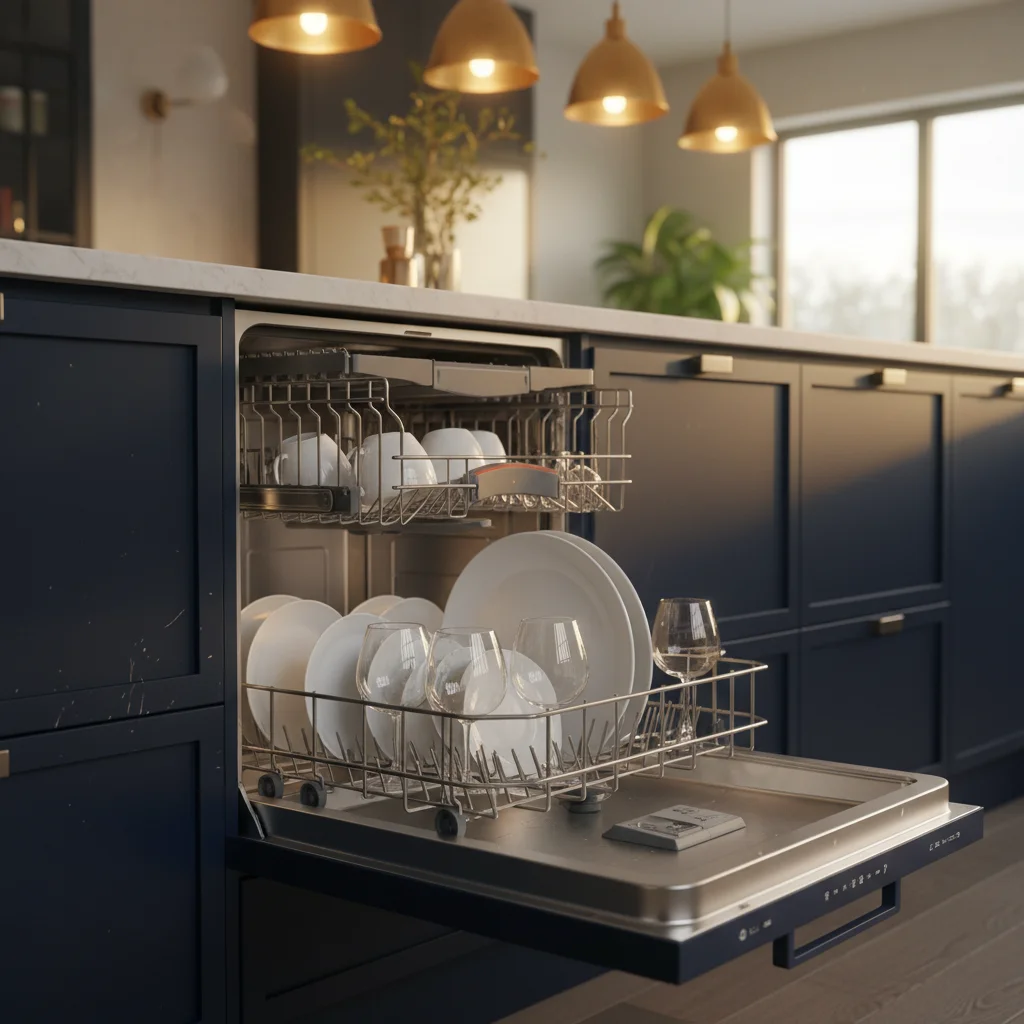
When the cycle runs but the dishes don’t come clean
The cycle sounds normal, the timer counts down — and you open it to spotted glasses, a film on the plates, and a shallow pool of water in the sump. On a KitchenAid dishwasher that combination rarely points to one obvious broken part, and that’s the trap. We translate the symptom into a cause on the first visit, then hand you one firm price. The on-site diagnostic is a flat $89, applied toward the repair when you approve it.
We’re an independent service that has worked the Denver metro since 2012, and we are not affiliated with, endorsed by, or sponsored by KitchenAid or any manufacturer.
How KitchenAid builds these dishwashers
KitchenAid dishwashers run on Whirlpool-group platforms with a few traits that shape every repair:
- Filtration-based wash. A fine filter and sump keep wash water clean, so a partly clogged filter quietly drags down both wash and drain.
- Three-level and ProWash cleaning. Sensors read soil and adjust the cycle, so a fouled sensor can make a healthy machine over- or under-wash.
- Heat dry plus optional ProDry. A heating element and, on many units, a fan handle drying — two separate things that can fail independently.
- Hidden top controls, panel-ready fronts. You see a symptom, not a control panel or an exposed pump, which is why guess-and-swap goes wrong.
Common problems we see
- Won’t drain — clogged filter or sump, blocked hose, stuck check valve, or a jammed drain pump.
- Poor cleaning, film, or grit — scaled spray-arm jets, a fouled soil sensor, or a tired circulation pump.
- Dishes stay wet — low rinse aid, a failed element or high-limit thermostat, or a stalled ProDry fan.
- Leaking or flood-float lockout — hardened door gasket, sump seal, or a cracked hose.
- Blinking clean light or won’t start — a stored fault, a door-latch switch, or a control issue.
- Long or stuck cycles — slow fill from a scaled inlet valve or a thermistor reading off.
Our diagnostic process
- Read the stored fault. We pull the blink-code or service data and pair it with how the machine actually behaves — which cycle, when it stalls.
- Trace the drain path. Filter, sump, hose, air gap, check valve, and drain pump get inspected and bench-confirmed, since a glass chip mimics a dead pump exactly.
- Test the wash and fill side. Inlet valve, float, circulation pump, spray arms, and diverter get checked for scale and blockage.
- Verify the drying chain. Rinse-aid metering, the heating element, its thermostat, and the ProDry fan are measured, not assumed.
- Quote one price. Nothing proceeds without your okay, and the $89 applies to the work.
Why Denver changes the diagnosis
At 5,280 feet the air is roughly 15% thinner, which changes how the machine sheds heat and moisture during the dry cycle — worth knowing before we call a “won’t dry” complaint a real fault. But the bigger force here is hard water at 150–250 ppm: scale crusts the spray-arm jets, coats the heating element so it transfers heat poorly, and narrows the inlet valve until the fill logic reads it as failing. None of those look like hard water — they look like a dead pump, a bad element, or a faulty valve. Add a very dry climate that hardens door gaskets and tub seals early, and a leak can surface well before the seal’s expected life.
Brands and related repairs
KitchenAid sits in the Whirlpool family alongside Jenn-Air, and we service built-in dishwashers from Bosch, Miele, Thermador, Viking, and Dacor too. We also repair KitchenAid refrigerators, ranges, cooktops, and ovens.
Book your repair
If your KitchenAid won’t drain, leaves dishes wet or spotted, leaks, or flashes its clean light, the sooner we see it the smaller the fix tends to be.
- Call (720) 770-4189 — answered 24/7, day or night.
- Book online at https://nexfield.pro/crm/book?u=33.
- Repairs run daily, 8 AM to 6 PM, with same-day or next-day appointments across the Denver metro.
- The diagnostic is a flat $89, applied toward the repair, with the exact price quoted only after an on-site inspection.
Call (720) 770-4189 or book online, and let’s get your KitchenAid clean and draining dry again.