What this repair actually involves
When you call us about a Jenn-Air, the work starts the same way every time: we figure out exactly which part stopped doing its job, then we tell you what it costs to put it right before we touch a screw. That sounds obvious, but on a brand built around moving parts you don’t see — a downdraft blower buried under the counter, an induction inverter behind glass, a convection motor at the back of an oven cavity — the symptom in front of you is frequently one layer removed from the actual failure. Weak downdraft suction can be the blower, a stuck damper, a crushed duct run, or a tired control switch. An oven that “runs cold” can be a sensor, an element, or a door that no longer seals. Our job is to tell those apart on the first visit.
The $89 service call pays for that on-site inspection and a firm, written price, and it folds into the repair if you decide to proceed. We don’t replace parts on a hunch, because the costly mistake on equipment this integrated is swapping a control board when a $35 sensor or a corroded connector was the real story.
If you’d rather skip ahead and book, the phone is (720) 770-4189, answered around the clock, and the online scheduler link is at the bottom of this page.
A quick word on what makes Jenn-Air, Jenn-Air
Jenn-Air earned its name on a single clever idea: the self-ventilating downdraft cooktop. Instead of mounting a hood overhead, the company pulled smoke, steam, and grease down through a vent at the cooking surface and out through ductwork — which let it sell the modular, convertible cartridge cooktop, where you could pop in a grill, a griddle, or a coil element wherever you wanted it. That downdraft DNA still defines the brand’s identity, even as the modern lineup has moved heavily toward induction glass cooktops, built-in column refrigeration, and design-forward wall ovens with connected controls.
The practical upshot for repair is this: a Jenn-Air tends to hide its mechanicals. The downdraft system has a blower, dampers, and ducting you can’t see. The induction tops carry real power electronics under the glass. The built-in refrigeration is engineered to disappear into cabinetry, which means a sealed-system or fan fault doesn’t always announce itself in the open. All of that rewards a technician who knows where the brand routes its complexity — and penalizes the parts-cannon approach, where someone replaces the obvious component and hopes.
What we service for Jenn-Air
- Downdraft cooktops and legacy grill-ranges — the self-venting cooktops and the older convertible cartridge models with interchangeable grill, griddle, and element modules.
- Induction and radiant glass cooktops — full-surface and zoned induction tops plus electric radiant glass-ceramic surfaces.
- Gas and dual-fuel ranges — freestanding and slide-in ranges, including dual-fuel layouts that pair gas burners with an electric convection oven.
- Wall ovens — single and double electric convection ovens, including steam and combination ovens and speed/convection microwave ovens.
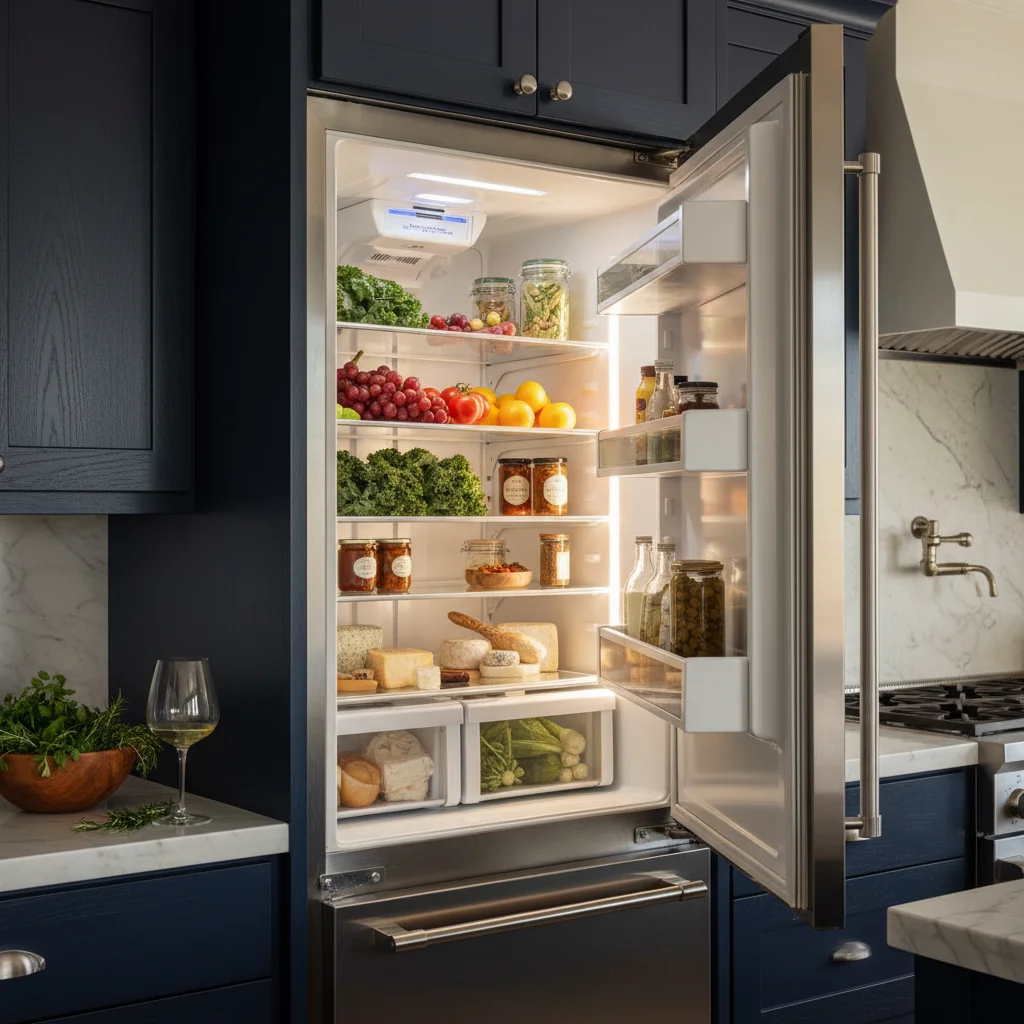
- Built-in and column refrigeration — built-in refrigerators, freezer and refrigerator columns, and matching panels designed to sit flush with cabinetry.
- Dishwashers and ventilation — Jenn-Air dishwashers and the hoods, blowers, and downdraft ventilation that complete the suite.
We are an independent repair company. We are not affiliated with, endorsed by, or sponsored by the manufacturer. What we offer instead is brand-specific experience and parts matched to your model, without making you wait on a factory dispatch queue.
Problems we see most often on Jenn-Air equipment
No two service calls are identical, but certain failures repeat often enough that an experienced tech can usually narrow the field before the panel comes off. On Jenn-Air gear, these are the complaints we diagnose most:
- Downdraft vent that won’t clear smoke — most often a failing blower motor, a damper stuck partway, an obstructed or disconnected duct run, or a worn fan-speed switch. Suction that’s merely weak rather than dead usually points to airflow restriction, not a dead motor.
- Grill or griddle cartridge that won’t heat — on the convertible legacy cooktops, a bad cartridge element, a corroded receptacle, or a control-switch fault. The modular design makes these isolatable once you know how the contacts seat.
- Induction zone errors, shutdowns, or no pan detection — typically the cooling fan, an inverter or relay board, a temperature sensor beneath the glass, or simply non-induction cookware. We verify the fault against the actual circuit before assuming the board.
- Cracked or chipped glass cooktop — induction and radiant surfaces are glass-ceramic; a dropped pan or thermal shock can fracture the top and kill the zones underneath.
- Oven baking unevenly or off-temperature — a drifting oven temperature sensor, a tired bake or broil element, or a convection fan motor that has slowed. The classic case is an oven running 25–40 degrees off without throwing a hard fault code.
- Gas range burner that lights slowly, clicks, or burns yellow — a fouled spark electrode, a cracked igniter, a burner cap seated off its locating pins, or moisture left after a spill. Altitude makes a rich, lazy flame more common here than at sea level.
- Built-in refrigerator not cooling or frosting over — a failing evaporator or condenser fan, a defrost heater or thermostat fault, a sensor reading out of range, or a sealed-system problem. Column units have their own behavior worth diagnosing precisely.
- Ice maker or water-dispenser trouble — clogged lines, a stuck inlet valve, or scale buildup from Denver’s hard water choking the flow.
- Dishwasher won’t drain, fill, or dry — a blocked drain path, a faulty inlet valve, a heating-element failure, or a control fault, frequently with mineral scale in the mix.
- Dead displays, unresponsive touch panels, or connectivity glitches — failed control boards, ribbon-cable issues, or a single touch zone that has gone unresponsive.
How we run the diagnosis
- Confirm the symptom. We reproduce what you’re actually seeing instead of taking the complaint at face value — “the downdraft is weak” and “the downdraft is dead” lead to different parts.
- Read the unit. Stored fault codes, sensor resistance, blower current draw, igniter glow, induction board behavior, and gas pressure where it applies.
- Trace it to one source. We follow the circuit, the airflow path, or the sealed system to the single component that’s out of spec.
- Quote before we wrench. You hear the cause, the part, and the total up front, and nothing moves forward without your okay.
Inspection and honest pricing
Here is exactly how the money works, with no asterisks. The $89 service call buys a complete on-site inspection, a genuine diagnosis, and a written price. If you approve the repair, that $89 is credited toward the total — so on any job you go ahead with, the diagnostic effectively becomes free. We quote the repair price only after a technician has seen the unit, because guessing a number over the phone for a brand with this much model-to-model variation would be dishonest. What you will never get from us is a quote that grows once the work is underway.
That up-front discipline matters more on Jenn-Air than on a budget appliance, because the wrong guess is expensive. An induction inverter board, a sealed-system repair, or a downdraft blower assembly are not cheap parts, and the difference between diagnosing the real fault and shotgunning the obvious one can be hundreds of dollars. We would rather spend an extra fifteen minutes confirming the cause than send you a part you didn’t need.
How Denver’s elevation, water, and dry air change the job
This is where servicing a Jenn-Air in Denver genuinely differs from servicing one at sea level — and it’s the part a generic, out-of-town dispatch tech tends to miss entirely.
Thinner air at 5,280 feet. Denver’s air is roughly 15% less dense than at sea level, and that touches almost everything Jenn-Air makes. Gas burns differently up here: the air-fuel mixture skews rich unless burner orifices and air shutters are sized for altitude, which is why a range burner that ran a crisp blue flame at a lower elevation can burn lazy and yellow after a move to Colorado. Thin air also matters for the downdraft system — a blower moving less-dense air does less work per revolution, so a marginal motor or a slightly restricted duct that coped at sea level can leave smoke hanging over the cooktop here. The same physics affects baking: a thinner atmosphere changes how an oven circulates and sheds heat, so a drifting sensor or a slowing convection fan produces noticeably worse results than it would near the coast. And refrigeration feels it too — thinner air rejects compressor heat less efficiently, so a sealed system already near its limit shows symptoms sooner. We build all of this into the diagnosis from the first minute.
Hard water, roughly 150–250 ppm. Much of the metro runs hard, and that mineral load scales up anything that touches water. On Jenn-Air equipment that means ice makers and water dispensers on built-in refrigeration, dishwashers, and the reservoirs and lines on steam ovens. Scale builds quietly and gets ignored until an ice maker slows to a trickle or a steam oven won’t fill, so we flag it whenever we see it and suggest a descale interval that fits local water.
A very dry climate. Denver’s low humidity is hard on rubber. Oven door seals and refrigerator gaskets dry out, stiffen, and crack sooner here than in humid regions, which shows up as longer preheats, uneven baking, a door that won’t hold heat, or a fridge running constantly to hold temperature. A door or gasket complaint that looks cosmetic is often an early seal failure worth catching before it costs you energy.
Strong UV and a punishing dry-cold winter round out the picture, accelerating wear on exposed trim, ventilation components, and externally routed parts. None of this is exotic — it’s simply Denver reality, and folding it into the diagnosis is what an altitude-aware local specialist offers that a national call center cannot.
Why an independent specialist instead of the manufacturer
Routing a premium-brand repair through a factory channel usually means a longer wait and a rigid script. As an independent specialist that has worked on high-end cooking and refrigeration across the Denver metro since 2012, we offer a different arrangement: same-day or next-day scheduling, a real diagnosis rather than a parts-swap lottery, OEM-grade parts matched to your exact model, and a price you approve before work begins. Because we concentrate on premium appliances, a downdraft cooktop or a built-in refrigeration column isn’t a unit we’re learning on your dime. To be clear, independent means independent — we are not authorized by or affiliated with the maker. For most Denver homeowners, the speed and the straight talk are the better deal.
Parts and making the fix last
A Jenn-Air is built to anchor a kitchen for many years, and a proper repair should respect that. We install OEM-grade and manufacturer-compatible parts from verified suppliers, matched to your model and serial number. That choice matters most on the components that decide how long a fix holds — oven sensors, igniters and spark modules, gas valves, convection and blower motors, induction power boards, and refrigeration controls. A bargain igniter that doesn’t match the original spec might light cleanly on day one and quit by the next holiday; a correctly matched part is what keeps you from calling us back for the same complaint.
Durability also comes from repairing the true cause, not the visible symptom. If an oven sensor reads high because its connector is corroded, replacing the sensor alone is a patch — we address the connector too. If a downdraft pulls weakly because the duct is partly blocked, a new blower solves nothing. Keeping the vent path clear, wiping spills before they bake on, using flat-bottomed induction-rated cookware, and descaling water-fed appliances on schedule all stretch the life of the parts we’d otherwise be back to replace.
Related repairs you might also need
A Jenn-Air rarely lives alone in a kitchen, and the same Denver conditions that age one appliance age the others. If you’re booking us for a cooktop or oven, it’s worth knowing we also handle the rest of the suite:
- Built-in and column refrigeration — cooling loss, frost, fan and defrost faults, ice and water issues.
- Dishwashers — drainage, fill, heating, and control faults, often with hard-water scale involved.
- Wall ovens and ranges — element, sensor, convection, igniter, and control-panel repairs.
- Downdraft and overhead ventilation — blower, damper, duct, and switch work.
We service these premium-appliance categories across other major brands too, so if your kitchen mixes makers, one call can usually cover more than one machine.
Ready to book
Getting a Jenn-Air looked at is quick:
- Call (720) 770-4189 — the line is answered 24/7, so you can reach a real person whenever it suits you. Repairs themselves run daily from 8:00 AM to 6:00 PM.
- Or book online through the scheduler and pick a window that works for you.
- Meet the technician, who diagnoses the real cause on site and gives you a firm, up-front price. The $89 service call covers that visit and is credited toward the repair if you proceed.
Whether it’s a downdraft that won’t pull smoke, an induction zone throwing a code, a wall oven baking off-temperature before a dinner party, or a built-in fridge losing its chill, we’ll find what actually failed and tell you the price before we fix it.
Ready when you are — call (720) 770-4189 or book online to get your Jenn-Air cooktop, range, oven, or refrigerator back in service across the Denver metro.