What sets a Gaggenau refrigerator repair apart
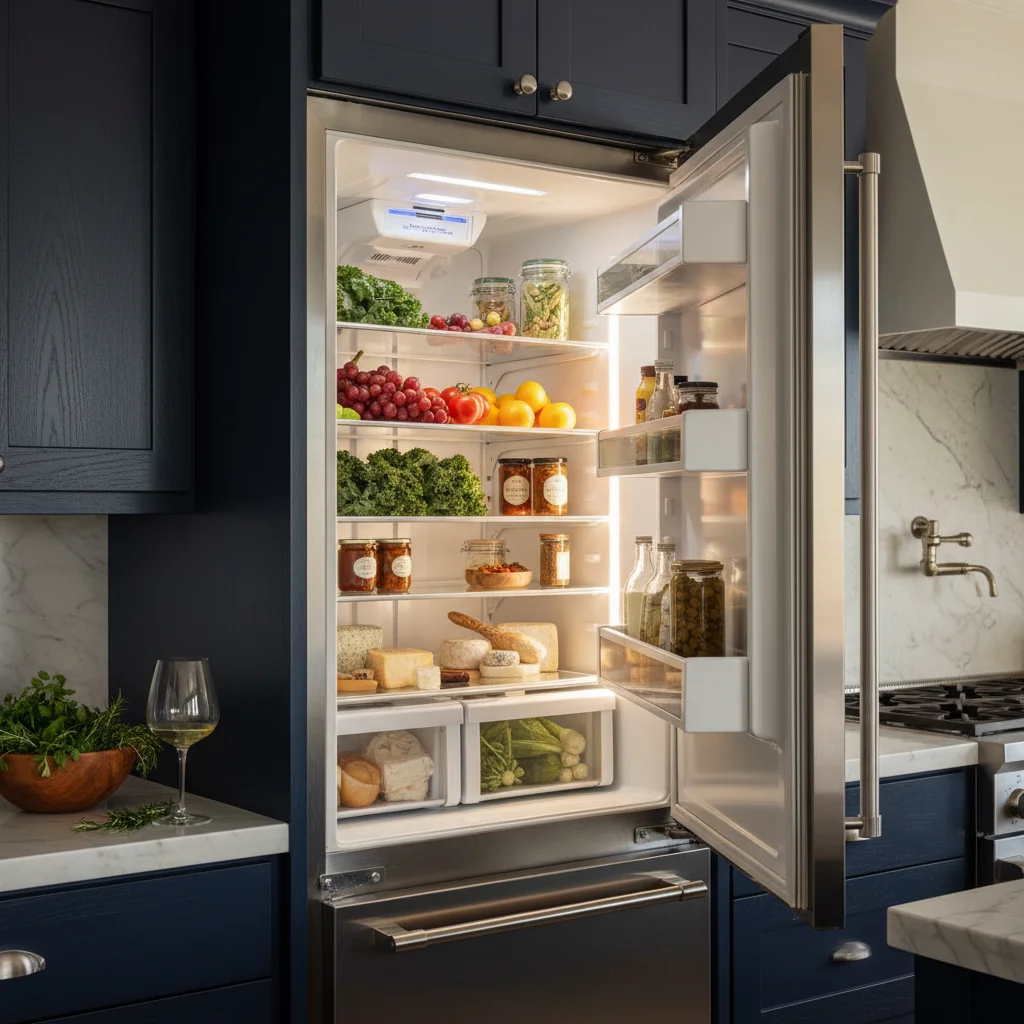
Most refrigerators are a single appliance: one box, one cooling system, one door. A Gaggenau is not built that way, and that difference shapes every repair. Gaggenau designs its cold storage as Vario columns — separate refrigerator, freezer, and wine cabinets meant to be mixed and built flush into a wall rather than parked beside one another as a single freestanding unit. Each column carries its own evaporator, its own fan and damper logic, and its own electronics that quietly track temperature, door events, and fault history. The brand’s design language leans architectural and deliberately spare: flush stainless, a soft interior glow, full TFT or touch controls, and an obsessive approach to even, drift-free temperature for serious cooking and wine.
That architecture is exactly why the symptom you notice rarely points straight at the broken part. A standard fridge that warms up has a short list of suspects. A Gaggenau column that warms up could be reporting a fan it can no longer spin, a damper stuck mid-travel, a defrost circuit that has shut down on one cabinet, or a sensor lying to the control board — and because the columns run independently, a fault in one says little about the others. Sorting that out takes a technician who reads how the unit is engineered, not one who swaps parts until the noise stops.
The $89 service call covers a full on-site inspection and folds into the repair if you go ahead. On equipment built this carefully, the costly mistake is condemning a compressor or a control board when an $80 sensor or a tired fan motor was the real story. If you would rather schedule now, the line is (720) 770-4189, answered around the clock, with online booking at the bottom of this page.
The repair, explained
A Gaggenau refrigerator keeps its cabinet cold through a chain of cooperating systems, and a good repair starts by knowing which link in that chain failed. Refrigerant is compressed, sheds its heat across a condenser, then expands through the evaporator inside the column where a fan pushes the resulting cold air across the food. A damper meters how much of that air reaches the fresh-food section, a periodic defrost cycle clears the evaporator of ice, and a network of sensors feeds the control board so it can hold a target within a tight band. Gaggenau wine columns add a second layer of precision — multiple temperature zones, humidity management, and UV-screened glass — because wine punishes the swings a beverage drawer would shrug off.
Built-in columns also live in a thermally tougher spot than a freestanding fridge. They sit inside cabinetry, vent through engineered grilles top and bottom, and depend on that airflow path staying clear to reject heat. When a column’s ventilation is choked, or its condenser is packed with the fine dust a built-in inevitably pulls in, the whole system has to work harder to hold the same temperature. Here is the sequence we work through on a typical Gaggenau cooling call:
- Confirm the real complaint. Warm fresh-food side, frost in the freezer, water on the floor, a column that runs without pause, or an error on the display — each starts the diagnosis down a different road.
- Read what the appliance reports. Gaggenau electronics log fault codes and let a technician interrogate sensor values, so we check what the unit believes about itself before we assume anything.
- Verify heat rejection. We inspect the condenser, the condenser fan, and the built-in ventilation path, because at altitude that side of the system has the least margin to spare.
- Trace the cold side. Evaporator condition, fan operation, damper movement, and the defrost circuit get checked against how that specific column is designed to behave.
- Isolate to one component, then quote. Only after the fault is pinned to a single part do we attach a firm, written price.
Symptoms and what usually causes them
No two service calls are identical, but Gaggenau refrigeration tends to fail along recognizable lines. An experienced tech can often narrow the field before a panel comes off, then confirm it with instruments rather than assumption. These are the patterns we see most:
- Fresh-food column drifts warm while the freezer holds. Because the columns are independent, this points at that cabinet’s evaporator fan stalling, a damper stuck closed, a frosted evaporator from a defrost fault, or a sensor feeding the control bad numbers — not a dead compressor.
- Column runs constantly and never cycles off. Almost always lost efficiency: a heat-clogged condenser, a fading condenser fan, a gasket no longer sealing in Denver’s dry climate, or a sealed-system charge that has slipped. We test these before the word compressor enters the conversation.
- Frost or ice where it does not belong. A broken automatic defrost cycle — failed heater, a defrost sensor or thermostat out of range, or a control board not triggering the cycle. The ice is the symptom; the failed part sits upstream of it.
- Water pooling inside or under the unit. Often a defrost drain clogged with debris or scale, or a melt event from an interrupted defrost cycle. On plumbed columns it can also trace to the water line or inlet valve.
- Ice maker or water dispenser problems on plumbed models. Restricted lines, a stuck inlet valve, or scale narrowing the works. Denver’s hard water, in the roughly 150 to 250 ppm range, deposits mineral scale faster than soft-water regions and is a recurring offender here.
- Wine column temperature or zone errors. A drifting sensor, a fan or damper fault between zones, or a control problem letting the cabinet swing outside the narrow band wine tolerates.
- Door, gasket, or alarm complaints. A door that no longer pulls flush, a gasket gone stiff and leaky, or a door-ajar alarm that will not clear — frequently a worn seal or a hinge out of adjustment, sometimes a switch.
- Noise, buzzing, or rattles. A worn evaporator or condenser fan bearing, refrigerant flow noise, or a loose component resonating against built-in cabinetry.
Why a Gaggenau refrigerator rewards a specialist
The temptation with any high-end fridge that warms up is to assume the worst and quote a compressor. On a Gaggenau that assumption is usually wrong and always expensive. The independent-column design means a single warm cabinet is far more likely a fan, damper, defrost, or sensor issue confined to that column — and the only way to know is to read the electronics and test the circuit, not to guess from the symptom.
Built-in installation raises the stakes too. These columns are integrated into cabinetry with panels, custom fronts, and engineered ventilation, so pulling one for service is a careful job, not a yank-and-replace. A technician who knows the platform diagnoses in place wherever possible, removes only what the repair genuinely requires, and reseats everything so the unit still sits flush and vents the way it was designed to. Get that wrong and a perfectly repaired column can run hot simply because its airflow path was never restored.
There is also the Denver factor, and it is not marketing. At our 5,280-foot altitude the air is roughly 15 percent thinner, which reduces how efficiently a condenser and condenser fan can reject heat. A sealed system that would coast at sea level runs with less margin here, so a slightly low refrigerant charge or a marginal condenser fan reveals itself sooner — and a sealed-system fault gets misread as something cheaper if the diagnostician does not account for elevation. Layer on hard water around 150 to 250 ppm that scales ice makers and water lines, and a very dry climate that ages door gaskets faster than humid regions, and you have a set of stresses a sea-level playbook simply does not anticipate. We diagnose with those conditions in mind from the first measurement.
We are an independent repair company. We are not affiliated with, endorsed by, or sponsored by Gaggenau or its parent group. What we offer instead is hands-on familiarity with these specific designs, parts matched to your unit, and no factory queue to wait in.
What a visit looks like
When you call (720) 770-4189, we gather the basics — what the refrigerator is doing, roughly how old it is, and the model and serial if you can find them, since those numbers let us arrive with the right parts more often. We confirm an appointment window, usually same or next day, and a technician comes to you.
On site, the work runs in a deliberate order:
- We listen to your description and reproduce the complaint so we are solving the real problem.
- We interrogate the control electronics for stored codes and live sensor readings.
- We check heat rejection first — condenser, condenser fan, and the built-in ventilation path — then move to the cold side: evaporator, fan, damper, and defrost circuit.
- We trace the fault to a single component and explain, in plain terms, what failed and why.
- You get a firm, written price before any repair begins. Nothing proceeds without your approval.
Many parts are common enough to carry, so a fair number of repairs finish in one visit. When a component has to be ordered to match your exact model and serial, we tell you that up front and schedule the return promptly. Either way, the diagnosis and the price come before the work, never after.
Pricing, plainly stated
Gaggenau refrigeration spans too many models and failure modes for an honest number over the phone, so we keep pricing simple and transparent:
- The on-site diagnostic is a flat $89.
- That $89 is credited toward the repair if you approve the work — it is the first part of the job, not an add-on.
- The exact repair price is quoted only after an in-person inspection, in writing, before anything is touched.
- We use OEM-grade and manufacturer-compatible parts from verified suppliers, matched to your model and serial.
- No surprise charges appear after the quote. The number you approve is the number you pay.
Common questions before you call
Is it worth repairing a high-end Gaggenau column, or should I replace it? Usually repairing. Built-in columns are expensive to buy and to install, and a single failed fan, sensor, damper, or defrost part is a modest fraction of replacement cost. We give you a straight assessment so you can decide with real numbers in hand.
My fridge column is warm but the freezer column is fine — is the whole system dead? Very unlikely. The columns run independently, so a warm fresh-food cabinet with a healthy freezer almost always isolates to that one column’s fan, damper, defrost, or sensor.
Could Denver’s altitude actually be causing my refrigerator trouble? It can tip a marginal system over the edge. Thinner air makes heat rejection harder, so a slightly low charge or a weak condenser fan that would hide at sea level surfaces here. We measure with elevation in mind rather than against a sea-level baseline.
Do you work on Gaggenau wine columns too? Yes. We diagnose zone temperature errors, humidity faults, fan and damper problems, and control issues on Vario wine columns, where the tolerances are tighter than ordinary refrigeration.
Will you remove a built-in column to service it? Only as far as the repair requires. We diagnose in place where possible, and when removal is necessary we reseat the unit so it sits flush and vents correctly afterward.
How do I get the fastest help if food is at risk? Call (720) 770-4189 now. The phone is answered 24/7, repairs run daily from 8 AM to 6 PM, and we will try to move an urgent cooling-loss call up in the day’s schedule.
If your Gaggenau refrigerator is warming, frosting, leaking, or running without pause, get it diagnosed before the food and the bigger components are at risk. Call (720) 770-4189 — answered any hour — or use the online booking link to lock in a same-day or next-day visit. The $89 service call gets you a real diagnosis, a written price, and a repair done right the first time, with that $89 credited toward the work.