Quick orientation
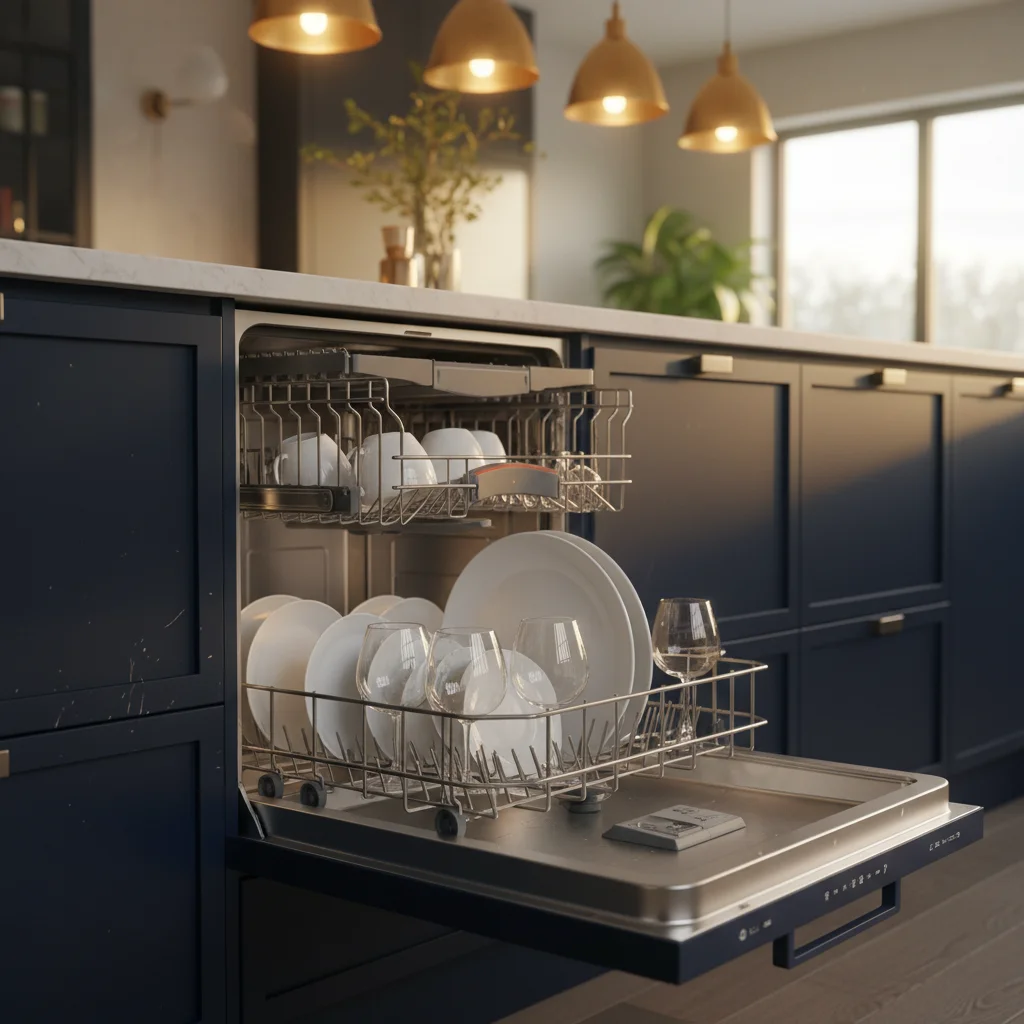
A Gaggenau dishwasher is built to be invisible. It hides behind a furniture-matched panel, seals to the cabinetry on flush-fit models so the seam nearly vanishes, and runs at a sound level you have to lean in to hear. That refinement is wonderful right up until something goes wrong — because the same quiet, sealed design that makes the machine feel premium also means the early warning signs are subtle. Dishes come out a shade damp. There’s a thin film of water over the filter after a cycle. A program light blinks once and you assume it reset itself. None of it is loud, so none of it feels urgent.
That is the trap. The fault that’s cheap to fix today is rarely the part you notice first, and on a machine this tightly integrated, guessing at the cause gets expensive fast. Our entire approach is built around not guessing. We read what the control board is reporting, we test the suspect circuit instead of assuming, and we trace the symptom back to a single named component before we quote anything.
You also get the price logic up front. The on-site diagnostic is a flat $89, and that covers a genuine inspection, an actual diagnosis, and a written repair price — not a vague estimate. If you approve the work, the $89 is credited toward the total, so you don’t pay for the visit twice. You’ll never hear an exact repair figure invented over the phone, because the honest number depends on what the technician finds inside your specific unit.
If your Gaggenau is leaving dishes wet, holding standing water, refusing to start, or weeping at the toe-kick, call (720) 770-4189 any time. The phone is answered around the clock, and we’ll get a technician scheduled.
Most common faults
Every job starts from a symptom, so it helps to describe what you’re actually seeing rather than guessing at the cause. On Gaggenau dishwashers, the complaints we hear sort into a handful of recognizable patterns — and knowing how the machine is built tells you why each one happens.
These are BSH-engineered units on a refined European platform: a recirculating wash pump and a separate drain pump, a fine multi-stage filter at the base of the tub, a turbidity/AquaSensor that reads how dirty the water is and adjusts the cycle, sensor-driven fill and temperature control, and a board that orchestrates all of it. Drying is condensation-based, sometimes assisted by a mineral drying medium (the zeolith-style approach) or a vent fan and damper rather than a glowing element. Most models include a base-pan flood float / AquaStop that locks the unit out the instant it detects water where it shouldn’t be. Here is how that architecture maps to what you notice:
- Dishes still wet at the end of the cycle. Plastics beaded, glassware spotted, the tub interior damp. Because Gaggenau dries by condensation — and on premium models by drawing the final stage’s moisture through a mineral medium — this rarely means a “burned-out heating coil.” It’s far more often a low rinse-aid setting, a stuck vent damper, a failed fan, or a heater/thermistor fault the board can flag.
- Standing water left in the bottom. A shallow pool over the filter after a finished program, sometimes with a sour edge to it. This is a drain-path story until proven otherwise — filter, sump, hose, check valve, or pump.
- Won’t start, or stops partway through. The cycle indicator blinks, the door feels latched but the program never advances, or the unit powers down a few minutes in. Usually a door latch/interlock not registering, a tripped flood float sitting in a base-pan leak, or a thermal or control fault shown as a specific blink pattern.
- A leak you can see or smell. Water at the toe-kick, a damp cabinet base, or a musty odor near the unit. On flush-fit installations the panel can mask a slow weep for a while, so the first real evidence is sometimes the floor.
- Poor wash results. Grit on plates, cloudy glassware, detergent not fully dissolving, or a residue that wasn’t there last month. Often a spray-arm, water-temperature, or hard-water-scale issue rather than the wash pump itself.
- New noise. A grinding or buzzing during drain or wash that wasn’t there before, typically pointing at the drain pump, the wash motor, or a foreign object — a shard of glass, a fruit pit, a bit of bone — lodged in the chopper or impeller.
- Won’t fill, or fills slowly. A weak or noisy fill traces to the inlet/AquaStop valve, a kinked supply line, or scale narrowing the water path — common on Denver’s hard water.
You don’t have to diagnose it yourself. The more precisely you can describe the symptom and exactly when in the cycle it happens, the faster we narrow the field before a single panel comes off. A drain complaint that only appears on heavy cycles points somewhere different than one that trips on every program, and that detail saves time on-site.
Parts & longevity
The reason we lean so hard on diagnosis-before-replacement is that a board-driven, tightly sealed machine punishes part-swapping. On a Gaggenau dishwasher, the costly mistake is condemning the control board when a $25 thermistor, a stuck flood float, or a partly blocked filter was the real culprit. So we test the suspect circuit, confirm a single root cause, and only then talk parts.
When a component genuinely needs replacing, we fit OEM-grade and manufacturer-compatible parts from verified suppliers, matched to your exact model and serial. We’re an independent company, not a factory channel, so we’re not routing you through an authorized-service bottleneck — but on the parts that decide whether the repair lasts, we choose correct fitment over the cheapest line item every time. The components that matter most for longevity on these machines are:
- Drain and wash pumps. The drain pump is the workhorse and the most common mechanical failure; the wash/circulation pump fails less often but louder. We bench-confirm a pump before quoting one, because a surprising share of “dead pump” calls turn out to be debris jammed in the impeller.
- Inlet / AquaStop valve. Controls fill and is a frequent casualty of hard-water scale and pressure cycling. A weak or stuck valve shows up as slow fills, no fill, or a flood-protection trip.
- Door gasket and tub seals. These are rubber, and rubber is exactly what Denver’s dry air attacks. Replacing a tired seal early is a small job; ignoring it is how a leak reaches the subfloor.
- Heater and thermistor. The heating circuit drives both wash-water temperature and the drying stage. When it drifts or fails, you feel it as poor drying and weak wash at once.
- Control board and sensors. The turbidity/AquaSensor, fill and temperature sensors, and the main board are the brains. They fail less than people assume, which is precisely why we verify them against the actual circuit before condemning one.
Treated well — descaled on a schedule that matches local water, filter cleaned regularly, rinse aid kept topped — these are long-lived machines. Most of the units we see haven’t reached the end of their service life; they’ve hit a single failed part, and replacing that one part returns the whole dishwasher to spec.
The altitude and water angle
Denver changes how appliances age, and a dishwasher is no exception. We factor three local realities directly into the diagnosis rather than treating your machine like it lives at sea level.
Hard water, roughly 150–250 ppm. Much of the metro runs hard, and that mineral load scales up everything water touches inside a dishwasher: the heater element, the spray-arm jets, the inlet valve, and the fine filter. Scale is slow and easy to ignore until a fill slows to a trickle, drying weakens because the heater can’t transfer heat through a mineral crust, or wash results go cloudy. When we see scale contributing to your symptom, we’ll say so plainly and suggest a descale interval matched to Denver’s water — not a generic one printed for a softer region.
Very dry climate. Denver’s low humidity is the opposite of the conditions European seal materials are typically rated for, and it hardens and shrinks rubber faster than humid regions do. That means door gaskets and tub seals here can crack and start weeping well before the part’s nominal service life — so on a Denver unit, a leak from seal shrinkage is a realistic finding even on a relatively young machine. The flip side is genuinely good news: condensation drying works better in dry air, so if your Gaggenau suddenly stops drying well, the climate isn’t to blame — a component is, and that narrows our search.
Thinner air at 5,280 feet. Denver sits a mile up, where the air is roughly 15% thinner. For a dishwasher this matters less than it does for a sealed refrigeration system or a gas burner, but it still nudges heat-transfer and drying behavior at the margins. Where it earns its keep is in judgment calls: when we’re deciding whether a drying or heating complaint is a true component failure or simply normal performance for this environment, accounting for altitude keeps us from chasing a “fault” that’s really just physics.
None of this is upsell. It’s the difference between fixing the symptom and fixing the cause — and between a repair that holds and one that comes back in three months.
How to book
Getting a Gaggenau dishwasher repaired here is meant to be simple and honest from the first call.
- Call (720) 770-4189. The phone is answered 24/7, so reach out whenever it’s convenient — late at night, early morning, weekend. If your only dishwasher is leaking or locked out, tell us; we’ll try to move your appointment up.
- Or book online any time, and we’ll confirm a window. We typically offer same-day or next-day appointments across the Denver metro. Repairs themselves run daily from 8 AM to 6 PM.
- Have your model and serial ready if you can — the E-Nr and FD numbers from the rating label inside the door. That lets us pre-stage the right OEM-grade parts and arrive prepared.
- The visit is a flat $89. That covers a full on-site inspection, a real diagnosis, and a firm written price. Approve the repair and the $89 is credited toward it.
We’ve served the Denver metro since 2012 as an independent appliance-repair company — Denver proper plus Aurora, Lakewood, Centennial, Highlands Ranch, Littleton, Arvada, Westminster, Englewood, and the neighboring communities. To be clear: we are not affiliated with, endorsed by, or sponsored by Gaggenau or its parent group, or any manufacturer. What we bring instead is brand-specific experience, parts matched to your model, and a diagnosis that finds the one component that actually failed.
If your Gaggenau dishwasher is leaving dishes wet, holding standing water, refusing to start, or quietly leaking behind the panel, don’t wait for a small fault to soak a cabinet base or seize a pump. Call (720) 770-4189 now, or book online, and we’ll get a technician out with an up-front $89 service call that turns a guess into a real answer.