A cycle that quits with the door still shut
Here is the scene we hear most often on Miele calls: you loaded the dishwasher last night, started a program, and this morning the door is still closed, the dishes are damp, and a small indicator is blinking. Maybe there’s a fault code in the display, maybe just an intake/drain light pulsing in the dark. Because a Miele is engineered to run almost silently and to seal tightly, nothing announced the failure — the machine simply stopped doing its job somewhere in the middle of the night and waited.
That quiet is exactly what makes these units easy to misread. A blinking light gets blamed on “the computer,” AutoOpen that never popped gets blamed on the drying element, and a unit that won’t start at all gets written off as a dead board. On a Miele, those assumptions are usually wrong, and acting on them is how a $25 sensor turns into a needless electronics swap.
If your Miele dishwasher has stopped mid-program, won’t drain, isn’t drying, or has thrown a fault code, the fastest path to a real answer is a real diagnosis. Call (720) 770-4189 — answered around the clock — and we’ll get a technician scheduled. The $89 service call buys an actual root-cause and a firm price, and it’s credited toward the repair if you go ahead.
How a Miele dishwasher is built — and why it matters
Miele designs and builds its dishwashers on its own platform rather than buying into a shared one, and the company tests them to a long service-life standard. That engineering is the reason these machines fail differently from the mid-market units a tech might see every day, and understanding the architecture is what turns a guess into a diagnosis.
A few traits shape almost every repair:
- A flow-through heater, not an exposed coil. Miele heats water as it circulates rather than with a visible element in the tub floor. When drying or wash temperature is off, the suspects are the heater, the NTC temperature sensor, and the circulation path — not a burned coil you can see.
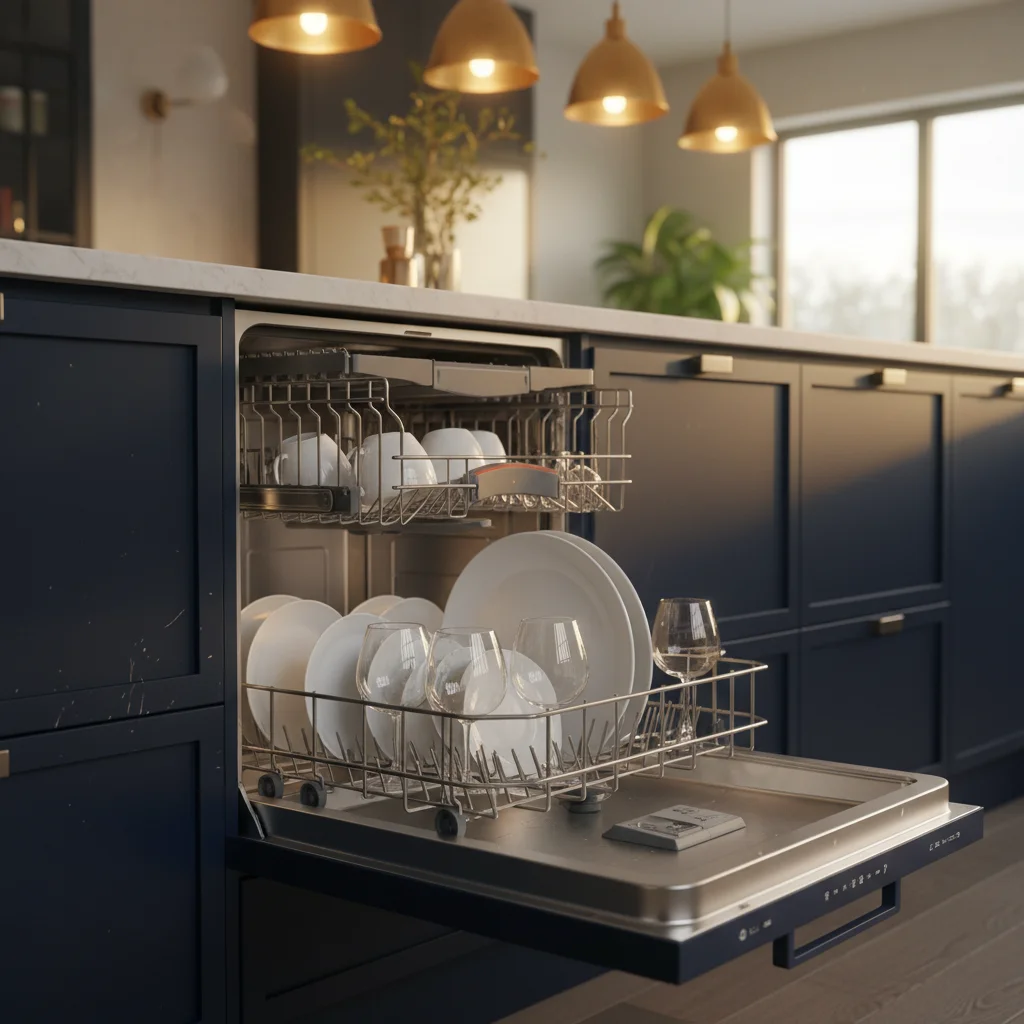
- Condensation drying, finished by AutoOpen. Instead of blasting heat, the tub cools and moisture condenses on the stainless walls; on AutoOpen models a motorized mechanism cracks the door at the end to vent steam and pull in ambient air. Drying performance therefore depends on rinse aid, the heating circuit, and the AutoOpen actuator all working together.
- A flow meter and sensor-driven fill. Miele meters incoming water by flow rather than relying solely on a timed fill, which makes intake faults (F12, slow or no fill) point toward the intake valve, the flow meter, or a starved water supply.
- The Waterproof System. A base-pan float and intake-hose safety valve cut water and lock the machine out the instant a leak is detected. This is a safety feature, not a malfunction — but it means many “won’t run” complaints are actually “there is water where there shouldn’t be.”
- A triple filter and quiet drain/circulation pumps. The fine filtration keeps wash water clean and keeps the machine quiet, but it also collects debris that, left alone, starves the wash and the drain.
- AutoDos with the PowerDisk and conveniences like Knock2open handleless doors and the 3D MultiFlex third tray, which add their own small electromechanical parts to the picture.
Name the architecture and the failures stop looking random.
Common problems on Miele dishwashers
Every job starts from a symptom, so it helps to describe what you’re actually seeing rather than guessing at the cause. On Miele units the complaints cluster into a recognizable set:
- A fault code or blinking light. F-codes such as F11/F12/F14 (drain, intake, or flow issues), F24-type heating faults, and pulsing intake/drain indicators. These are clues, not verdicts — each points at a subsystem to test.
- Standing water in the bottom. A pool over the filter after a finished cycle, sometimes sour-smelling. This is a drain-path story until proven otherwise: filter, sump, hose, check valve, or pump.
- Won’t drain at all. The cycle ends but the tub stays full, often with an intake/drain warning. A jammed drain pump or a blocked non-return valve is common here.
- Damp dishes / AutoOpen that didn’t open. Plastics beaded, glassware spotted, and on AutoOpen models a door that never cracked at the end. Rinse aid, the heater circuit, or the AutoOpen actuator.
- It won’t start or stops partway. A door/Knock2open latch not registering, a tripped Waterproof float sitting in a base-pan leak, or a thermal/flow fault that halts the program.
- A leak you can see or smell. Water at the toe-kick, a damp cabinet base, or a musty odor — frequently paired with a Waterproof lockout once the float trips.
- Weak wash results. Grit left on plates, cloudy glass, detergent not dissolving. Usually scaled spray-arm jets, a clogged filter, low water temperature, or hard-water film — often several at once on Denver water.
- New noise. Grinding or buzzing on drain or wash that wasn’t there before, pointing at the drain pump, the circulation motor, or a foreign object in the pump chamber.
You don’t have to diagnose it yourself. The more precisely you can describe the symptom — which code, when in the cycle it happens, whether the door opened — the faster we narrow the field before a panel comes off.
Our diagnostic process
We run the same disciplined sequence on every Miele dishwasher, because this brand rewards patience over part-swapping.
Read what the machine is reporting
Miele’s electronics store fault information, and the service menu and code history tell us far more than the single blinking light a homeowner sees. We pull the code, note the cycle behavior, and pair both with your description of when the problem appears. A drain fault that shows up only on intensive programs points somewhere different than one that trips on every cycle. That read narrows the suspects before any disassembly.
Trace the fault to one named component
From there we test rather than assume. If the unit won’t drain, we open and inspect the triple filter and sump, check the drain hose and the non-return valve, and bench-confirm the pump before quoting it — because a seed or glass shard in the impeller mimics a dead pump exactly. If drying is weak, we verify the rinse-aid setting and metering, confirm the flow-through heater and NTC sensor, and watch the AutoOpen actuator actually release the door, instead of condemning a heater because the dishes were wet. If the machine is locked out, we find the water the Waterproof float is reacting to before touching electronics. The goal is one root cause with a name, not a list of maybes.
Factor in Denver’s water and air
We adjust the diagnosis for the local environment directly rather than treating every unit as if it lived at sea level:
- Hard water (~150–250 ppm) lays scale on the flow-through heater, the spray-arm jets, and the intake valve. We look for mineral buildup as a contributing cause of weak drying, poor wash, and slow fills, and we’ll tell you honestly when a descale and a regular-maintenance habit will head off the next failure.
- Very dry air ages the door gasket and tub seals faster than Miele’s humid-climate assumptions, so a leak on a Denver unit can come from seal shrinkage well before the part’s typical service life.
- Thinner air at 5,280 feet subtly changes heat behavior, which matters most when we’re judging whether a drying or heating complaint is a true component fault or simply normal performance for this environment.
Quote it straight, then fix it
You get a plain explanation of what failed and one written price before we touch a part. We install OEM-grade and manufacturer-compatible parts matched to your exact model and serial, and we don’t pad the job with components that tested fine. The $89 diagnostic folds into that repair price if you proceed.
Denver-specific factors on a Miele
It’s worth dwelling on why a high-altitude, hard-water city is rough on a precision dishwasher, because it changes what wears out and how fast.
Miele’s filtration and quiet pumps are engineered around clean, scale-free water moving freely through narrow passages. Denver’s 150–250 ppm hardness fights that on every cycle. Scale builds on the flow-through heater, where it slows heat transfer and pushes drying and wash temperatures down; it narrows the spray-arm jets, which shows up as grit left on the bottom rack; and it crusts the intake valve, which the flow meter then reads as a slow or failed fill. None of these failures look like “hard water” to a homeowner — they look like a broken heater, a worn pump, or a dead valve — which is exactly why the descaling angle gets missed by techs who don’t account for it.
The dry climate works on a different part. A door gasket on a Front Range Miele lives in roughly fifteen-percent-thinner, far drier air than the gasket in a coastal home, and rubber that dries out shrinks and hardens, then weeps. Because the Waterproof System reacts to that weep by locking the machine out, a tired seal frequently surfaces not as a visible puddle but as a dishwasher that flatly refuses to start. We’ve learned to check the base pan and float before assuming the control side is at fault.
Altitude matters least but isn’t nothing: thinner air shifts heat rejection and boiling behavior slightly, and on a condensation-drying machine that informs whether a “won’t dry” complaint is a genuine fault or the unit performing as it should up here.
Coverage, brands, and the rest of your kitchen
We’re an independent appliance-repair company that has served the Denver metro since 2012. We are not affiliated with, endorsed by, or sponsored by Miele or any manufacturer — what we offer instead is brand-specific experience and parts matched to your model, without routing you through a factory channel.
For Miele, we service fully integrated, panel-ready, and freestanding dishwashers, including G 5000 and G 7000 generations and Lumen-era units, models with AutoOpen drying, the 3D MultiFlex tray, Knock2open handleless fronts, and the AutoDos/PowerDisk system. Because the same drain-path, sensor, and seal logic carries across premium dishwashers generally, that diagnostic discipline extends to the other brands we handle — Sub-Zero, Wolf, Cove, Bosch, Thermador, Gaggenau, Viking, Dacor, JennAir, KitchenAid, Fisher & Paykel, and more — and to the rest of a Miele kitchen suite, from ovens and steam ovens to cooktops and refrigeration.
We cover Denver proper and the surrounding suburbs — Aurora, Lakewood, Centennial, Highlands Ranch, Littleton, Arvada, Westminster, Englewood, and the neighboring communities across the metro.
Book your Miele dishwasher repair
A Miele dishwasher is a precise, tightly sealed machine, and it deserves a repair that finds the one component that actually failed instead of guessing through expensive parts. If yours has thrown a fault code, stalled with the door shut, left dishes damp, held standing water, or locked itself out after a leak, the smart move is to catch it before a small fault becomes a soaked cabinet base or a seized pump.
Call (720) 770-4189 any time — the phone is answered 24/7, and repairs run daily from 8 AM to 6 PM. The $89 service call covers a full on-site inspection and a firm, up-front price, and it’s credited toward the repair if you go ahead. You can also book online whenever it’s convenient, and we’ll confirm a same-day or next-day window anywhere across the Denver metro.