What happens on a Fisher & Paykel service call
When you book a Fisher & Paykel repair, the first move is to figure out which self-contained module has drifted out of spec — not to grab the most obvious-looking part. Fisher & Paykel built its reputation on a design idea most brands never committed to: break the appliance into independent, electronically governed units, then let smart control software run each one. The DishDrawer is the clearest example — two dishwashers stacked in one cabinet, each with its own pump, motor, and brain — but the same modular thinking runs through the ActiveSmart fridge and the brand’s laundry line. That philosophy is great for the owner and demands a specific kind of troubleshooting from the technician.
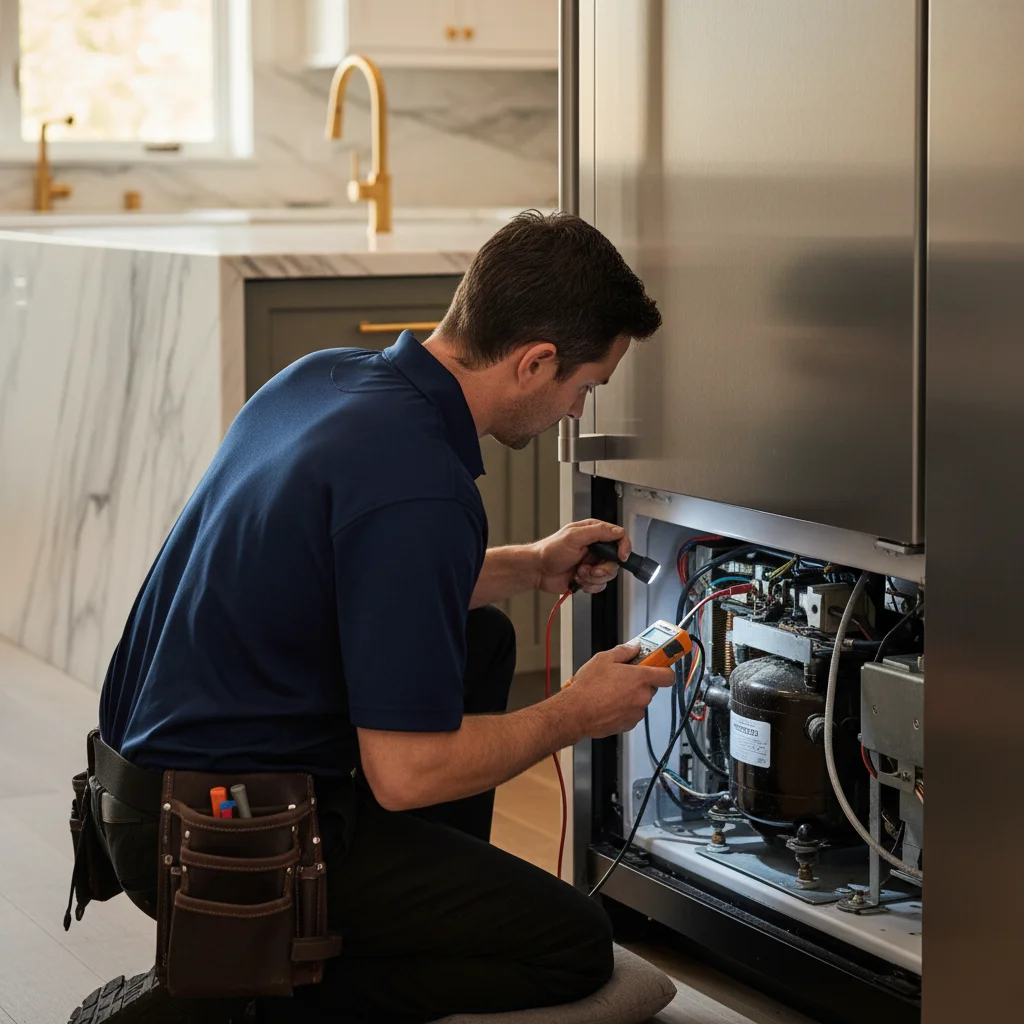
So we work backward from the symptom to the module. We confirm the complaint, read whatever the appliance is reporting, isolate the one drawer, fan, valve, or sensor that’s actually at fault, and then hand you a plain explanation and a firm number before any tool comes out. The $89 service call covers that inspection and rolls into the repair if you go ahead. Nothing gets swapped on a hunch — on an appliance this modular, the costly mistake is replacing a whole control unit when the real problem was a single actuator or a scaled valve.
Prefer to skip ahead? The line is (720) 770-4189, answered around the clock, and online booking sits at the bottom of this page.
What makes a Fisher & Paykel its own kind of repair
Fisher & Paykel is a New Zealand engineering company that has never been shy about doing things differently. It pioneered the direct-drive washing machine motor, put two independent drawers where most brands put one tub, and leaned hard on sensor-driven control software long before it was common. For a technician, that means the brand rewards anyone who understands its logic and frustrates anyone who treats it like a generic appliance.
A few traits shape every visit. First, modularity: a fault is almost always confined to one unit, which narrows the search quickly once you know where to look. Second, electronic control: these appliances lean on sensors and boards that throttle, pause, or shut a function down the moment a reading drifts, so a Fisher & Paykel often misbehaves quietly rather than failing loudly. Third, the parts ecosystem is smaller in the U.S. than the German or domestic majors, which makes correct identification up front matter even more — you don’t want to wait on the wrong part. We diagnose with all three in mind.
Fisher & Paykel appliances we service
- DishDrawer dishwashers — single and double DishDrawer models, where each drawer is diagnosed as its own machine, plus standard built-in dishwashers.
- Refrigeration — ActiveSmart French-door, bottom-mount, and quad-door fridges, plus CoolDrawer multi-temperature drawers and integrated panel-ready columns.
- Cooking — gas and induction cooktops, freestanding and built-in ranges, and single and double wall ovens.
- Laundry — front-load washers and AeroCare and condensing dryers, including stacked configurations.
We are an independent repair company. We are not affiliated with, endorsed by, or sponsored by Fisher & Paykel or any manufacturer. What we bring instead is brand-specific experience and parts matched to your model — without routing you through a factory dispatch queue.
The faults we see most often on Fisher & Paykel appliances
Every visit is its own puzzle, but certain failures repeat often enough that an experienced tech can usually narrow things down before a panel comes off. These are the ones we diagnose most on Fisher & Paykel equipment around Denver:
- DishDrawer won’t drain or shows a flashing fault — typically the drawer’s own drain pump jammed with debris, a clogged filter, a failed pressure or rotor sensor, or a water valve that has scaled shut. Because the drawers are independent, the top can fail while the bottom runs fine.
- DishDrawer leaking from the rim — the drawer’s perimeter seal stiffens and lets water past, or the lid actuator that closes and seals the drawer during a cycle has worn. Denver’s dry air is unusually hard on that seal, which we cover below.
- DishDrawer won’t fill or stalls mid-cycle — a stuck inlet valve, a flow or thermistor fault, or a motor/rotor issue the control board is protecting against. The error code points at the subsystem; we confirm the specific part.
- ActiveSmart fridge running warm or cycling oddly — most often a failed evaporator or condenser fan, a defrost-system fault icing up the coil, a sensor reading off, or a control-board issue. The fridge will often hold a degraded temperature rather than quit outright.
- Fridge ice maker producing little or no ice — a scaled or frozen water line, a failed inlet valve, or a clogged filter. Denver’s hard water makes ice-maker complaints one of the most common refrigeration calls we get.
- Range or cooktop burner burning lazy or yellow — on gas models, an air-fuel mixture skewed rich because the orifices aren’t sized for altitude, a clogged burner port, or a failed igniter. This is a classic Denver-elevation symptom, explained further down.
- Induction cooktop flashing an error or losing power — an overheated or cracked control board, a cooling-fan fault, a failed coil, or a thermal sensor that has tripped on heat.
- Oven won’t hold or reach temperature — a drifting temperature sensor, a failed bake or broil element, or a control fault. At altitude a marginal element shows itself faster than it would near sea level.
- Washer won’t spin, drain, or finish a cycle — a drain-pump blockage, a worn door lock, an out-of-balance detection fault, or a direct-drive motor/sensor issue. The direct-drive design is durable, but the lock and pump are the parts that age.
- Dryer runs long and clothes stay damp — a clogged airflow path or lint filter, a failed heating element or thermostat, or a moisture sensor coated in residue and reading wet when the load is nearly dry.
How we run the diagnosis
- Reproduce the symptom. “The dishwasher won’t finish” and “the dishwasher won’t fill” lead to different parts, so we confirm what’s actually happening rather than taking the complaint at face value.
- Read the appliance. Stored fault codes, sensor resistance, pump and valve operation, water flow, heating current, and — on water-using units — scale buildup.
- Isolate the module. We follow the circuit, water path, or airflow to the one self-contained unit that’s out of spec, which on a Fisher & Paykel is often the fastest part of the job.
- Quote before we touch it. You hear the cause, the part, and the total up front. No work proceeds without your okay.
Inspection and honest, up-front pricing
The $89 buys a complete on-site inspection. We verify the fault, pull whatever the appliance is reporting, and run the checks that separate a genuine part failure from a maintenance issue or a setting that has slipped. Then you get a written price for the actual repair — cause, part, and total — before a single component comes out. Approve the work and that $89 is credited toward the job. Decide to wait and you owe only the diagnostic, but you walk away knowing exactly what’s wrong and what it would take to fix.
We don’t quote Fisher & Paykel repairs over the phone beyond that fee, and we’re straight about why. Two DishDrawers flashing the same code can need entirely different parts — one a worn lid actuator, the other a scaled valve. A fridge running warm might want a $50 fan or a more involved sealed-system diagnosis. Pricing that sight-unseen either pads the number to cover ourselves or sets you up for a “revised” quote later. We’d rather do one inspection, give one honest price, and let you decide.
Why Denver is tough on a Fisher & Paykel specifically
This is where servicing a Fisher & Paykel in Denver genuinely differs from servicing one in a milder climate — and it’s the part a national dispatch script tends to skip.
Hard water, roughly 150 to 250 ppm. Much of the metro runs hard, and Fisher & Paykel’s water-using appliances feel it. DishDrawers depend on narrow spray paths, inlet valves, and spray arms that scale up quietly until a drawer fills slowly, washes poorly, or trips a fault. The ActiveSmart fridge’s ice maker and water line are prime targets too — scale narrows the line and chokes the valve until ice output drops off. We treat scale as a root cause when we find it, not a cosmetic note, because on these appliances it usually is one.
Thinner air at 5,280 feet. Denver’s air is roughly 15% less dense than at sea level, and that matters for anything that burns gas or manages heat. On Fisher & Paykel gas ranges and cooktops, the air-fuel mixture skews rich unless the orifices are sized for altitude — which is exactly why a burner that ran a crisp blue flame at a lower elevation can turn lazy and yellow after a move to Colorado. Thin air also changes how ovens and dryers shed heat, so a slightly weak element or a partly blocked airflow path produces noticeably worse results here than it would lower down. Altitude is part of our diagnosis from the first reading, not an afterthought.
A very dry climate. Denver’s low humidity quietly punishes rubber and plastic seals. The perimeter seal on a DishDrawer, the door gasket on an ActiveSmart fridge, and oven and washer seals all dry out, stiffen, and crack sooner here than in humid regions. That surfaces as a DishDrawer weeping at the rim, a fridge door that won’t seal and frosts the cabinet, or a washer that drips at the boot. A seal complaint that looks cosmetic is often an early failure worth catching before it costs you in water damage or wasted energy.
Strong UV and a harsh dry-cold winter round out the picture, accelerating wear on exposed trim, hoses, and any externally routed water lines. None of this is exotic — it’s local reality, and folding it into the diagnosis is precisely what an altitude-aware specialist brings that a national call center does not.
Related repairs we handle
A Fisher & Paykel rarely stands alone. Its DishDrawer often shares a kitchen with another brand’s range, or an ActiveSmart fridge sits a few feet from a high-end built-in. We service those neighbors too — including Sub-Zero refrigeration and Wolf, Thermador, and Viking cooking equipment — and the same refrigeration and combustion quirks that altitude and hard water bring out apply across all of them. The diagnostic discipline doesn’t change from brand to brand: confirm the symptom, isolate the one failed part, and price the fix before any work begins. Mention it when you call and we can often look at more than one appliance on a single visit.
Book a Fisher & Paykel repair in Denver
Getting a Fisher & Paykel looked at is quick:
- Call (720) 770-4189 — the line is answered 24/7, so you can reach a person whenever it suits you. Repairs run daily from 8:00 AM to 6:00 PM.
- Or book online through the scheduler and pick a window that works for you.
- Meet the technician, who diagnoses the real cause on site and gives you a firm, up-front price. The $89 service call covers that visit and is applied to the repair if you go ahead.
Whether it’s a DishDrawer that won’t drain, an ActiveSmart fridge running warm, a gas range burning lazy at altitude, or a washer that won’t spin, we’ll find what actually failed and tell you the price before we fix it.
Ready when you are — call (720) 770-4189 or book online to get your Fisher & Paykel DishDrawer, refrigerator, range, cooktop, washer, or dryer back in service across the Denver metro.